Tag: ANAROCK

2024 Housing Sales Drop 4 Percentages, Value Climbs 16 Percentages – ANAROCK

Mumbai, 26th December 2024: Strong homebuyer demand and hardening property prices coupled with the general and state elections dented India’s residential growth momentum in 2024. ANAROCK data indicates that housing sales in the top 7 cities witnessed a marginal 4% decline in 2024 – approx. 4,59,650 units in 2024 against 4,76,530 units in 2023.

However, the overall sales value of housing units saw a 16% yearly jump – from approx. INR 4.88 lakh Cr in 2023 to approx. INR 5.68 lakh Cr in 2024.

MMR witnessed the highest sales of approx. 1,55,335 units in 2024, registering a 1% yearly rise. Pune followed with approx. 81,090 units sold. The two western markets together led residential sales in 2024.

New launches in the top 7 cities saw a 7% annual decline – from approx. 4,45,770 units in 2023 to approx. 4,12,520 units in 2024. MMR and Bengaluru saw the maximum new launches, together accounting for an almost 50% of the new supply in the year.

image001

Anuj Puri, Chairman – ANAROCK Group, says, “2024 has been a mixed bag for the Indian housing sector. Apart from the dampening effect of general and assembly elections, project approvals slowed down markedly; this inevitably impacted new housing supply. While sales also saw a marginal decline when compared to 2023, this was offset by a 16% jump in the overall sales value, thanks to average price appreciation and increasing unit sizes.”

“Compared to 2023, 2024 saw a 21% rise in the average price in the top 7 cities,” says Puri. “2025 is unlikely to match this steep growth, though. Average residential prices hikes will stabilize in the coming year, though there will be steady growth amid increased input costs and high demand. 2025 will also see generous new supply infusions by listed developers, who have significant inventory lined up. The elections and slow project approval process had dented the new supply pipeline in 2024.”

Among budget categories, luxury housing demand and new supply increased exponentially in 2024 as homebuyers demand continued the post-pandemic trend of bigger, better homes by branded developers. The new luxury supply addition across the top 7 cities rose by 24% in 2024 against 2023. There is no reason to expect luxury housing demand to taper off in 2025.

City-wise Housing Sales Overview

City-wise Absorption (In Units) and Y-o-Y Percentage Change
 Cities Name 2024 2023 % Change (2023 Vs 2024)
NCR 61,900 65,625 -6%
MMR 1,55,335 1,53,870 1%
Bangalore 65,230 63,980 2%
Pune 81,090 86,680 -6%
Hyderabad 58,540 61,715 -5%
Chennai 19,220 21,630 -11%
Kolkata 18,335 23,030 -20%
Total 4,59,650 4,76,530 -4%

Source: ANAROCK Research

MMR, Pune, Bengaluru, Hyderabad, and NCR, together accounted for 92% of overall sales in 2024 across the top 7 cities.

  • MMR saw the highest sales with approx. 1,55,335 units sold in 2024; the annual rise over 2023 was a humble 1%.
  • Bengaluru also saw just a marginal yearly rise of 2% in housing sales, with approx. 65,230 units sold in 2024.
  • Pune saw approx. 81,090 units sold in 2024 – a yearly decline of 6% over 2023.
  • NCR recorded sales of approx. 61,900 units in 2024, declining by 6% over last one year.
  • Hyderabad saw approx. 58,540 units sold in 2024 – a 5% decline over 2023.
  • Kolkata recorded sales of approx. 18,335 units in 2024 – a decline of 20% over the previous year.
  • Chennai saw approx. 19,220 units sold in 2024 – a yearly fall of 11% over 2023.

City-wise New Launches Overview

City-wise Supply (In Units) and Y-o-Y Percentage Change
 Cities Name 2024 2023 % Change (2023 Vs 2024)
NCR 53,000 36,735 44%
MMR 1,34,500 1,57,700 -15%
Bangalore 70,965 54,435 30%
Pune 60,540 83,625 -28%
Hyderabad 58,335 76,345 -24%
Chennai 20,940 20,140 4%
Kolkata 14,240 16,790 -15%
Total 4,12,520 4,45,770 -7%

Source: ANAROCK Research

The top 7 cities saw approx. 4,12,520 new units launched in 2024, against 4,45,770 units in 2023 – a 7% annual decline. The key cities contributing to new unit launches in the year were MMR, Hyderabad, Pune, and Bengaluru, together accounting for 79% of the total new supply addition.

  • MMR saw the highest number (approx. 1,34,500) of new units launched in 2024 among the top 7 cities, declining by 15% against 2023. Over 75% of the new supply was in the sub-INR 1.5 Cr budget segment.
  • Bengaluru added approx. 70,965 units in 2024, a yearly increase of 30%. Approx. 90% of the new supply was in the INR 40 lakhs – INR 2.5 Cr budget segment.
  • Pune added approx. 60,540 units in 2024, an annual decline of 28% over the previous year. Over 93% of the new supply was in the sub-INR 2.5 Cr budget segment.
  • Hyderabad added approx. 58,335 new units in 2024, declining by 24% over 2023. Over 80% of the new supply was in the INR 40 lakh to INR 2.5 Cr budget segment.
  • NCR launched approx. 53,000 new units in 2024 – a significant 44% rise over 2023. Over 59% of the new supply was in the ultra-luxury segment priced >INR 2.5 Cr.
  • Chennai added approx. 20,940 units in 2024, an annual increase of 4% against the previous year. Over 96% of the new supply was in the INR 40 lakh to INR 2.5 Cr budget segment.
  • Kolkata added approx. 14,240 units in 2024, an 15% decline over 2023. Approx. 83% of the new supply was in the sub-INR 1.5 Cr budget segment.

Price Movement

City-level price trends (INR/sq. ft.) 
 Cities Name Q4-2024 Q4-2023 % Change (Q4-2023 Vs Q4-2024)
NCR 7,550 5,800 30%
MMR 16,600 13,700 21%
Bangalore 8,380 6,550 28%
Pune 7,720 6,750 14%
Hyderabad 7,300 5,750 27%
Chennai 6,790 5,950 14%
Kolkata 5,820 5,150 13%
Total  8,590 7,080 21%

Source: ANAROCK Research

On an annual basis, housing prices rose between 13-30% across the top 7 cities, primarily due to increased input costs and strong homebuyer demand. Delhi-NCR recorded the highest yearly jump of 30% in average residential price – from INR 5,800 per sq. ft. in 2023 to nearly INR 7,550 per sq. ft. in 2024. The top 7 cities together saw a 21% yearly jump in average residential price – from INR 7,080 per sq. ft. in Q4 2023 to over INR 8,590 per sq. ft. in Q4 2024.

Available Inventory – 2024-end

Annually, available inventory across the top 7 cities had declined by 8% by 2024-end, largely because of curtailed new housing supply during the year. Approx. 5.53 lakh units are currently on the primary sales market across the top 7 cities. Pune saw the highest decline of 20% in unsold stock annually – from approx. 1,01,220 units by 2023-end to approx. 80,670 units by 2024-end. Bengaluru and Chennai were the only cities to see their unsold stock rise.

Pune’s Real Estate Boom – Is Now the Perfect Time to Invest?

akash pharande

By-Akash Pharande, Managing Director – Pharande Spaces

Pune, one of India’s most vibrant real estate markets, has experienced rapid changes over the past few years. Latest data from leading real estate consultancies show a scenario of strong housing price increases and ongoing changes in market dynamics, pointing towards further price hikes in the future.

According to real estate consultants Anarock, Pune and the Mumbai Metropolitan Region (MMR) saw over 50% of the overall housing sales in Q2 2024 among the top seven cities. This is a resounding statement for Pune — a city once considered the laid-back cousin of the financial capital and is now competing in the same league.

Rising Property Prices: A Continuum

Recent data from various leading consultancies clearly show Pune’s trend of rising property prices. There has been a significant 20-23% year-on-year increase compared to Q1 2023. This resilience and rising demand are driving prices higher. Several factors explain Pune’s growing housing prices

– Economic Growth & Employment Opportunities: Pune’s real estate market has improved significantly due to its development into a major IT and manufacturing center. High demand from professionals seeking homes near their workplaces has led to a surge in property values in and around IT parks and manufacturing hubs.

– Infrastructure Development: Ongoing and planned infrastructure improvements such as road extensions, new flyovers, and the Pune Metro are boosting the city’s property values and connectivity. This dynamic is evident across Greater Pune, which includes the Pune Municipal Corporation (PMC) and the infrastructure-driven Pimpri-Chinchwad Municipal Corporation (PCMC).

– Shift in Housing Segments: Pune’s housing market is now driven by mid-range and premium-to-luxury housing, thanks to higher demand for such options. The higher purchasing and borrowing power of the target clientele supports ongoing price increases.

pune real estate

So – Buy Now or Later?

To answer this very important question, it is necessary to consider some fundamentals. Pune’s strong economic growth draws professionals and families from various industries. The city offers a high livability quotient, better housing affordability, and a superior climate compared to neighboring Mumbai. It also boasts top-grade healthcare and education options and proximity to Mumbai, Maharashtra’s main economic hub.

Pune has delivered an overall residential price appreciation of well over 20% in just one year. Naturally, both end-users and investors find the city very appealing, especially considering its rapid growth since 2020, which saw Pune’s lowest year for housing demand in the last decade due to the COVID-19 pandemic.

Job losses, economic disruption, and the disappearance of construction labour brought building activity to a halt. The lockdowns caused a significant decline in real estate market demand and supply.

But in 2021, the market began to bounce back powerfully. With a 17% year-on-year increase, Pune saw the highest property sales since 2013. Buyer confidence increased steadily. In 2023, the Pune housing market rebounded remarkably. The current year is poised to set new benchmarks.

The writing is clearly on the wall — there is no stopping the Pune housing market, and a wait-and-watch stance can cost buyers dearly. For those who want to buy a home in Pune, either to live here or to reap investment returns, there is a strong argument for acting now. Historical data and current patterns clearly imply that the city’s property values will keep rising.

Given the continuous growth of the city and its expanding economic base, homes bought now will deliver significant value addition over time. Pune is currently second only to Mumbai in new residential launches and sales and is also attracting increasing interest from institutional investors eyeing its commercial real estate market.

This means more workplaces, more jobs, and even higher housing demand driving prices steadily northward. For potential buyers and investors, the message is clear – there is no equity in waiting for a more opportune time in Pune’s thriving housing market.

About the Author:

Pune's Real Estate Boom - Is Now the Perfect Time to Invest?Akash Pharande is Managing Director – Pharande Spaces, a leading real estate construction and development firm famous for its township projects in Greater Pune and beyond. Pharande Promoters & Builders, the flagship company of Pharande Spaces and an ISO 9001-2000 certified company, is a pioneer of townships in the region. With the recent inclusion of Puneville Commercial into one of its most iconic townships, Pharande Spaces taken a major step towards addressing Pune’s current and future requirements for fully integrated residential-commercial convenience

Unsold Housing Inventory – NCR Down 57%, South 11%, West 8% in 5 Years

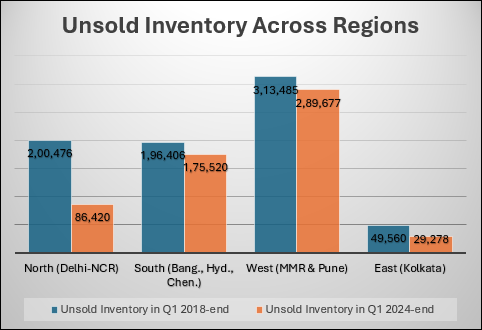
Mumbai, 24 May 2024: Going by a region’s prevailing unsold housing inventory as an indicator of its realty market’s health, North India’s Delhi-NCR – once notorious for speculation-driven oversupply and all-round market disarray – is in significantly better shape than the other regions. Latest ANAROCK data indicates that Delhi-NCR’s unsold inventory declined by a massive 57% in the last five years.

image002

The top Southern markets Bengaluru, Hyderabad, and Chennai saw their collective unsold stock shrink by 11% in this period. MMR and Pune in the West saw their cumulative unsold stock reduce by 8%. In the East, Kolkata saw its unsold inventory decline by an impressive 41% in the period.

NCR’s unsold stock declined from approx. 2 lakh units at Q1 2018-end to approx. 86,420 units by Q1 2024-end. In the same period, the main southern cities saw their unsold stock decline from over approx. 1.96 lakh units in Q1 2018 to over 1.76 lakh units in Q1 2024.

image001

Source: ANAROCK Research

South India’s relatively low decline of unsold inventory is attributable to a massive new launch rate in Hyderabad, most notably over the last two years. The city saw its housing stock almost quadruple in the last 5 years. Bengaluru saw unsold inventory decline by 50% in this period.

In the West, MMR and Pune saw unsold stock decline by 8% in the last five years – from approx. 3.13 lakh units in Q1 2018 to approx. 2.90 lakh units in Q1 2024.

Santhosh Kumar, Vice Chairman – ANAROCK Group, says, “What really worked for NCR market was developers’ determination to keep new supply addition under control. ANAROCK data indicates that NCR witnessed total new supply of approx. 1.81 lakh units between Q1 2018 to Q1 2024. In contrast, the southern and western markets saw significantly higher new supply additions of approx. 6.07 lakh units and 8.42 lakh units respectively.”

NCR‘s upbeat performance also reflects renewed buyer confidence in the region,” says Santhosh Kumar. “RERA, GST and the intervention of AIFs like the SWAMIH fund have played a major role in this sentiment revival. As a result, more leading and listed players have increased supply in the region.”

Zone New Supply Added in last 5 Yrs. (Units)
North 1,80,885
South 6,06,654
West 8,42,298
East 80,934

Source: ANAROCK Research

Of the total unsold inventory in NCR:

  • Gurgaon currently has the maximum stock of approx. 33,326 units – a 37% decrease in the last five years.
  • Greater Noida is next with approx. 18,668 units lying unsold as of Q1 2024-end. However, Greater Noida reduced its stock by a whopping 70% since Q1 2018.
  • Ghaziabad saw its unsold stock decline to approx. 11,011 units in Q1 2024, from approx. 37,005 units in Q1 2018 – a massive 70% 5-year decline.
  • Noida had approx. 7,451 unsold units by Q1 2024-end, against 25,669 units in same quarter of 2018 – thus declining by 71%.
  • Delhi, Faridabad & Bhiwadi together had approx. 15,964 unsold units as on Q1 2024-end, from approx. 23,038 units at Q1 2018-end – a 31% decrease.
Available Inventory in Delhi-NCR (Units)
  Q1 2018-end Q1 2024-end % Change
Gurgaon 53,136 33,326 -37%
Noida 25,669 7,451 -71%
Greater Noida 61,628 18,668 -70%
Ghaziabad 37,005 11,011 -70%
Faridabad, Delhi, Bhiwadi 23,038 15,964 -31%
Total 2,00,476 86,420 -57%

Source: ANAROCK Research

Retail’s Brightest Minds Convene at Retail Leadership Summit 2024 to Forge Future Pathways

Mar 4, 2024 by Mansi Praharaj 0 Comments #Abhishek Bansal, #Amazon (US and India), #Amazon (US and India) and Vivek Somareddy, #ANAROCK, #Anujj Puri, #APAC International Stores, #Ashwin Khasgiwala, #Avjit Mitra, #Avnish Anand - CaratLane; Avnish Kumar, #Being Human Clothing; Sanjay Vakharia, #bigbasket, #bigbasket; Johnson Verghese, #Bijou Kurien, #Celio Future Fashion; Gautam Saraogi, #CEO, #CEO & Co-Founder, #CEO of the Middle East Council of Shopping Centres (MECSC) and the International Council of Shopping Centres (ICSC), #Chairman, #Co-founder & CEO, #Croma, #Darpan Mehta, #David Macadam, #Dhiraj Agarwal, #Dhishoom Cinemas., #Director, #Emerging Markets, #Executive Director, #Forum Malls; Rajneesh Mahajan, #Fossil India; Nissan Joseph, #Founder & MD, #Go Fashion (India) Ltd (Go Colors);, #Hari Menon, #Infiniti Retail; Hari Menon, #Inorbit Mall; Sagar Daryani, #Inorbit Malls and Shibu Phillips, #International Council of Shopping Centres (ICSC), #Lalit Agarwal, #Lalit Agarwal - V-Mart Retail; Sagar Daryani, #Lulu group. While on the brands side were Manish Kapoor, #MD & CEO, #Metro Brands; Rajneesh Mahajan, #Middle East Council of Shopping Centres (MECSC), #Neeru's; Sanjay Vakharia, #Nexus Malls; Muhammed Ali, #Pacific Group; Dalip Sehgal, #Parul Gulati, #Pepe Jeans; Rajesh Jain, #Rajesh Jain, #Reliance Retail Limited, #Retailers Association of India (RAI), #Seller Experience and Global Trade, #Shopping Malls, #Sports & Leisure Apparel (Lacoste India), #Sports & Leisure Apparel Ltd; Sanjeev Rao, #Spykar Lifestyles;, #Spykar; P Jayakumar - Apollo Pharmacy; Rajiv Nair - Kaya Ltd; Samir Srivastav- Looks Salon; Satyen Momaya, #Trent, #Tushar Dhingra, #V-Mart Retail, #VP, #Wow! Momo Foods, #Wow! Momo Foods; Venkatesalu P

March 4, 2024, Mumbai: The Retail Leadership Summit 2024 (RLS 2024), organised by the Retailers Association of India (RAI), took place on February 28 and 29 at the Hotel Westin Powai Lake, Mumbai. This annual event brings together the brightest minds in retail to explore forward-thinking strategies within the industry.

Retail's Brightest Minds Convene at Retail Leadership Summit 2024 to Forge Future Pathways 2

Welcoming the audience at RLS 2024, Kumar Rajagopalan, Chief Executive Officer, Retailers Association of India (RAI), said, “In 2023, the retail industry witnessed a tale of two halves: robust growth initially, followed by a plateau. This reflects the criticality of aligning with market dynamics and consumer needs. We’re observing a transformative shift, with retailers blending digital and physical experiences to create seamless consumer journeys. The key to future success lies in harnessing the power of omnichannel strategies and understanding the evolving consumer preference for convenience and trust. As we move forward, embracing innovation and agile responses to market trends will be pivotal in shaping the retail landscape.

Setting the tone for the summit, Bijou Kurien, Chairman, Retailers Association of India (RAI), expressed,  “The retail industry in India is poised for significant growth in the year ahead. Driven by an 8%+ growth in GDP in Q3 FY’24 and based on steady investment by the Government and Private sector, consumption is bound to grow. The combination of online commerce coupled with offline expansion, driven by a more technology savvy consumer with greater aspirations would herald significant changes in retail structure, and channel strategy. Retailers and brands are gearing up for aggressive growth, particularly eyeing tier 2 cities for deeper market penetration. This strategic focus not only indicates a broadening of access for consumers but also signifies a shift towards tapping into the burgeoning demand in emerging urban centres. This optimistic outlook underscores the sector’s resilience and its pivotal role in the broader economic landscape of India.”

Highlights of RLS 2024 included presentations and knowledge reports by RAI-Boston Consulting Group report titled ‘Unlocking the $2Tn retail opportunity by 2030: An activist agenda’, RAI-Deloitte report titled ‘Future of Retail: Profitable Growth through Technology and AI’, RAI-KPMG report titled ‘Achieving seamless commerce in India’ and PWC report titled ‘How India shops online: Consumer preferences in the metropolises and tier-1, 2, 3, 4 cities’. Furthermore, Best Retail Workplaces 2024 report by RAI – Great Place To Work was unveiled and the respective teams were felicitated.

The Summit saw the participation retail leaders, as well as top names in the retail service provider space. Retail stalwarts speaking at the summit included Hari Menon, CEO & Co-Founder, bigbasket, Lalit Agarwal – V-Mart Retail; Sagar Daryani, Co-Founder & CEO, Wow! Momo Foods, Avnish Anand – CaratLane; Avnish Kumar, Director, Neeru’s; Sanjay Vakharia, CEO, Spykar; P Jayakumar – Apollo Pharmacy; Rajiv Nair – Kaya Ltd; Samir Srivastav- Looks Salon; Satyen Momaya, CEO, Celio Future Fashion; Gautam Saraogi, CEO, Go Fashion (India) Ltd (Go Colors); among many others.

Speaking during the panel discussion on RLS 2024, Lalit Agarwal, Founder & MD, V-Mart Retail, discussed creating experiences in retail that resonate deeply with customers, especially budget-conscious customers, to make them feel smart and stylish within their means. He emphasised on emotional connection through personalised service and storytelling, making customers feel valued and understood. Lalit Agarwal advocates for building strong brand connections that extend beyond the store, through all interactions, including advertisements. This approach aims to turn customers into authentic influencers, leveraging word-of-mouth for brand promotion. The key is continuous engagement and storytelling, which ensures customer loyalty and organic growth.

Noting the importance of strategy differences across retail categories, Rajesh Jain, MD & CEO, Sports & Leisure Apparel (Lacoste India), highlighted the approach in the premium fashion segment, emphasising a uniform customer experience across online and offline channels without price differentiation except during season-end sales. He said that this strategy aims to cultivate customer habits and preferences for purchasing channels, whether for convenience online or the experience in-store. By maintaining consistent pricing and service, customers understand the brand’s value proposition, reducing their expectation for discounts and fostering brand loyalty.

Furthermore, Darpan Mehta, Director Tax, APAC International Stores, Amazon (US and India) and Vivek Somareddy, VP, Emerging Markets, Seller Experience and Global Trade, Amazon (US and India) made a presentation on “Unlocking Mechanisms and Working Capital for Business Expansion”.

Additionally, the second day of RLS 2024 featured a keynote speech by David Macadam, CEO of the Middle East Council of Shopping Centres (MECSC) and the International Council of Shopping Centres (ICSC). This was succeeded by a dynamic panel discussion titled ‘Mahasangram: Retail and Retail Real Estate,’ bringing together prominent figures from both retail real estate and retail industries for an engaging exchange of ideas.

Mall Developers participating in the discussion were Abhishek Bansal, Executive Director, Pacific Group; Dalip Sehgal, CEO, Nexus Malls; Muhammed Ali, CEO, Forum Malls; Rajneesh Mahajan, CEO, Inorbit Malls and Shibu Phillips, Director, Shopping Malls, Lulu group. While on the brands side were Manish Kapoor, MD & CEO, Pepe Jeans; Rajesh Jain, MD & CEO, Sports & Leisure Apparel Ltd; Sanjeev Rao, CEO, Being Human Clothing; Sanjay Vakharia, CEO, Spykar Lifestyles; and Tushar Dhingra, Co-founder & CEO, Dhishoom Cinemas.

In his keynote address at the summit before the Mahasangram Session, David Macadam, CEO, Middle East Council of Shopping Centres (MECSC), International Council of Shopping Centres (ICSC), shared insights on the evolution of experiential retail and e-commerce. He discussed the challenges and opportunities within the retail industry, emphasizing the importance of adapting to consumer demands for experiential and sustainable shopping experiences. Macadam highlighted the significant role of AI and technology in retail, the impact of mixed-use developments, and strategies for business development. He advocated for embracing change, prioritizing customer experience, and leveraging strategic partnerships to navigate the retail landscape successfully.

Retail's Brightest Minds Convene at Retail Leadership Summit 2024 to Forge Future Pathways 3

Day 2 of RLS 2024 also had a dedicated D2C segment that saw participation of leaders of top D2C brands namely, Dhiraj Agarwal, Founder, Campus Sutra; Sneh Jain, Managing Director, The Baker’s Dozen; Harsh Lal, Co-Founder, The Souled Store. A scintillating Fireside chat with Parul Gulati, Actor & Founder of Nish Hair (featured on Shark Tank India). This segment explored the unconventional strategies that has enable these brands to achieve immense success in a short frame of time.

Parallelly to RLS 2024 was an extensive session of ‘Retail Store Design’ that saw participation of top retailers and brands deliberating on topics such as ‘Future of Retail Design: Exploring Emerging Trends and Technologies’, ‘Balancing Design and Functionality in Retail Spaces’, a captivating Fireside Chat and  a Masterclass on ‘The art of curating memorable and meaning customer journey’.

The advisory board of RLS 2024 includes Anujj Puri, ANAROCK, Ashwin Khasgiwala, Reliance Retail Limited; Avjit Mitra, Croma, Infiniti Retail; Hari Menon, bigbasket; Johnson Verghese, Fossil India; Nissan Joseph, Metro Brands; Rajneesh Mahajan, Inorbit Mall; Sagar Daryani, Wow! Momo Foods; Venkatesalu P, Trent.

The first day of RLS 2024 came to a close with the grand felicitation of the crème de la crème of the retail industry with India’s Retail Champions Award 2024 and the Retail Start-up Awards 2024, both evaluated by eminent personalities from the industry as the Jury.

Winners of India’s Retail Champions Awards 2024 were:


Categories Name of the Company Name of the Brand
Apparel & Lifestyle The Souled Store The Souled Store
Apparel & Lifestyle Raymond Lifestyle Ethnix
Apparel & Lifestyle Spykar Lifestyle Pvt Ltd Spykar
Apparel & Lifestyle Brand Concepts Ltd BAGLINE, House of Luxury Bags
Beauty Himalaya Wellness Company Himalaya Wellness
Wellness Wellness Forever Wellness Forever
Wellness Apollo Pharmacy Limited Apollo Pharmacy
Consumer Durables & IT (CDIT) Vijay Sales (India) Private Limited Vijay Sales
Consumer Durables & IT (CDIT) Infiniti Retail Ltd Croma
D2C Cleardekho Eyewear Pvt Ltd ClearDekho
Department store Shoppers Stop Limited Shoppers Stop
Food & General Retail (Large format over 5,000 sq. ft) LULU Group International LULU HYPER MARKET
Food & General Retail (Small format below 5,000 sq. ft) Reliance Retail Limited Reliance Fresh Signature
Footwear Metro brands Ltd Footwear
Footwear Liberty shoes Ltd. Footwear
Home Decor / Home Improvement Godrej & Boyce Mfg Co Ltd Godrej Interio
Jewellery Reliance Jewels (Reliance Retail) Reliance Jewels
Restaurant & QSR Apsara Ice Creams LLP Apsara Ice Creams
Restaurant & QSR Dindigul Thalappakatti Dindigul Thalappakatti
Speciality Retail Ample Technologies Private Limited Monobrand Stoes of Apple, ASICS, UA and Bose. Apple Store brand name “Imagine”
Success Story of 2024 Trent Zudio

myHQ by ANAROCK Partners With Awfis to add 100+ New Coworking Centers for On-Demand Day Passes

Mumbai, 26 December 2023 – myHQ by ANAROCK, India’s leading platform for flexible workspace solutions, has entered a strategic partnership with Awfis, the country’s largest provider of agile office spaces, to give on-demand access to Awfis’s 100+ centers across the country.

Utkarsh

Utkarsh Kawatra, Senior Director – myHQ by ANAROCK, says, “Under this collaboration, myHQ user base of 100,000 individuals, will now have seamless access to Awfis centers to book on-demand seats and meeting rooms across the country via the myHQ app. Our on-demand solutions are one of the most popular options for professionals who need to get work done in an enabled corporate setting on a short-term or occasional basis. They can book individually or together, a single seat or a meeting room, whatever they need.”

This unique collaboration will leverage the hugely increased post-pandemic pace of the Indian coworking industry. As per myHQ research, since 2017, an astonishing 25 mn. sq.ft. of coworking spaces have penetrated the top 7 cities of the country.

“Today, coworking represents a 21% share of the country’s entire commercial office space sector,” says Kawatra. “In Q3 2023, the top 7 cities have absorbed 10.5 million square feet of office space, of which coworking accounts for a approx. 20% share. The most vibrant coworking hubs in India are currently NCR, Pune, and Bengaluru – but the flex workspace trend is rapidly penetrating even Tier 2 and Tier 3 cities and towns.”

Sumit

Description automatically generated Sumit Lakhani, Deputy CEO – Awfis, says, “We are excited to collaborate with myHQ for our mobility solutions. For us, this becomes another key source of helping a wider audience base experience our services. Our products have been carefully designed keeping in mind the evolving preferences of the new-age workforce and our pricing strategy ensures that people get elevated workspace experience in key micro-markets across cities at a very competitive price. This partnership aligns with our goal to maximize our reach to individuals and corporates across the country.”

Post the Covid-19 pandemic, 70% of Indian companies have adopted various iterations of flexible work models. Coworking spaces have thus become the go-to option for firms and their employees to accommodate their dynamic work approach. More than 50% of startups and fledgling firms with smaller teams find coworking an exceptionally cost-effective solution for hybrid work.

Coworking centers have become a very attractive proposition for businesses, especially startups and companies with smaller teams. The myHQ SaaS platform has already enabled such firms, as well as large corporates who have added flexible work to their traditional office approach, access to 1000+ centers across India.

Model Tenancy Act Brings Cheer to NRIs

Shajai JacobBy Shajai Jacob, MD & Country Head – ApnaComplex & CEO – GCC, ANAROCK

The Union Cabinet’s approval for the Model Tenancy Act is being hailed as a landmark moment in Indian real estate. In one of the most significant developments for residential real estate investors, no one will henceforth be allowed to enter into a rental situation without a written agreement – and that’s not all.

Aimed at increasing confidence of landlords to rent out their vacant properties, this Act will serve as booster for NRI investments. For an NRI investor, it is a great assurance that the tenant of their property is bound by legal terms. Further, the act defines the timeline within which any rental disputes will be resolved.

The new law also calls for a digital platform where tenancy agreements need to be submitted to the rent authority in future. Digital infrastructure is more convenient and brings an added level of transparency for NRI landlords. With this Act, there is now a clear demarcation of responsibilities between a tenant and landlord.
NRIs have always shown a keen interest in investing in Indian real estate. However, the uncertainties around ensuring that tenants uphold the terms and condition of the rental agreements were, so far, significantly high for NRIs. The entire process of finding a tenant and collecting the dues is usually carried out by family or close associates in India.

With the rental market now becoming more organized, institutional service providers will come into the picture to address the market demands. The increased trust and confidence thus generated will enable NRIs to easily monetize their existing vacant residential properties by letting them out in a coherent, cohesive, and easily manageable way.

The last two quarters have seen significant traction of ready-to-move inventories in India’s prime residential markets. The new regulatory framework will provide additional impetus to this demand. With the implementation of the Model Tenancy Act, prices of RTMI properties are expected to increase soon.

As per ANAROCK Research, over 4.22 lakh homes are scheduled for delivery by 2021-end. It is interesting to note that only 28% of these homes are unsold as on date. Going by the burgeoning demand for ready homes, developers will continue to be mindful of adhering to delivery schedules despite the impact of the pandemic’s second wave – which is already showing signs of abating.

Most of these near completion units are in the mid-range and affordable segments. 40% of the stock is priced less than INR 40 lakhs and 35% is priced between INR 40 to INR 80 lakhs.

With very low interest rates and the currency exchange rate still very much on the side of NRIs, this is indeed a promising time for those with an eye of income-generating residential assets. Property rates remain range-bound and developer offers and discounts are still available for serious buyers.

With the regulatory framework for rental homes now also being strengthened and rendered increasingly transparent, it is the perfect time for NRIs to invest in Indian real estate for sustained rental income.