Tag: Santhosh Kumar

Rental Price Growth Drops 50% In Top Cities as Housing Supply Surges

 Mumbai 19 June 2024: With more supply hitting the top 7 cities‘ markets, over-heated housing rents are stabilizing. Latest ANAROCK data shows that average residential rental prices across key markets in these cities saw a 2-4% quarterly rise in Q2 2024 to date over the preceding quarter. Q1 2024 saw rents in these markets rise by between 4-9% quarterly against Q4 2023.

image001 (2)

Santhosh Kumar, Vice Chairman – ANAROCK Group, says, “In India, the second quarter of most years typically sees rents increase more than in other quarters due to the commencement of the new academic year and the employment of new staff. This year, declining rental value growth coincides with substantial new housing supply entering these markets.”

The top 7 cities are set to deliver approx. 5.31 lakh new units in 2024 while in 2023, these cities saw approx. 4.35 lakh units hit their markets. This denotes a 22% annual supply increase this year if delivery schedules remain on track.

Average rents for a standard 1,000 sq.ft. 2 BHK in Bengaluru’s Whitefield rose by 4% – from INR 32,500/month in Q1 2024 to INR 35,000/month in Q2 2024 to date. In Q1 2024, the quarterly jump against Q4 2023 was double at 8%.

A Quick Look

  • Avg. rents in Noida’s Sector 150 rose by a mere 4% – from approx. INR 24,000/month in Q1 2024 to approx. INR 25,000/month in the current quarter. The quarterly hike stood at 9% in Q1 2024 against Q4 2023. Sohna Road and Dwarka saw their respective quarterly rents increase by 3% and 2% in Q2 2024; in Q1 2024, the hikes stood at 4% and 6% respectively.
  • MMR’s key markets Chembur and Mulund saw avg. rents rise by just 2% against the preceding quarter (Q1 2024); in Q1 2024, they rose by over 4% against Q4 2023.
  • Hyderabad’s HITECH City and Gachibowli saw avg. rents rise by 3% each in Q2 2024 to date over the preceding quarter. In Q1 2024, the quarterly avg. rent hike in both these markets was 5%.

Cities

Micro Markets

2023-end

Q1 2024

Q2 2024

Bengaluru

Sarjapur Rd

31,600

34,000

35,000

Whitefield

30,200

32,500

33,700

Hyderabad

HITECH City

31,000

32,500

33,500

Gachibowli

30,500

32,000

33,000

Pune

Hinjewadi

25,600

26,500

27,000

Wagholi

20,600

22,000

22,700

NCR

Sohna Road

32,700

34,000

35,000

Sector-150 (Noida)

22,000

24,000

25,000

Dwarka

25,800

27,400

28,000

MMR

Chembur

60,000

62,500

63,500

Mulund

46,500

48,500

49,700

Kolkata

EM Bypass

25,600

27,000

27,800

Rajarhat

18,500

19,000

19,500

Chennai

Perambur

20,200

21,000

21,600

Pallavaram

19,500

20,300

20,800

City-wise Completions in 2024

“ANAROCK data indicates that approx. 5,31,470 units are expected to be completed in 2024 across the top 7 cities, provided there are no delivery delays,” says Santhosh Kumar. “In 2023, approx. 4,35,045 units were completed in these cities.”

Among the top 7 cities, MMR is slated to see the highest completions at approx. 1,60,900 units in 2024. In 2023, the region saw approx. 1,43,500 units completed

  • NCR is expected to see approx. 1,44,315 units delivered in 2024, against approx. 1,14,280 units in 2023.
  • Pune is expected to see approx. 97,000 units completed in 2024. In 2023, approx. 65,000 units were completed here.
  • Bengaluru, the key rental hub with the highest rental value hikes, will see approx. 51,685 units delivered in 2024, against approx. 52,565 units in 2023.
  • Hyderabad is slated to see approx. 34,770 units completed 2024-end; in 2023, approx. 20,500 units were completed.
  • Kolkata is expected to see approx. 25,220 units delivered in 2024. In 2023, approx. 25,075 units were completed here.
  • Chennai will see the delivery of approx. 17,580 units in 2024, against 14,125 units in 2023.

Unsold Housing Inventory – NCR Down 57%, South 11%, West 8% in 5 Years

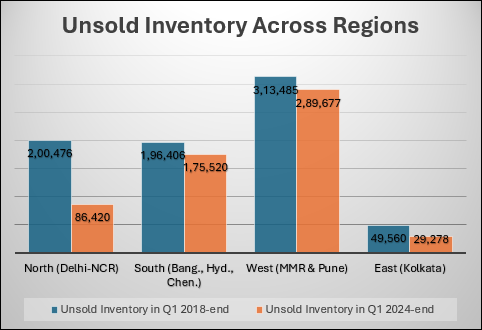
Mumbai, 24 May 2024: Going by a region’s prevailing unsold housing inventory as an indicator of its realty market’s health, North India’s Delhi-NCR – once notorious for speculation-driven oversupply and all-round market disarray – is in significantly better shape than the other regions. Latest ANAROCK data indicates that Delhi-NCR’s unsold inventory declined by a massive 57% in the last five years.

image002

The top Southern markets Bengaluru, Hyderabad, and Chennai saw their collective unsold stock shrink by 11% in this period. MMR and Pune in the West saw their cumulative unsold stock reduce by 8%. In the East, Kolkata saw its unsold inventory decline by an impressive 41% in the period.

NCR’s unsold stock declined from approx. 2 lakh units at Q1 2018-end to approx. 86,420 units by Q1 2024-end. In the same period, the main southern cities saw their unsold stock decline from over approx. 1.96 lakh units in Q1 2018 to over 1.76 lakh units in Q1 2024.

image001

Source: ANAROCK Research

South India’s relatively low decline of unsold inventory is attributable to a massive new launch rate in Hyderabad, most notably over the last two years. The city saw its housing stock almost quadruple in the last 5 years. Bengaluru saw unsold inventory decline by 50% in this period.

In the West, MMR and Pune saw unsold stock decline by 8% in the last five years – from approx. 3.13 lakh units in Q1 2018 to approx. 2.90 lakh units in Q1 2024.

Santhosh Kumar, Vice Chairman – ANAROCK Group, says, “What really worked for NCR market was developers’ determination to keep new supply addition under control. ANAROCK data indicates that NCR witnessed total new supply of approx. 1.81 lakh units between Q1 2018 to Q1 2024. In contrast, the southern and western markets saw significantly higher new supply additions of approx. 6.07 lakh units and 8.42 lakh units respectively.”

NCR‘s upbeat performance also reflects renewed buyer confidence in the region,” says Santhosh Kumar. “RERA, GST and the intervention of AIFs like the SWAMIH fund have played a major role in this sentiment revival. As a result, more leading and listed players have increased supply in the region.”

Zone New Supply Added in last 5 Yrs. (Units)
North 1,80,885
South 6,06,654
West 8,42,298
East 80,934

Source: ANAROCK Research

Of the total unsold inventory in NCR:

  • Gurgaon currently has the maximum stock of approx. 33,326 units – a 37% decrease in the last five years.
  • Greater Noida is next with approx. 18,668 units lying unsold as of Q1 2024-end. However, Greater Noida reduced its stock by a whopping 70% since Q1 2018.
  • Ghaziabad saw its unsold stock decline to approx. 11,011 units in Q1 2024, from approx. 37,005 units in Q1 2018 – a massive 70% 5-year decline.
  • Noida had approx. 7,451 unsold units by Q1 2024-end, against 25,669 units in same quarter of 2018 – thus declining by 71%.
  • Delhi, Faridabad & Bhiwadi together had approx. 15,964 unsold units as on Q1 2024-end, from approx. 23,038 units at Q1 2018-end – a 31% decrease.
Available Inventory in Delhi-NCR (Units)
  Q1 2018-end Q1 2024-end % Change
Gurgaon 53,136 33,326 -37%
Noida 25,669 7,451 -71%
Greater Noida 61,628 18,668 -70%
Ghaziabad 37,005 11,011 -70%
Faridabad, Delhi, Bhiwadi 23,038 15,964 -31%
Total 2,00,476 86,420 -57%

Source: ANAROCK Research

ANAROCK Group.

Top 7 Cities See 1,757+ Acres Land Deals in A Year – 69% for Residential Development

Mumbai: Land is still the most precious resource amid rapid urbanization and quite a lot of this finite resource changed hands across the top cities during the pandemic. ANAROCK data indicates that many developers and entities sealed around 45 separate land deals cumulatively accounting for over 1,757 acres of area across the top 7 cities between Q3 2020 and November 2021.

Of the total transacted land area, approx. 69% or 1,205 acres are proposed to be developed into multiple residential projects across these cities. The total development potential of these deals works out to at least 45-50 Mn sq. ft. of residential area.

As many as 28 residential land deals were closed across the cities in the last year:

Land-starved MMR saw 11 land deals involving 768 acres of area – a 64% share of the total 1,205 acres of planned residential development across the top cities

NCR came a distant second with 4 separate deals accounting for 12% of the total land deals with approx. 150 acres earmarked for development. This includes 3 deals for a total of 77 acres in Gurugram, and one deal for over 73 acres in Noida

Kolkata saw 2 separate deals for over 92 acres of land on a joint development agreement (JDA) basis
Hyderabad witnessed 2 separate land deals for a total of 78 acres

Bengaluru saw 5 separate deals for a total of 59 acres earmarked for residential development, Pune saw 3 deals for approx. 42 acres, and Chennai saw 1 deal for 16+ acres.

The top developers who bought land parcels for residential developments include Godrej Properties, Sunteck Realty, Ashiana Housing, Mahindra LifeSpaces, M3M Group, and Runwal Developers.

Description automatically generated with medium confidence“The last 7-8 months before COVID-19 (March 2020) saw limited land deals as the real estate industry was grappling with liquidity issues at the time,” says Santhosh Kumar, Vice Chairman – ANAROCK Group. “Then COVID-19 brought the sector to a virtual standstill for 3-4 months. For about a year, developers preferred to either service their debts or complete previously-launched projects.”

“However, from Q3 2020, activity resumed and several landowners who previously held fast to their land put their holdings up for sale. Resultantly, some prominent deals took place in the last one year, at more or less the same price points as the previous year. Many developers with the financial wherewithal saw this period as opportune to secure good land parcels in key micro-markets across the top 7 cities.”

Top Land Deals Across Cities


Deal in Quarter Landowner Buyer City Approx. Size (in Acres) Approx. Value (INR-crore) Proposed Development
Q3-2020 Individual Sunteck Realty MMR 50 JDA Residential
Q3-2020 Century Group Godrej Fund Management Bengaluru 15 700 Commercial
Q4-2020 Anonymous Godrej Properties Bengaluru 18 150 Residential
Q4-2020 HSIIDC Flipkart Gurgaon 140 432 Logistic Park
Q1-2021 The Garodia Family Shapoorji Palonji Group MMR 500 521 Residential
Q2-2021 Ramprastha Group Ashiana Housing Gurgaon 22.1 170 Residential
Q3-2021 Kadam Developers M3M Group Noida 73 900 Residential
Q3-2021 K Raheja Corp Brookfield Asst. Management MMR 30 550 Data Centre
Q3-2021 Macrotech Developers Flyjac Logistics MMR 22.3 80 Industrial Park

Source: ANAROCK Research

Proposed Developments – Other Segments

Besides proposed residential developments, industrial, commercial, data centres, and retail also saw land acquired for development:

Out of the total of 45 land deals for over 1,757 acres, at least six deals for 411 acres of land are earmarked for a logistics & industrial park and township. Of this, two deals for over 275 acres were closed in Gurugram, followed by two deals in Chennai for over 83 acres, and one each in Howrah and MMR for 31 acres and 22 acres, respectively
For mixed-use developments, three land deals for over 58 acres were closed – one each in MMR, Chennai and Gurugram

At least five deals for at least 44 acres were closed for commercial developments in Bengaluru (3) and MMR (2). The details for one of these deals have not been disclosed

At least 30 acres are proposed to be utilized for data centres in Navi Mumbai

Approx. 9 acres have been earmarked for two separate retail developments

housing sales in Bengaluru

Bengaluru Real Estate – A Post-COVID-19 Snapshot

Santhosh Kumar, Vice Chairman – ANAROCK Property ConsultantsBy Santhosh Kumar, Vice Chairman – ANAROCK Property Consultants

Bengaluru has always been a rather unique real estate market. Heavily driven by IT/ITeS industries, it is nevertheless a city where most of the housing demand comes from end-users. The absence of more investors has historically kept the lid on housing price increases.

It is also a city which, despite its dynamism, remains deficient in terms of public transport and road infrastructure. Nevertheless, compared to its other southern counterparts Chennai and Hyderabad, Bengaluru has so far had several advantages as far as housing activity is concerned.

Residential Real Estate

Despite the pandemic, the city saw property prices rise by 2% – from INR 4,975 per sq. ft. in Q1 2020 to INR 5,060 per sq. ft. in Q1 2021. This was the highest price rise among the top 7 cities, and it happened primarily because the city continued to see steady growth in housing sales q-o-q.

Amidst restricted new supply, ANAROCK data reveals that Bengaluru saw total sales of approx. 8,670 units in the first quarter of 2021, while its unsold inventory declined by 7% in a year – from approx. 62,800 units in Q1 2020 to approx. 58,350 units in Q1 2021.

Bengaluru

In Bengaluru, the affordable and mid-segments are driving residential demand. Given the good sales, developers saw it opportune to increase the average prices. Also, property prices in the city had remained range-bound in the past few years, and growth was long overdue.

Unfortunately, the reduction in stamp duty in Karnataka announced in March of 2021 was only for homes valued between INR 35 lakh to INR 45 lakh. This reduction has, so far, not given a significant boost to housing sales in Bengaluru on the lines seen in Mumbai and Pune.

This is because, albeit for a limited period, Maharashtra reduced stamp duty across all budget segments and not just one category. Housing demand in Bengaluru is skewed towards the mid-segment – properties priced within INR 50 lakh to INR 1 Crore budget. The stamp duty charges for this budget category have remained unchanged at approx. 5%. The Karnataka State government would do well to consider limited-period stamp duty cuts across all budget segments.

The Bangalore Development Authority may soon tie-up with developers to deploy its many huge land parcels for housing development. How much this will help the city will depend on the type of projects to be built. In states like Maharashtra, government land is primarily released for the development of affordable housing. However, in Bengaluru, the highest demand is for mid-range homes.

Office Real Estate

Bengaluru’s office real estate market has been under strain since the pandemic started. While there was some momentum seen in the first quarter of 2021, the second COVID-19 wave in the April-June quarter saw much of it eroded. For now, most IT/ITeS companies have extended the WFH option for now and are waiting for things to change in favour of the previous status quo.

Industry and ANAROCK data indicate that in 2021, over 7,400 leases accounting for approx. 90 Mn sq. ft. of commercial real estate area in the top 6 commercial real estate hubs – Bengaluru, Mumbai, Pune, Chennai, Gurugram, and Noida – will be due for renewal this year. Moreover, when compared to the next two years (2022 and 2023) 2021 has the highest lease expiry pipeline. Of the 90 Mn sq. ft. area leases up for renewal in 2021, IT capital Bengaluru has the highest share at 37%.

That said, the IT/ITeS sectors – which are Bengaluru’s economic heartbeat – have been actively hiring new employees in the last two years. Factoring in the gradual return of employees and adoption of hybrid workplace practices by major IT/ITeS firms, Bengaluru’s office space demand is set for growth again as these companies will assuredly renew their leases.

Infrastructure

The lack of adequate physical infrastructure facilities remains a challenge in Bengaluru. Despite it being the IT hub of the country, the city’s infrastructure is disproportionately weak when it comes to accommodating growth.

The unavailability of sufficient public transportation nodes in the form of metro and bus lines causes excessive usage of private vehicles, leading to Bengaluru’s legendary traffic congestion. While the COVID-19 pandemic has reduced vehicular traffic considerably, this is just a temporary respite.

Future developments on Government-owned land parcels will need the benefit of this hindsight. Any new housing projects developed there will need far better road and public transport support than what is currently available in Bengaluru.