Tag: Coworking

Commercial Integration – Reshaping India’s Residential Landscape

By  – Akash Pharande, Managing Director – Pharande Spaces

Akash Pharande, Managing Director - Pharande Spaces

One important feature changing how people live and work in India’s fast-urbanizing terrain is the incorporation of commercial areas into residential townships. While this concept – which combines residential areas with workplaces, shops, and recreational areas – is not new, its uptake has sped up recently, particularly in the wake of COVID-19.

Evolution and Origins

Mixed-use projects are nothing new to India; even in pre-independence India, residential areas and bazaars coexisted together. But in the early 2000s, integrated townships, as they are now known, started to take off. Encouraged by India’s economic expansion and rapid urbanization, developers realized the benefits of creating an all-encompassing residential experience for the growing middle class.

This trend became even more evident after the 2008 financial crisis. This is when forward-thinking builders began to seek out ways to make projects more profitable and desirable. Including residential and commercial areas into one complex promised to boost footfall in retail malls by providing a captive market for retailers. Office buildings within the same precincts gave homeowners the possibility of walking, bicycling to work, or taking a short drive there with no traffic woes to contend with.

The COVID-19 epidemic kicked off a major move towards remote work, less crowded residential areas with sufficient greenery, the convenience and safety of having necessary retail outlets within easy reach, and small commutes to work. In short, the pandemic solidified the already strong attraction for integrated townships.
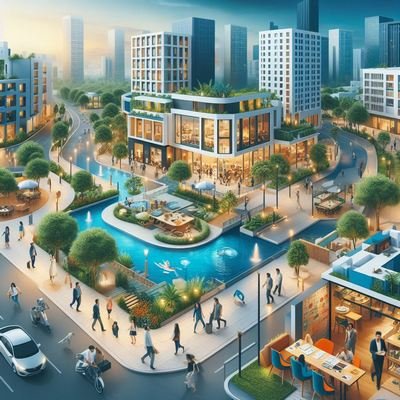
integrated township

The Coworking Revolutions

Residential-commercial complexes like integrated townships are becoming all the more relevant because of the increasing popularity of coworking. If we take Pune as an example, the relevance and impact of coworking is hard to miss.

This city has evolved massively from its previous tags of ‘Oxford of the East‘ and ‘Pensioner’s Paradise’. Pune’s vibrant educational institutions and IT/ITeS sector generate and attract more and more young professionals and millennial entrepreneurs. Simultaneously, even some of the biggest MNCs in Pune have been looking at cutting costs after COVID-19.

Coworking spaces are the logical solution to bring down corporate costs and provide a fertile environment for collaboration, networking, and creative engagement. The most successful ones are located in and around residential catchments, so their availability in integrated townships is a win-win proposition.

Pune has been seeing steady growth in the coworking segment, with more operators of varying sizes constantly entering the fray. Especially after COVID-19, the coworking solution has found favour with many companies as well as the city’s growing young population. Pune’s thriving startup culture has contributed hugely to its growing popularity, as have the gig economy and service-based companies such as digital marketing, automobiles, and blockchain.

Not surprisingly, leading property consultants reported that 2021 saw a no less than 30% increase in demand for integrated townships over the same period the year before. Where work-from-home (WFH) has become ingrained, especially in metros and tier-1 cities, this rise is significant. Compared to exclusively residential projects, mixed-use townships have seen higher residential sales following the epidemic.

work-life 2.0

Integrated commercial-residential townships are growing in popularity in India because of:

Work-Life Balance: Integrated townships encourage a healthy it by merging living and recreational areas, and minimizing travel time to and from work. This is something that the modern workforce appreciates more and more.

A Sustainable Lifestyle: Sustainable living is becoming more and more important to urban Indians. Mixed-use townships lessen the need for driving and therefore have a lower carbon footprint overall. The more modern integrated townships also offer advanced green features such as wastewater recycling, use of solar lighting and heating, green areas to act as lung space, and proper cross-ventilation in flats to reduce cooling costs in summer.

Profitability for Developers: Integrated townships with commercial components baked in are a lucrative proposition for developers. The added appeal and convenience factor of these projects usually makes them more expensive than ordinary residential projects; however, Indians today are willing to spend more on a sustainable, convenient, and hassle-free lifestyle. Also, there is considerable brand value involved in creating and sustaining modern integrated townships, since such projects require specialized knowledge and considerable capital to build and maintain.

Policy Support: Integrated townships are encouraged and promoted by Indian government programs like the Smart Cities Mission, and sustainability factors are also incentivized for both homebuyers and developers. Mixed-use integrated projects in suburban areas are also actively encouraged by the government because they help decongest urban areas.

Buyer Preferences: The pandemic changed consumer preferences considerably. More and more Indians are choosing to live in spacious, uncluttered, and health-promoting projects that provide quick access to workplaces and the requirements of daily living. Mixed-use integrated townships negate most of the stresses and health hazards of inner-city life. They are also ideal for remote working scenarios.

The Future of Mixed-use Townships

The trend of developing residential- and commercial projects is not only a durable one but the very call of the future in India. Companies’ growing acceptance of remote working arrangements will increase demand for residential developments that meet professional requirements even more. Moreover, the continuous urbanization and increasing disposable incomes in India point to a long-term interest in these kinds of living arrangements.

The boundaries dividing residential and commercial areas are blurring as urban India develops. More than just a real estate fad, integrated townships are the logical answer to the evolving demands and lifestyles of contemporary Indian society. Their increasing popularity is bringing about a profound change in urban planning and development—a move toward a more comfortable, sustainable, convenient, and all-encompassing residential experience.

About the Author: Akash Pharande is Managing Director – Pharande Spaces, a leading real estate construction and development firm famous for its township projects in West Pune and beyond. Pharande Promoters & Builders, the flagship company of Pharande Spaces and an ISO 9001-2000 certified company, is a pioneer of townships in West Pune. With the recent integration of Puneville Commercial into one of its most iconic townships, Pharande Spaces taken a major step towards addressing Pune’s current and future requirements for fully integrated residential-commercial convenience.

Post Covid-19 era: Coworking will be the new normal for work spaces

Mr. Manas Mehrotra, Founder, 315Work Avenue, a leading co-working company

The past few years have witnessed an unparalleled success for the coworking juggernaut in India. This accelerated growth has stemmed from the revolutionary shift in the Indian traditional workspace to a more flexible, accessible and affordable coworking space. The present disruption due to Covid-19 is seen as temporary as the coworking industry is expecting a resurgence as the economy emerges out of lockdown.

However, medium- to long-term fundamentals remain sound as corporate occupiers seek out alternative options to reduce costs and capital expenditure. As a result, even the most conventional occupiers are now seeing the merit in co-working. The post lockdown scenario is set to bring in a wave of new opportunities for the co-working players. There will be a lot of focus on distancing measures and communication protocols to ensure a safe working environment.

Flexible workspaces are a practical choice as companies rise up to face the new normal. The key aspect that will favour this segment post-COVID-19 apart from the premium facility management is de-densification. The segment will also see the adoption of high levels of hygiene and other measures that will attract businesses. It will also attract companies previously not exposed to co-working and its benefits. Co-working segment is best placed to cater to these flexible demands.

With the impact of the pandemic taking effect during Q2 2020, the decline in absorption was seen across all the markets. As per a recent report, while the five major cities of Bengaluru, Mumbai, Chennai, Hyderabad and Kolkata saw absorption of approximately 4.42 million sqft office space during Q2 2020, depicting a steep decline of 54% over the absorption observed in Q2 2019, however notwithstanding the crisis at hand, Bengaluru continued to lead the way with 45% share of the total absorption in these five cities.

There are many important factors that explain why coworking will bounce back post-pandemic:

Work from home has its own challenges

While work from the home model would have worked well in the lockdown, many companies however may not want it as a culture. Many business verticals and functions still require employees to work in an office setting. The overall ecosystem needs to be conducive for an employee to be productive while working from home. While WFH may look appealing as a concept initially, yet, in due course, it may impact operational efficiencies and productivity as managing work-life balance for employees might emerge as an area of concern. Work from home may co-exist, but office space will not lose its importance as a strategic tool for corporate culture development and a source of competitive advantage.

Large enterprises will seek smaller spaces

Another win for flexible workspaces will also come from the fact that companies will have to practice social distancing within their campuses, which means they might have to station some employees in different locations. Companies will strive to be agile and prefer to build more flexibility into their real estate portfolios. The current situation will also see larger enterprises seeking smaller spaces to ensure synergised business continuity in the near future. There’s now a lot more interest now in taking dedicated and secure private offices, which is the big shift in the flexible office space industry. As large enterprises look to curb capital expenditure or long-term commitments on office property, coworking spaces will see a surge as they offer flexible infrastructure solutions and also set precedents for safe and healthy practices too.

Coworking spaces offer flexibility

As the professional world returns to normalcy, traditional offices owing to their rigidity will not be equipped to address the new normal. Many companies, even pre-pandemic, have had to deal with the burden of long-term, lock-in leases with heavy security deposits, which take away the ‘business cashflow’ ability to respond to changes in the economy quickly. Now, more than ever, flexibility is crucial and hence co-working spaces, with their natural flexibility and inherent readiness to add value are best positioned to adapt and redefine the future of work and workspace. As companies look to resume business, redesigning and restructuring of existing real estate will pose yet another challenge, however, coworking spaces will be able to respond to design changes required post-COVID-19 quicker and more efficiently than traditional office spaces.

Consolidation on the cards

We can expect more mergers and acquisitions among operators soon as the smaller ones will find it difficult to survive as it is a capital-intense industry. The market, certainly, cannot accommodate hundreds of operators and large firms will hold sway and garner a larger portion of the market. Smaller players may be absorbed in mergers or will alternatively have to close down operations.

Coworking faster at innovation

COVID-19 has also accelerated the digitalization of workspaces. An innovative technology ecosystem provides flexible and on-demand places to support convenience, functionality, and well-being. To avoid the transmission of germs at workspaces, coworking companies have enabled comprehensive contactless technology and robotic technology that has attracted clients. The traditional desk will likely be non-existent in the coming years with wearable technology, artificial intelligence, machine learning and Internet of Things taking over coworking spaces, causing massive disruption and transforming them into autonomous workspaces. Smart access, meeting rooms and receptions have already forayed enabling cloud-based access system, facial recognition and real-time security monitoring.

A complete solution, not just a space provider

The pandemic has evolved brands from just being workspace providers to becoming a fully integrated workspace solution platform for their clients which offers products to the entire spectrum of work requirements including co-working, enterprise solutions and remote working. Coworking players are curating unique experiences and engagements by providing state-of-the-art amenities like gyms, cafés, creches and managing the complete building ecosystem by bringing alliances, events and community focus to the occupants.

The inherent flexibility to adapt and adopt, and its ability to foster a strong community spirit determined to win in these trying times will augur well for the co-working industry. The covid-19 pandemic and the prolonged lockdown have made both employers and employees realise some great benefits of remote work, which has potentially changed the dynamics of workplace usage forever. As the Indian economy is slowly getting back to a ‘new normal’ following the Covid-19 outbreak, each industry is re-inventing its business model to adapt to a post-Covid -19 era.

Sometimes, a crisis also presents an opportunity to make decisions that would be hard to make in more business-as-usual times. Despite the disruption, the focus would remain on managing revenues and increasing productivity and flexible workspaces will play an even more important role in rationalising costs and maintaining financial agility. Co-working space providers are in a unique position to leverage the opportunity and make the segment more attractive for its consumers. Hence flexible workspaces can fit the bill and address the gap with the right blend of safety, sustainability, and cost optimisation for any business to grow and change large enterprises with the current scenario.