Tag: Nvidia

Kyndryl Teams With NVIDIA to Accelerate Adoption of Generative AI-enabled Solutions

NEW YORK, May 21, 2024 – Kyndryl , the world’s largest technology infrastructure services provider, announced a collaboration with NVIDIA to accelerate the development, implementation and use of AI-powered insights and business outcomes.

Kyndryl’s AI-powered open integration digital business platform, Kyndryl Bridge, will support the end-to-end lifecycle of AI development and implementation in real-world business environments for customers running full-stack NVIDIA accelerated computing and software. Kyndryl also will tap into the domain and industry expertise of Kyndryl Consult to speed customers’ ability to test, verify and deploy generative AI solutions, facilitate rapid application deployment and enhance operational experience.

This collaboration will provide a combination of technology and services critical to customers looking to rapidly scale generative AI solutions to remain competitive in their respective industries. By coupling Kyndryl’s expertise with NVIDIA technologies, customers will be able to tap into a wealth of knowledge crucial to their continued adoption and ability to scale.

To further accelerate customer adoption and implementation of generative AI solutions in their mission-critical IT operations, Kyndryl will leverage the NVIDIA NeMo platform and NVIDIA NIM inference microservices to address industry-common and industry-specific use cases such as customer support, IT operations automation, fraud and loss prevention, and real-time analytics.

Kyndryl is adding generative AI capabilities to its successful Kyndryl Bridge platform and AIOps services, leveraging NVIDIA NIM to simplify and speed generative AI deployments for network and application management. The incorporation of NVIDIA NIM into Kyndryl Bridge will enable AIOps to be optimized on NVIDIA Tensor Core GPUs to rapidly process failure prediction and analysis while delivering comprehensive insights that will significantly reduce network and IT infrastructure failure. The incorporation of retrieval-augmented generation (RAG) with NVIDIA NeMo Retriever microservices allows the solution to be uniquely customized to enterprise environments. This development will provide a holistic view and approach to managed IT services.

“We’re excited to be working with NVIDIA to provide the building blocks and know-how customers need to fully unleash the potential of generative AI throughout their businesses,” said Hidayatullah Shaikh, vice president, Software Engineering, Kyndryl Bridge. “By combining NVIDIA’s generative AI software with Kyndryl’s capabilities, we’re uniquely prepared to help address and resolve the biggest pain points for customers seeking to integrate AI across their hybrid IT estates.”

“As generative AI can scale productivity and insight for companies across industries, many organizations are seeking experts to help them quickly integrate AI applications into their operations,” said John Fanelli, vice president of enterprise software at NVIDIA. “Kyndryl’s solutions and expertise in integrating full-stack NVIDIA AI can help customers rapidly establish and scale their AI strategies.”

Kyndryl is offering comprehensive services via the Kyndryl Bridge catalog, providing the NVIDIA AI platform across industries, including financial services, retail, telecom and healthcare. Kyndryl Consult will support customer implementations running on the NVIDIA accelerated computing infrastructure, in on-premises deployments or in a private cloud, hybrid or multicloud environment.

Kyndryl Bridge’s integration with NVIDIA AI will enable the following new benefits to customers:

  1. · Accelerate generative AI performance on Kyndryl Bridge using NVIDIA AI and accelerated computing to enhance efficiency and speed customer adoption across industries.
  2. · Drive value for customers through Consult & Managed Services generative AI offerings on the Kyndryl Bridge platform (LLMOps, Data Modernization and Infrastructure Services with NVIDIA NIM) leveraging NVIDIA capabilities to facilitate creation of integrated solutions.
  3. · GPU-aware workload placement – via CloudOps and SustainabilityOps – to drive improved performance and deliver insights to support energy efficient generative AI workloads.
  4. · Enhance performance of generative AI applications, such as AI-powered chatbots and virtual avatars on NVIDIA-powered systems through real-time insights from Kyndryl Bridge AIOps.
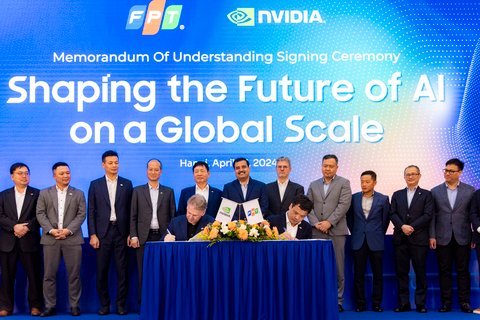
FPT to Shape the Future of AI and Cloud on a Global Scale in Collaboration with NVIDIA

April 23, 2024, Hanoi, Vietnam
Global leading IT firm FPT today announced a comprehensive strategic partnership with NVIDIA, aiming to offer a one-stop shop for AI & Cloud consisting of AI products, GPU infrastructure, tech experts, and domain expertise for clients in Vietnam and all FPT’s presence areas. This endeavor will be attained by establishing AI factories for AI research and development in the region, expanding advanced AI and cloud capabilities on a global scale, and fostering a future-ready workforce in technology.

FPT plans to invest USD 200 million in building an AI factory that will serve as a sovereign cloud. These will feature NVIDIA’s latest technologies, including NVIDIA AI Enterprise software and frameworks and NVIDIA H100 Tensor Core GPUs.

FPT_NVIDIA

This initiative is a critical part of FPT’s strategy in reinforcing AI research and development, creating AI applications and solutions with a focus on generative AI, autonomous driving, and green transformation for sustainability. This empowers FPT to realize the vision of transforming Vietnam into an AI nation and accelerating the adoption of AI applications in Asia, including but not limited to Vietnam, Japan, and Korea.

AI Factory will provide cloud GPU services to accompany FPT’s corporate customers globally to access the most core resources to improve research capacity, accelerate the speed of AI applications, especially Generative AI, and achieve breakthroughs in improving productivity and customer experience.

At the same time, it helps FPT accelerate the construction and development of AI platforms and applications with higher value for customers in all industries.

As part of the collaboration, FPT has joined the NVIDIA Partner Network as a Service Delivery Partner and aims to become a Global Systems Integrator, leveraging the full potential of NVIDIA’s cutting-edge products and technologies to develop bespoke cloud services, hardware, software, and most importantly, generative AI solutions. Prioritizing three key verticals, including automotive, manufacturing, banking, financial services, and insurance, FPT will offer end-to-end generative AI services, empowering businesses to unlock the next level of productivity and automation. The integrations will enhance FPT’s AI Labs while introducing new software frameworks.

Additionally, FPT’s education group will work to strengthen the AI workforce by incorporating NVIDIA’s programs into educational curriculum and activities, training programs, and lab facilities at both university and high school levels, aiming to reach at least 30,000 students within 5 years.

FPT further intends to collaborate with NVIDIA on opportunities to develop cloud gaming with NVIDIA GeForce NOW in Vietnam.

Speaking at the signing ceremony, Dr. Truong Gia Binh, FPT Corporation Chairman and Founder, affirmed: “FPT is committed to Digital transformation, AI, Cloud, and Education. FPT strives to enhance our R&D competence and establish a comprehensive platform for state-of-the-art products and services built on AI and Cloud that exceeds global demands, working to achieve its vision to turn Vietnam into an AI hub of the world through collaboration with NVIDIA in technology, business development, and training.”

Keith Strier, NVIDIA Vice President of Worldwide AI Initiative, said: “By accelerating innovation in healthcare, agriculture, climate, manufacturing, and more, AI has the potential to improve lives and strengthen the economies of every nation. FPT is working with NVIDIA to empower organizations across Vietnam to drive transformation, helping the country become an AI nation.”

Akamai Rolls Out Cloud Infrastructure and Services Powered by NVIDIA

Bengaluru, India – April 18, 2024: Akamai Technologies, Inc. (NASDAQ: AKAM), the cloud company that powers and protects life online, added a new media-optimized offering based on NVIDIA GPUs to its growing cloud portfolio. With the NVIDIA RTX 4000 Ada Generation GPU, the new cloud-based service provides better productivity and economics for companies in the media and entertainment industry that are challenged with processing video content faster and more efficiently.

Internal benchmarking conducted by Akamai demonstrated that GPU-based encoding using the NVIDIA RTX 4000 processes frames per second (FPS) 25x faster than traditional CPU-based encoding and transcoding methods, which presents a significant advancement in the way streaming service providers address their typical workload challenges.

Using Akamai’s offering, media and entertainment companies can build scalable, resilient architectures and deploy workloads that will be faster, more reliable, and portable, while taking advantage of the world’s most distributed cloud platform and integrated content delivery and security services.

“Media companies need low-latency, reliable compute resources that maintain the portability of the workloads they create,” said Shawn Michels, Vice President of Cloud Products at Akamai. “NVIDIA GPUs provide superior price performance when deployed on Akamai’s global edge platform. Together with our Qualified Compute Partners and open platform, we give our customers the capability to architect their next-gen workloads to be cloud agnostic and support multicloud architectures.”

The need for industry optimized GPUs

In a market hyper-focused on using NVIDIA GPUs to support large language modeling, Akamai’s media-tailored GPU service homes in on an industry underserved by current industry offerings, which can be expensive. Building on its rich heritage and deep experience in the space, Akamai fine-tuned its new GPU offering to meet the demanding and specific requirements of the media and entertainment industry.

Use cases

The NVIDIA RTX 4000 GPU achieves the speed and power efficiency necessary to tackle demanding creative, design, and engineering workflows for digital content creation, 3D modeling, rendering, inferencing, and video content and streaming. Media-specific use cases include:

Video transcoding and live video streaming: GPUs can perform faster-than-real-time transcoding of live video streams, improving the streaming experience by reducing buffering and even playback, while GPU-based encoding improves efficiency and reduces processing times compared with traditional CPU-based transcoding. The NVIDIA RTX 4000 GPU is equipped with the latest-generation NVIDIA NVENC and NVDEC hardware, which enables additional capacity for simultaneous encoding and decoding tasks. This is critical for applications requiring high-throughput video processing, such as live streaming. The eighth-generation NVENC engines provide support for the latest video codecs, including the highly efficient AV1 codec, which enables higher-quality video at lower bitrates.
Virtual reality (VR) and augmented reality (AR) content: VR and AR applications require the rendering of 3D graphics and multimedia content in real time. GPUs are ideal for processing such content.
While Akamai optimized the new solution for the media market, the new offering also has applicability for developers and companies looking to build apps tied to several other industry use cases, including:

Generative artificial intelligence and machine learning (GenAI/ML): One of the primary applications of GPU cloud computing is in generative AI/ML. GPUs are well-suited for tasks such as training and inference with neural networks, as they can perform many calculations in parallel, which allows faster and more efficient training of new models, which can lead to better accuracy and performance. The NVIDIA RTX 4000 GPU harnesses the NVIDIA Ada Lovelace architecture to deliver exceptional performance in inferencing tasks. A total of 192 fourth-generation Tensor Cores accelerate more data types and include a new Fine-Grained Structured Sparsity feature for up to 4x the throughput for tensor matrix operations when compared with the previous generation. The inclusion of 20 GB of GDDR6 memory provides extensive capacity for large models and datasets.
Data analysis and scientific computing: GPU cloud computing is also commonly used in data analysis and scientific computing because of the nature of its tasks, which often involve processing large amounts of data. These tasks are time-consuming and computationally intensive. GPUs can help accelerate these tasks by processing large amounts of data in parallel, which enables faster and more efficient analysis and simulation.
Gaming and graphics rendering: GPUs are widely used in the gaming industry, mainly for graphics rendering and other tasks related to video game development. This is because GPUs are designed to handle complex graphics processing and can provide fast, high-quality rendering of 3D graphics.
High-performance computing: GPU-enabled cloud computing is commonly used for high-performance computing applications, such as modeling and simulation, that require fast and efficient processing of large amounts of data. GPUs can also be used to accelerate simulations, calculations, and other computationally intensive tasks, which leads to faster results and better performance.
“In order to support a wide range of workloads, you need a wide array of compute instances,” continued Michels. “What we’re doing with industry-optimized GPUs is one of many steps we’re taking for our customers to increase instance diversity across the entire continuum of compute to drive and power edge native applications.”

Market Analysis on Behalf of Antonio Ernesto Di Giacomo – Market Analyst Latam at Xs.com

23rd February 2024

February 21, 2024, marked a significant milestone for Nvidia as the company unveiled financial results that surpassed all market expectations. Investors, analysts, and technology enthusiasts turned their attention to this artificial intelligence giant, quickly realizing the reason for such anticipation.

In its fourth quarter of the fiscal year, Nvidia reported impressive revenues totaling $22.103 billion. This result significantly exceeded analysts’ estimates, with projected revenues of around $20.550 billion. But that’s not all; earnings per share exceeded expectations, reaching $5.16, compared to the expected $4.61. To illustrate the company’s growth and the benefits for its shareholders, for the same quarter in 2023, the artificial intelligence technology firm reported earnings per share of $0.57.

The news of Nvidia’s impressive financial results prompted an immediate market reaction. After-market close, the company’s shares recovered the day and week’s losses and surged more than 7%, reaching the $725.00 zone compared to the $680 at the session’s opening. This substantial increase in the value of the shares reflects the market’s confidence in Nvidia’s future.

Nvidia’s growth expectations continue to be impressive. The company projects its revenues to reach $24.000 billion and operating expenses to be approximately $3.500 billion. These projections are even more ambitious than the market initially expected, demonstrating the company’s confidence in its ability to continue leading the artificial intelligence and cutting-edge technology market.

Nvidia has solidified its position as the undisputed leader in artificial intelligence. Its microprocessors are considered the most powerful in the market, and demand for its products continues to grow exponentially, driven by the increasing needs associated with generative artificial intelligence. This growing global demand has significantly contributed to Nvidia’s rapid growth in value and its rise as one of the world’s most valuable companies.

From February 23, 2023, to February 21, 2024, Nvidia’s shares have experienced an exponential increase of over 200%, rising from $230 to $725.00 after the post-market. This impressive growth has positioned Nvidia as the third-largest capitalized company in the world, surpassing tech giants like Amazon and Alphabet. With such solid performance and promising prospects, Nvidia continues to lead the way in the exciting world of technology and artificial intelligence, inspiring both its shareholders and the industry.