Archive: June 8, 2022

Business Inflation Expectations Survey (BIES) – April2022

The Business Inflation Expectations Survey (BIES) provides ways to examine the amount of slack in the economy by polling a panel of business leaders about their inflation expectations in the short and medium term. This monthly survey asks questions about year-ahead cost expectations and the factors influencing price changes, such as profit, sales levels, etc. The survey is unique in that it goes straight to businesses – the price setters – rather than to consumers or households, to understand their expectations of the price level changes. One major advantage of BIES is that one can get a probabilistic assessment of inflation expectations and thus get a measure of uncertainty. It also provides an indirect assessment of overall demand condition of the economy. Results of this Survey are, therefore, useful in understanding the inflation expectations of businesses and complement other macro data required for policy making. With this objective, the BIES is conducted monthly at the Misra Centre for Financial Markets and Economy, IIMA. A copy of the questionnaire is annexed.


Companies are selected primarily from the manufacturing sector. Starting in May 2017, the “BIES – April 2022” is the 60th round of the Survey. These results are based on the responses of around 1000 companies.


  1. Inflation expectations


  • One year ahead business inflation expectations in April 2022, as estimated from the mean of individual probability distribution of unit cost increase, havemarginally declined by 10bps to 6.02 from 6.12% reported in March 2022.The business inflation expectations remained above 6% for the third consecutive month. The trajectory of one year ahead business inflation expectations is presented in Chart 1.


  • The uncertainty of business inflation expectations in April 2022, as captured by the square root of the average variance of the individual probability distribution of unit cost increase,hasremained around 2.1%, same as reported duringFebruary-March2022.


Chart 1: One year ahead business inflation expectations(%)

Business Inflation Expectations Survey (BIES) – April2022


  • Respondents were also asked to project one year ahead CPI headline inflation through an additional question using a probability distribution. This question is repeated every alternate month, coinciding with the month of RBI’s bi-monthly monetary policy announcement.


  • The businesses in April 2022 expect one year ahead CPI headline inflation to be5.90%, further up from 5.74% reported in February 2022, with a relativelylow standard deviation of 1.1% (Chart 2).


Chart 2: Expected CPI headline inflation (%) – one year ahead

Business Inflation Expectations Survey (BIES) – April2022


  1. Costs


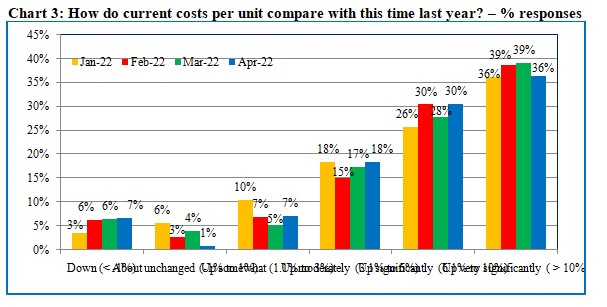
  • The cost perceptions data indicates persistence of high cost pressures. Over66% of the participating firms in the survey perceive significant (over 6%) cost increase for the consecutive three months(Chart 3).


  • Over 36% of the firms in April 2022 round of the survey perceive that costs have increased very significantly (over 10%). For the consecutive four rounds, over 36% of the firms reported more than 10% cost increase.


Chart 3: How do current costs per unit compare with this time last year? – % responses
Business Inflation Expectations Survey (BIES) – April2022

  1. Sales Levels


  • Firms’ sales expectations in April 2022 havefurther improved. Percentage of firms reporting ‘much less than normal’ sales has marginally declined.


  • Notably around 28% – highest in the last 5 years – of the firms in April 2022 report that sales are ‘about normal’(Chart 4).


Chart 4: Sales Levels – % response

Business Inflation Expectations Survey (BIES) – April2022


  1. Profit Margins


  • For the past 4 consecutive rounds, over77% of the firms in the sample are reporting ‘much less than or somewhat less than normal’ profit(Chart 5).


  • Improved sales expectations are offset by high cost increases. As a result, profit expectations remain muted.


Chart 5: Profit Margins – % response

Business Inflation Expectations Survey (BIES) – April2022


Business Inflation Expectation Survey (BIES) –Questionnaire


A. Current Business Conditions


Q1. How do your current PROFIT MARGINS@ compare with “normal”* times?

o   Much less than normal

o   Somewhat less than normal

o   About normal

o   Somewhat greater than normal

o   Much greater than normal


Q2. How do your current sales levels compare with SALES LEVELS@ during what you consider to be “normal”* times?

o   Much less than normal

o   Somewhat less than normal

o   About normal

o   somewhat greater than normal

o   Much greater than normal


@   of the main or most important product in terms of sales.

*”normal” means the average level obtained during the corresponding time point of preceding 3 years, excluding the Covid-19 period.


B. Current Costs Per Unit^

Q3. Looking back, how do your current COSTS PER UNIT^compare with this time last year?

o   Down (< -1%)

o   About unchanged (-1% to 1%)

o   Up somewhat (1.1% to 3%)

o   Up moderately (3.1% to 6%)

o   Up significantly (6.1% to 10%)

o   Up very significantly (> 10%)

o

^of the main or most important product in terms of sales.


C. Forward Looking Costs Per Unit$

Q4. Projecting ahead, to the best of your ability, please assign a percent likelihood(probability) to the following changes to costs per unit$ over the next 12 months.


%
%
%
%
%
%

o   Unit costs down (less than -1%)

o   Unit costs about unchanged (-1% to 1%)

o   Unit costs up somewhat (1.1% to 3%)

o   Unit costs up moderately (3.1% to 6%)

o   Unit costs up significantly (6.1% to 10%)

o   Unit costs up very significantly (>10%)


$of the main or most important product in terms of sales.

Values should add up to 100%.


“Normal” means as compared to the average level obtained in the preceding 3 years, excluding the Covid-19 period.


Quote by Ms. Rajni Thakur, Chief Economist, RBL Bank on Monetary policy announcement

– Ms.Rajni Thakur, Chief Economist, RBL Bank

MPC decisions announced this morning- 50 bps hike in policy rates, resetting inflation projections and no change in CRR- were all broadly along the expected lines. Coming right after an inter-policy MPC in May, which kind of spooked the market a bit, RBI choosing to stay predictable this time will help sooth market sentiments. MPC’s CPI projections for FY23 at 6.7% now are more realistic in view of current geo-political uncertainties and their fall outs. However, with multiple risks on price levels driven largely by external factors, the rate hikes will help anchor inflation expectations and impact the actual inflation outcome to a much lesser extent. This also, makes it difficult to gauge a terminal rate level for the cycle, even though, continual rate hike expectations till pre-Covid levels have been firmed up by the fact that Monetary Policy stance has changed from “accommodative with focus on withdrawal of liquidity” to “focus on withdrawal of accommodation”. We now expect a further rate hike of 50 bps in August, taking Repo rates higher than pre-Covid levels, followed by pause to re-access the macro-dynamics and hikes in smaller quantum thereafter pushing year end Repo-rates close to 6% levels.

2000 Farmers Benefit as Gram Unnati Brings Climate Compatible Agriculture to over 5,000 Acres of Farmland in Uttarakhand; Helps save 4,000 Litres Of Water Per Acre

At a time when economies across the world are finding ways for sustainable farming due to depleting groundwater levels, Gram Unnati, India’s first integrated agri-tech solutions company, worked closely with multiple stakeholders to help farmers in Udham Singh Nagar district of Uttarakhand save 4,000 liters per acre by bringing climate-compatible agriculture to over 5,000 acres of farmland.

In what may become a lesson in climate compatible agriculture to millions of Indian farmers, Gram Unnati worked closely with the local district administration, local maize processors, input companies, and lead farmers in a short span of 18 months prompting 2,000 farmers to switch to climate-compatible crops that are commercially viable as well.

Commenting on the success of the project, Aneesh Jain, CEO and Founder, Gram Unnati, said, “The success of the project comes at a time when we are dealing with acute water shortage across the world. According to the United Nations, by 2050 more than five billion people could be affected by water scarcity. India, which constitutes 16% of the total world population, has access to a meagre 4% of the world’s water resources. The success of our pilot project in Uttarakhand will impact other farmers to shift towards climate compatible crops without having an impact on yield and returns.” 

Farmers of Udham Singh Nagar and adjoining areas in Uttar Pradesh (Rampur, Bareilly, and Pilibhit) traditionally take up a short duration summer paddy crop after their Rabi harvest and before Kharif sowing. Based on research, Gram Unnati identified Maize as a reasonably remunerative substitute for summer paddy. Maize is not only a short-duration crop, requiring less water compared to paddy but is also known to bring higher returns. Its multiple utilities such as ‘food’, ‘fodder’, and ‘feed’ help in de-risking farmers against potential low-demand situations.

“The pilot project was successful in moving 5,000 acres of land to spring maize, which resulted in substantial water savings of as much as 4,000 litres per acre. The crop also generated 25 percent higher yield on the same piece of land. This has emerged as a good example of ‘more crop per drop’. The project also contributed towards fulfilment of Sustainable Development Goals like reducing poverty, increasing agricultural productivity, judicious use of water, and sustainable production,” added Jain.

Jain said that the success of the project in Udham Singh Nagar has encouraged Gram Unnati to take up newer challenges.

“Gram Unnati intends to scale up this intervention to 100,000 acres of Spring Maize in the next five years. Not only would this reduce dependency on groundwater resources, but it will also help in making agriculture more remunerative for the farmers and more sustainable for the environment,” Jain added.

As agriculture is the largest consumer of fresh water in India, the shift from high to low-intensity crops such as Maize, pulses, millets, oilseeds, etc. has the potential to significantly reduce farmers’ dependence on rainwater/ irrigation, while helping in greater water conservation, enhancing farmers’ capacity to better cope with climate change and in the long run making India more self-sufficient in these crops.

It is estimated that out of total extractable groundwater available in India, 90% goes to agriculture annually to often support highly water-intensive crops like paddy, sugarcane, and wheat, sometimes in severely water stressed regions of the country. As many as 30% of districts in India have reported ‘critical’ groundwater levels according to recent Central Ground Water Board data. The growing water crisis is being worsened by climate change with rising temperatures and uncertain rainfall patterns.

ADDX is first Singapore financial institution to recognise crypto assets of accredited investors

SINGAPORE, 8 JUNE 2022 – Private market exchange ADDX has become the first financial institution in Singapore to recognise cryptocurrency assets for the purposes of onboarding accredited investors.

The move opens the way for more individuals to qualify for accredited investor status. They can thereby participate in more sophisticated investment opportunities in the private markets, which tend to be more resilient in times of market volatility. These include asset classes such as private equity and venture capital funds, hedge funds and pre-IPO companies.

In line with regulations, ADDX will implement appropriate risk management measures that take into account the price volatility of crypto assets. For example, ADDX will recognise only cryptocurrencies with a higher market capitalisation and will apply a discount rate when valuing the assets.

Under Singapore’s regulatory regime, individuals have to meet any one of three criteria in order to qualify as accredited investors: their income in the past twelve months exceeds SGD 300,000, or their net financial assets exceed SGD 1 million, or their net personal assets exceed SGD 2 million. While crypto assets are not currently recognised as income or financial assets, they can be recognised under the third category of net personal assets.

As part of its process for verifying accredited investors, ADDX will begin recognising three coins – Bitcoin, Ether and USDC. The discount rates ADDX will apply when calculating the value of these crypto holdings is 50% for Bitcoin or Ether and 10% for USDC. These coins and discount rates will be reviewed at regular intervals and may be revised as market conditions change. To qualify as accredited investors, individuals can provide documents to show that the value of their net personal assets meets the SGD 2 million threshold after the inclusion of crypto assets with the discount rate applied.

The latest development comes at a time when crypto ownership rates are at record levels worldwide. According to a global survey by Gemini, crypto ownership rose by more than 80% in 2021. Ownership rates have hit 30% in Singapore, 24% in Hong Kong, 20% in the US, 18% in the UK and 17% in Germany.

ADDX CEO Oi-Yee Choo said: “Cryptocurrencies are here to stay. They no longer exist only on the fringes of wealth and investment conversations. With a large minority of investors owning crypto, it is reasonable for these digital assets to be recognised as a part of one’s portfolio – not unlike any other assets that can be valued in the marketplace, such as real estate or equity. In line with ADDX’s mission of democratising private market investing, recognising crypto holdings helps us to serve a much wider segment of investors – not just investors with traditional holdings, but those who hold crypto as well. At a time when the markets are volatile, this move is also designed to enable crypto investors to diversify into the regulated private markets, which tend to be more stable across different phases of market cycles.”

Ms Choo added: “As a regulated financial institution that understands blockchain technology, ADDX is well-positioned to bridge the two worlds – traditional finance and digital assets. Investors increasingly expect a seamless view of their complete holdings because their traditional wealth and crypto wealth ultimately belong to a single portfolio. They want the best of both worlds. Last year, ADDX listed our first fund with exposure to crypto, and today we are recognising crypto assets for accredited investor verification. These steps form part of a more strategic and comprehensive crypto roadmap for ADDX. In time to come, we are likely to enable customers to fund their investment wallets with cryptocurrencies and to convert their assets between fiat currencies and crypto.”

Founded in 2017, ADDX is Asia’s largest private market exchange. Using blockchain and smart contract technology, ADDX tokenises private market investments such as private equity funds, hedge funds, pre-IPO equity and bonds. The resulting efficiency allows the platform to reduce minimum investment sizes from USD 1 million to USD 20,000. ADDX has listed more than 30 deals on its platform involving blue-chip names such as Hamilton Lane, Partners Group, Investcorp, Singtel, UOB, CGS-CIMB, as well as Temasek-owned entities Mapletree, Azalea and SeaTown. The Singapore Exchange (SGX) backed company is regulated by the Monetary Authority of Singapore (MAS) as a digital securities exchange.

Using Tech For Good: Talabat Plants Over 1,000 Trees and Facilitates EGP 2.5 Million in Donations

Cairo – Egypt, 8 June 2022: talabat, the leading local food aggregator and quick commerce platform, has been stepping up its corporate responsibility efforts in Egypt, with a focus on using tech for good and encouraging customers to participate in diverse initiatives. The tech company is set to plant 1,000 trees with Shagrha in celebration of World Environment Day and facilitated EGP 2.5 million in donations during Ramadan.

“We are honored and thankful for connecting our customers to causes close to their hearts; making donations and social impact a click away is how we adopt tech for good. talabat will continue to work on supporting even more people and organizations, within our ecosystem and beyond,” said Hadeer Shalaby, Managing Director of talabat Egypt.

In effort to create greener spaces across Cairo and in celebration of World Environment Day, which took place on June 5, talabat transformed online food and grocery ordering into an influential action, by joining forces with local environmental enterprise, Shaghra. Under the theme of #OnlyOneEarth, the company will plant a tree for every 1+ orders made on talabat and talabat mart. The one-day “Plant a Tree” initiative resulted in over 1 thousand fruit trees scheduled to be planted in degraded lands and public spaces.

Besides supporting local businesses in achieving sustainable growth and partnering with organizations to champion important topics, the tech platform also hosts renowned charitable institutions to simplify donation processes to its wide-customer base. talabat facilitated over EGP 2.5 million in donations for humanitarian causes in Egypt, inclusive of 50,000 meals to communities in need. On a regional level, the tech company raised more than 1 million Euros during the holy month of Ramadan.

Commenting on the recent efforts, Asmaa Khalil, Head of Public Affairs, Communications & Corporate Responsibility at talabat Egypt said, “We would like to recognize our partners for their passion and grass-root work with Egyptian communities.” Partnering with influential, national organizations is not only advancing our ambitious corporate responsibility agenda, but also compliments the Government’s efforts in promoting conscious business practices and enabling Egyptians to attain a decent life,” she added.

talabat also recognized generous customers who have donated the most during Ramadan by rewarding the top 5 donors with an exclusive golden ticket, holding EGP 1,000 in credit valid for use on talabat mart. The move comes in light of encouraging more customers to give back and amplify their goodwill through technology.

The platform currently hosts the Egyptian Food Bank, Misr El-Kheir, Magdi Yacoub Foundation, Al-Orman Association and Ibrahim Badran Foundation, and will be working to include additional organizations in the near future to address diverse causes.

Consumers can donate to charitable organizations on talabat year round, download the app on the iOS App Store, Google Play Store and Huawei App Gallery now.

Dress for Success Tampa Bay and CareerSource Tampa Bay Celebrate Boutique’s Second Anniversary

Tampa, FL (June 7, 2022) — Two years ago, Dress for Success Tampa Bay and CareerSource Tampa Bay partnered to help more women get job-ready by opening a clothing boutique in the CareerSource Building at 9215 North Florida Avenue in Tampa. This month, they are celebrating the second anniversary of that landmark boutique in a three-day event, from Monday, June 13, to Wednesday, June 15, 2022, 10 a.m. to 2 p.m. each day, and you are invited to join them!

Katie McGill, Dress for Success Tampa Bay’s Executive Director, said, “The boutique at CareerSource Tampa Bay is one of our three locations, and we are very proud of it. Since its inception in 2020, this location has served more than 600 women. The pandemic created a greater need for our community, and we are excited that we were in place to meet their needs.”

Diane Howard, President of the Dress for Success Tampa Bay’s Board of Directors, said, “We are committed to assisting women to live their best and healthiest lives by focusing on support, comfort, wellness, and career programs that inspire them to meet their goals.”

Clients are referred to the CareerSource boutique, where they receive personal styling sessions with a knowledgeable and compassionate volunteer by appointment. Each client is provided with a complete interview outfit, including shoes, accessories, and a handbag, as well as a week’s worth of additional clothing once she’s secured employment. Since its inception in 1998, Dress for Success Tampa Bay has provided interview attire for more than 25,000 women.

In addition, Dress for Success Tampa Bay also offers career search assistance, job skills training, and other development tools to help women thrive in work and life. In collaboration with CareerSource Tampa Bay, the “Moving Forward” program teaches participants how to conduct a job search using technology and social media, how to express themselves positively and effectively in a job interview, and ultimately how to obtain employment.

Dress for Success is a worldwide organization with a mission to empower women to achieve economic independence by providing a network of support, professional attire, and the development tools to help women thrive in work and life.

For more information about Dress for Success Tampa Bay, visit https://tampabay.dressforsuccess.org or call 813-259-1876.

COAI Position on 5G Private Networks

  1. Presently, the resources for operating such private network are made available from the resources of licensed service providers which include spectrum acquired through a transparent auction process.
  2. We are of the firm opinion that notwithstanding any advancement of technologies, there is no justification whatsoever for allocating spectrum to industry verticals for operating private captive networks. The licensed Access Service Providers are fully capable of providing all customised solutions including M2M / Industrial 4.0 services in the most competitive and economic manner and are in fact providing such network configurations to private and public sector entities. Hence, there is no need to alienate spectrum directly to companies for captive private networks.
  3. When a private network is part of a commercial network, it addresses the following issues for orderly growth of the sector:
    • Neither the legitimate revenue of licensed service provider is truncated nor there is any revenue loss to the Government exchequer in terms of payment for acquiring spectrum through auctions and payment of license fee and Spectrum Usage Charge (SUC). Thus, it is respectfully submitted that the requirement of industry verticals can be best met through operator-led private networks.
    • This approach also adheres to the principle of “Same Service Same Rules”. Any move such as setting aside/ allocation of 5G spectrum (via delicensed/ administrative basis) for catering to the connectivity needs of Industry 4.0 / M2M communication services by way of industry-led private captive networks, will not only truncate the revenues of the licensed service providers but also affect the revenues of the government. this will also create a non-level playing field, leading to arbitrariness in basic policies discouraging investment in the networks and leading to disorderly growth of the sector by back door entry with undue advantage to private commercial entities at the cost of the government exchequer.
    • A private network operated within the commercial network also fulfils the requirement of “law enforcement agencies” as necessary lawful interception and monitoring is provided by the service provider while no such facility is available to leas in private captive networks. the anti-social elements may exploit this facility to bypass interception and monitoring of messages which would be detrimental to national security.
    • It is pertinent to note that spectrum is a key finite resource with high economic value. The spectrum allocation in any spectrum band that can be used to deploy and provide communication services, irrespective of the entity desiring to use the spectrum or the technology deployed or the type of services offered, should be allocated only through a transparent and open auction process. Therefore, we do not support delicensing/ reserving any Spectrum bands for Private Captive Networks or any other services like M2M services in the guise of Industry 4.0.
  4. We would also like to bring to your notice the GSMA Report on ‘Mobile Networks for Industry Verticals: Spectrum Best Practice’ vide which they have stated that great care needs to be taken to ensure verticals are fully supported without harming other wireless users – especially consumers and businesses who rely on 4G and 5G. Verticals can benefit from telco’s more extensive networks, more substantial spectrum assets, expertise and, typically, operators’ lower cost base. Use of dedicated set-asides for verticals poses significant risks to wider mobile services, most notably slower 5G networks and reduced coverage. The main highlights of the report are given below:
    • Commercial mobile operators support the needs of a wide variety of vertical sectors and will have added capabilities with 5G
    •  Spectrum leasing or, when carefully planned, other types of spectrum sharing can be viable options for supporting verticals who want to build private networks
    •  Spectrum that is set aside exclusively for verticals in core mobile bands risks being underused and can undermine fair spectrum awards
    • Spectrum set-aside in core mobile bands can also threaten the wider success of 5G – including slower rollouts, worse performance and reduced coverage
    • Policymakers should consider coexistence challenges when different use cases need to be supported in the same mobile band
    • Unlicensed spectrum is likely to play an important role for numerous verticals
    • Policymakers should carefully consider their options and consult stakeholders to ensure they most efficiently support the needs of verticals without undermining other spectrum user
  5. With the digital transformation of industry and increased automation, telecom players are both able and willing to offer connectivity in terms of private networks or any other services like m2m services. such networks are part of their commercial operations and therefore, all resources should be procured in transparent commercial manner only. In a competitive market, the true value of resources can only be realized through a commercial process which ensures efficient allocation and best use of the resources.
  6. We urge the Government not to reserve or de-license any spectrum which has been identified or likely to be identified for use of IMT/ commercial services for Private Captive Networks. Any de-licensing/reservation of IMT/commercial spectrum for captive industrial use/establishment of private networks, as demanded by few companies, would not only cause huge loss to the exchequer but will also lead to sub-optimal utilization of this scarce resource. Hence, such a move is also technically uncalled for. Sufficient unlicensed spectrum bands are available to cater these private network requirements for captive networks.
  7. It is not out of context that in our country, Hon’ble Supreme Court of India has pronounced a judgment in CWP 423 of 2010 mandating the Government for the alienation of resources like spectrum through a transparent auction process only. Therefore, in our humble submission delicensing/ administrative allocation of spectrum for Captive Networks/ M2M services/ Industry 4.0 is legally untenable in our country.
  8. Keeping in view the above, we submit that: 
    • In today’s scenario there is no need for separate private captive networks and same should be dispensed with given the availability of state-of-art telecommunication network.
    • Private Captive Networks can be detrimental to national security.
    • The licensed Access Service Providers are fully capable of providing these services in most competitive and economic manner compared to private companies looking for such solutions.
    • Request the Government not to reserve or de-license any spectrum which has been identified or likely to be identified for use of IMT/ commercial services for Private Captive Networks. It amounts to undue advantage to private commercial entities at the cost of government exchequer.
    • Any de-licensing/reservation of spectrum for Industrial use/establishment of private Captive networks, as demanded by few companies, would not only cause huge loss to the exchequer but will also lead to sub-optimal utilization of this scarce resource. Hence, such move is not only technically uncalled for but also legally untenable.

RBI policy announcement: Comments by Mr Rohan Pawar, CEO of Pinnacle Group

-Mr. Rohan Pawar -CEO of Pinnacle Group

“During the pandemic, the low interest rate regime had boosted the housing demand. RBI’s decision to hike the interest rate again by 50 bps to 4.90 was expected to tackle the tight inflation of the country. The increase of rates could adversely affect housing demand because of increased EMIs and lower eligibility on home loans. This will create an impact on the ongoing growth momentum in the sector in addition to increasing input costs. However, we still believe that preference of homebuyers for owning a home will continue to boost demand.”

HDFC Bank Parivartan launches #EnginesOff Campaign in 40 cities

To commemorate World Environment Day, HDFC Bank Parivartan today launched a high-decibel campaign called #ENGINESOFF to raise awareness on the importance of reducing air pollution through a short street play. Motorists idling their vehicles at busy traffic intersections were encouraged to switch off their engines while they waited for the signal to turn green.

The bank is rolling out this short play at over 126 busy signals in 40 cities across the country. The three-day campaign was from June 5th which included large metros such as Kolkata, Mumbai, Gurugram, Bangalore, and Pune, as well as smaller cities like Ludhiana, Varanasi, Nasik, Rajkot and Guwahati among others. There were three different locations in Kolkata where #EngineOff was visible. These locations were Shyambazar crossing, Esplanade crossing, Rasbehari crossing.

 “HDFC Bank has always been committed to leading responsibly. We believe that as India’s largest bank, we must use our brand to create a positive social impact and make a difference in the lives of communities,” said Mr. Ravi Santhanam, CMO, HDFC Bank. “With this campaign, we want to raise awareness on the simple steps we can take to prevent a catastrophic future. We need to come together and act now so we can create a better tomorrow,” he added.

 The street play is part of HDFC Bank’s nationwide ESG campaign highlighting the small steps we can take towards sustainable progress. The campaign shows how the future can be better if we change things today. The bank also launched four unique films that highlight its social and environmental initiatives under its flagship programme “Parivartan”, as part of the same campaign. HDFC Bank is amongst the largest corporate CSR spenders in the country. The bank’s key focus areas include care for climate, rural development, education, skill development, healthcare & hygiene and financial literacy under Parivartan.

Mango Mania at Conrad Bengaluru

8th June 2022: Dedicated to mango lovers in the city, Conrad Bengaluru brings to you a specially curated brunch that not only incorporates mango to its dishes but enjoyed alongside refreshing Mimosa’s as well! The perfect combination for a perfect Sunday.

A few scrumptious delicacies you would not want to miss out on include Fioccheti Pasta with Mango and Parmesan Cream, Poached Mango Lobsters, Raw Mango Avocado Salad, Alphonso Mango Cremeux and Mango Bread Loafs to name a few at Caraway Kitchen, Conrad Bengaluru.

Celebrating the king of fruits and queen of drinks, make way to Caraway Kitchen this Sunday, 12th of June 2022 for brunch so delectable, leaving you wanting for more!

For reservations: +91 88844 00194