Tag: Women Workforce

Toyota Kirloskar Motor Commits to Significant Increase in Women Workforce

Bangalore, 14 March 2024: In alignment with its dedication to cultivating a more inclusive and dynamic workforce, Toyota Kirloskar Motor (TKM)  announced focused efforts to enhance gender diversity and Inclusion in its operations. Contributing to the larger goal of “Skill India Mission”, the company is also implementing a series of innovative initiatives aimed at not only enhancing the skillset of women but also empowering their holistic development.
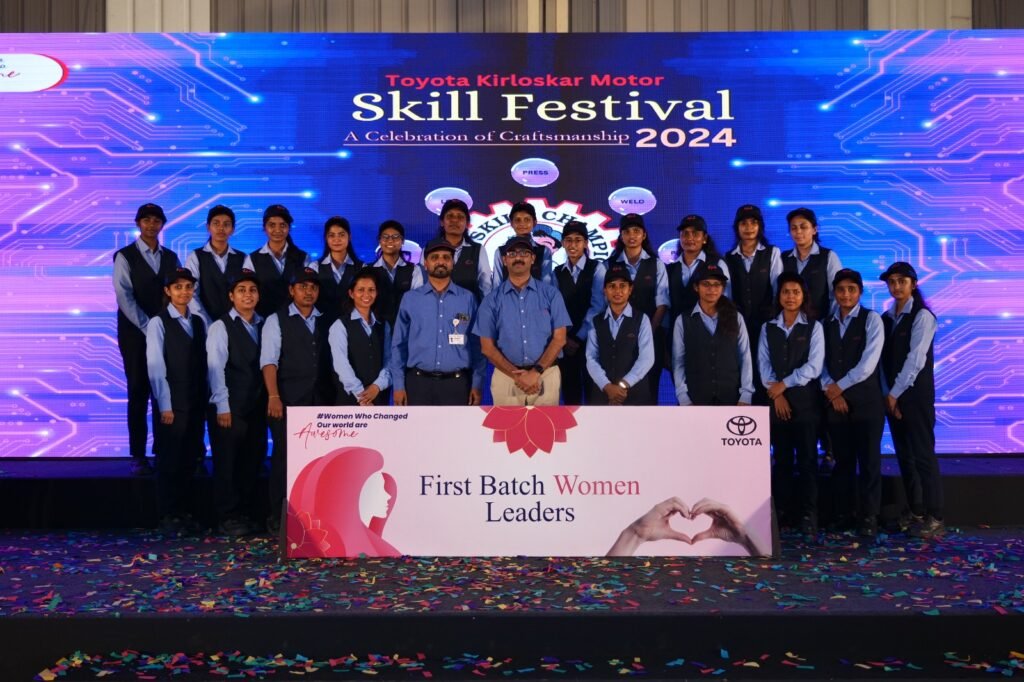
1. TKM First Batch of Women Leaders

While celebrating International Women’s Day, TKM announced the induction of 124 female team members and 55 female leaders into its manufacturing operations. These skilled individuals will play an integral role in driving the company’s operations while exemplifying its commitment towards fostering a culture marked by diversity, equality, and inclusion.

Furthermore, TKM also organized skill contest for female members thus marking a significant new milestone. The contest encompassed a diverse array of skill categories, enabling participants to showcase their expertise across various manufacturing processes. A panel of industry experts from Toyota India evaluated participants based on criteria such as problem solving, creativity, and technical skill.

Commenting on this development, Mr. G. Shankara, Executive Vice President and Director for Finance and Administration said, “At TKM we are committed to contributing positively towards strengthening the Indian auto industry with a highly skilled, diverse, and globally competitive workforce. We believe that the vision of gender inclusivity extends beyond the organization’s borders, encompassing the entire value chain and society at large. We are thrilled to welcome our new female team members and leaders into the manufacturing line. This resonates with our core belief that diversity and inclusion are not seen just as a corporate responsibility but reflects TKM’s strong commitment towards developing rural talent into world-class competitive technicians. We believe that this approach will not only offer them enhanced opportunities in both domestic and international markets but also contribute to producing mass happiness in the society.”

TKM has also established a Business Reform Team on Diversity, Equity, and Inclusion (DEI) to spearhead these efforts. Following extensive benchmarking and leadership engagement, TKM has achieved significant progress thanks to the progressive and supportive measures by the State Government in facilitating the inclusion of women to work in shifts. Furthermore, these efforts are also well complemented by a comprehensive ecosystem assessment through an unconscious bias survey, leading to targeted sensitization programs.

As a strong step in the direction of supporting “Skill India Mission,” Toyota Kirloskar Motor (TKM) recently announced the expansion of its Toyota Technical Training Institute (TTTI) in Bidadi. As a part of this expansion, the company announced doubling its intake from 600 to 1200 students which included upto 600 female students, providing opportunities for students from economically challenging backgrounds and rural areas in Karnataka, with a steadfast focus on enhancing gender diversity as a pivotal component of its expansion.

Through TTTI, TKM will train female students in knowledge (16%), skill (34%) and body and mind (50%) from economically challenging background and rural areas. The infrastructure has been upgraded with improved residential facilities for female students, new classrooms, and updated equipment to enrich skill training. These enhancements are designed to support a comprehensive learning and development experience for TTTI students.

Going forward, TKM remains committed to support the professional development and advancement of women workforce through targeted initiatives and programs, ensuring that they have the resources and opportunities to thrive in their careers.

Unlocking India’s potential through Women Workforce

Despite the challenges faced during the COVID-19 pandemic, women representation has improved significantly in the workforce across roles and hierarchies. The year 2021 brought a massive transformation, reflects apna.co – India’s largest jobs and professional networking platform. With around 5 million female users, apna has recorded trends that are encouraging and highlight the shifting dynamics of India’s rising workforce.

apna has witnessed a massive 430% increase in female users in 2021. According to apna, this percentage will continue to grow in 2022. Cities such as Pune, Hyderabad, and Ahmedabad noted a significant rise in women users on the platform. Maximum female content creators on apna communities hail from metros such as Delhi-NCR, Mumbai and Bengaluru.

The pandemic and its subsequent work-from-home regime created avenues for women to join the workforce. Female users also showed an inclination towards building professional networks and invested their time towards the same. apna became a safe space for them to have professional conversations and interact with industry peers. Women have been actively engaging in apna communities on government, business, learning languages, tele-caller, back-office jobs, teacher, computer/data entry, beauticians, lab technician and cooking.

As per data from apna, there was a 12X increase in women interviewing on its platform in comparison to last year. In fact, on average women are interviewed at least 8 times a month – 33% more times than men. This highlights the accelerated intent in women to apply for more jobs. They are not only joining the workforce but also taking up unconventional jobs and breaking barriers created centuries ago.

With easily available and verified hyperlocal opportunities, mentorship programs and upskilling courses, apna became a default choice for India’s women workforce. Interestingly, 39% of the female users on apna.co are 12th pass or lower and rely on apna to find jobs and build their professional network. The platform is empowering millions of women by helping them find a career in around 70 categories.

More popular roles on apna included tele-callers and BPO, back office, receptionist, front office, teacher, accounts, finance, admin, office assistant and data entry operators. Unlike last year, apna also recorded a rise in women applying for various non-traditional roles, including delivery partners, security guards, lab technicians, fitness trainers and drivers to name a few.

Talking about these trends, Manas Singh, Chief Business Officer – apna.co: “According to a recent report from IMF, reaching gender parity would boost India’s GDP by as much as 27%. Similarly, the World Bank reports that India’s GDP growth rate will climb above 9% if women have an equitable share of jobs and the nation can boost its growth by 1.5 percentage points per year if just 50% of women join the workforce. While we still have a long way to go, the 2021 Women Workforce data by apna is encouraging and signifies an upward graph in their participation. Through the mission of #AcceleratingIndia, we will continue empowering our female users and building a trusted platform for them to find relevant job opportunities.”

Other interesting trends of women users apna witnessed in 2021

  • Women engaged in 48 million professional conversations during this year
  • 56% of these conversations were by women from Tier-I cities, the rest in Tier-II markets
  • Top companies posting the maximum women-only jobs: Urban Company, Lakme, Zomato, Motherhood India Hospitals, Fortis
  • Maximum women-only jobs were posted in Mumbai, Hyderabad, Bengaluru, Delhi and Kolkata
  • apna recorded an 8x growth in new users in Tier II markets and 3.3x in Tier I cities
  • Women on apna have an equal assessment passing rate as men
  • Employers have been hiring women in unconventional roles of drivers, security guards, delivery partners, fitness trainers, mechanical and electrical engineers, peons, accounts and finance
  • There are more than 15,000 female influencers on apna.co
  • Top communities with the highest women’s engagement: government, business, learning English, tele-caller, back office, teacher, computer/data entry, beautician, lab technician, cook/chef
  • Tele-caller and BPO jobs are the most popular jobs in all the major cities
  • 11x increase in healthcare jobs for women

City-wise trends

  • Women in Delhi-NCR gave the maximum interviews and also applied for the most night shifts in India.
  • In Tier-II cities, women users in Lucknow were more inclined towards WFH jobs while Bengaluru saw maximum applications for remote working.
  • Pune witnessed the most number of civil engineer applications by women.
  • In Tier-II cities, the most professional conversations happened in Lucknow.
  • An average user in Ranchi applies for 9 jobs in a month – the highest among all cities.
  • Delivery partner is among the most in-demand roles in Amritsar, where one can expect an order to be delivered by a woman.
  • A fieldless exploration by women, aircraft repair saw the most applications from women in Mumbai.
  • Chandigarh saw more women carpenters than any other Tier-II city.
  • More women in Jaipur are interested in back-office jobs
  • Maximum women applied for the role of telecallers in Surat
  • Women in Kolkata applied for the role of Refrigerator Technician.
  • Coimbatore saw the most applications for teachers.
  • In Guwahati, tele-caller/BPO is the most searched job.
  • Users in Agra are more open to applying for the role of a driver.
  • Bhopal recorded the maximum number of computer data entry operators.
  • For Chennai women, finance is a popular sector.

The data shared by apna. co clearly signifies the closing gender gap and increasing gender diversity in India’s rising workforce. Present in 45-plus cities across India, apna is trusted by 22 million users.

User Stories: Breaking barriers

The story of Jyoti Shukla, the power of networking and helping people through the pandemic

During the pandemic, a nurse, Jyoti, found a job through the apna app in less than 24 hours after joining the platform. She was appointed in one of the most reputed hospitals, working with COVID-19 patients. This was just the beginning. Her aspirations didn’t stop there. Jyoti saw opportunities and grabbed them with both hands. She met an individual (among many people she connected with) on the app in “business group” and after a week of planning, the two set up their placement agency. Jyoti joined the app only to get a job and help people in distress. During the pandemic, at Jyoti’s workplace, there was an urgent need for masks and PPE kits. Jyoti instantly turned to her network on the apna app and sourced the needed masks within hours. In this way, she has leveraged her network for the greater good. Jyoti has also found several part-time gigs, travelling to Delhi and cities in Gujarat to home-nurse COVID patients.

Today, Jyoti is a popular member of apna groups. Moreover, she single-handedly provides for her family and has created a position for herself in society. As she crossed many hurdles over the years, apna became the platform that fast-forwarded her journey to success.