Greater Pune – A Urban Expansion Benchmark by PMRDA

By Akash Pharande, Managing Director – Pharande Spaces
The Pune Metropolitan Region Development Authority (PMRDA) oversees an extensive and strategically significant territory now collectively referred to as Greater Pune. It covers both urban and rural regions.
The two key territories under Greater Pune are the Pune Municipal Corporation (PMC) and the Pimpri-Chinchwad Municipal Corporation (PCMC). PMRDA also governs the pivotal Talegaon Dabhade and Lonavala Municipal Councils – the former a strong and growing industrial hub, and the latter arguably Maharashtra’s favourite tourist destination.
Beyond these municipalities, PMRDA also administers numerous suburban and rural areas which are vital for Greater Pune’s expansion and development. These include the rapidly developing industrial hotspots Chakan and Pirangut, as well as Pune’s pre-eminent and pioneering IT hub Hinjawadi.
Among the rural areas are Mulshi, Maval, Khed, Haveli, and Junnar, which are important for their agricultural contributions and potential for future development. Known for their scenic landscapes, Mulshi and Maval are already attracting considerable real estate development.
As can be seen, Greater Pune is vast and diverse and showcases PMRDA’s governance across many major urban centres, IT hubs, industrial zones, and rural areas.
Over the past decade, Greater Pune’s exponential growth stands as a strong testament to PMRDA‘s strategic planning and robust implementation of development initiatives. But is this pace of growth really necessary? Let’s look at the facts.
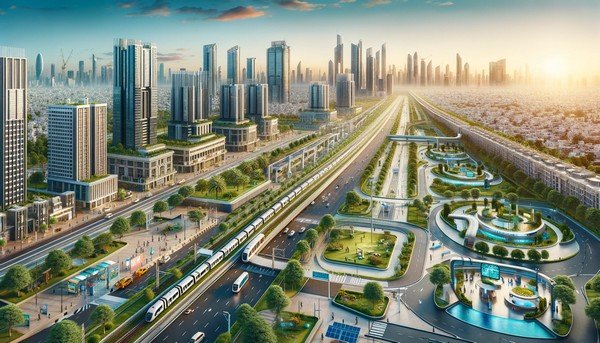
Population Growth and Urbanization
As of 2024, Pune’s population is estimated to be around 7.35 million in the metropolitan area and approximately 4.44 million within the city limits. Its vast talent pool across all employment categories is Greater Pune’s greatest asset, and this population needs to be accommodated.
It stands to reason that the region’s real estate sector has been booming. According to data from MahaRERA (Maharashtra Real Estate Regulatory Authority), there has been a consistent rise in the launch of new housing projects. In 2023 alone, Pune saw over 50,000 new homes launched, while Pimpri-Chinchwad added 20,000.
Prominent real estate developers have been having a field day – or rather, a field epoch – launching massive projects to aid this expansion. Given that home seekers in Greater Pune are looking for options across categories, a large number of these projects offer modern amenities that cater to the middle and upper-middle-class homebuyer segments.
While the supply of affordable housing projects has been more muted due to decreased demand, the market is replete with options even in this category.
Infrastructure Development
Across the length and breadth of Greater Pune, PMRDA has consistently focused on infrastructure development as a cornerstone of the region’s urban growth. One prime example is the Pune Metro which, in just the first phase, will connect key areas like Hinjewadi, Shivajinagar, and Pimpri. The reduced commute time creates more housing demand across all areas.
Additionally, the 128 km Ring Road will decongest city traffic by giving Greater Pune an alternative road travel route and connecting various parts of the region across major highways and economic zones. For Pune’s economic triple engine of IT, manufacturing, and the services sector, this spells gold and will massively boost trade and commerce. According to recent reports, absorption in Pune’s commercial office space reached 6.5 million square feet in 2023.
Sustainable Urbanization
PMRDA‘s commitment to Greater Pune includes a strong focus on sustainable urbanization. It has now made it mandatory that green spaces and energy-efficient designs be included in all new projects. Also, digital infrastructure, smart transportation, and efficient waste management have been prioritized.
Social Infrastructure
The growth of Greater Pune extends beyond just economic and infrastructural development. PMRDA is keenly aware that for overall quality of life and livability, adequate social infrastructure to support its growing population is of paramount importance. Not surprisingly, the region under its aegis boasts top-grade schools and colleges, hospitals, and recreational amenities.
To summarize…
Under the able administration of PMRDA, Greater Pune’s urban expansion has emerged as one of the most impressive success stories of planned growth, economic prosperity, and sustainable development. It sets a new benchmark for urban and urbanizing India, demonstrating how strategic governance and innovative planning can create a thriving, modern metropolis.
With continued focus on infrastructure, sustainable development, and quality of life, Greater Pune is poised to be a model city for the future, embodying the aspirations of a rapidly urbanizing nation.
About the Author:
Akash Pharande is Managing Director – Pharande Spaces, a leading real estate construction and development firm famous for its township projects in Greater Pune and beyond. Pharande Promoters & Builders, the flagship company of Pharande Spaces and an ISO 9001-2000 certified company, is a pioneer of townships in the region. With the recent inclusion of Puneville Commercial into one of its most iconic townships, Pharande Spaces taken a major step towards addressing Pune’s current and future requirements for fully integrated residential-commercial convenience