Tag: Mr. Navneet Munot

HDFC Mutual Fund launches HDFC NIFTY200 Momentum 30 Index Fund

Mumbai, February 10, 2024: HDFC Asset Management Co. Ltd., investment manager to HDFC Mutual Fund (HDFC MF), one of India’s leading mutual fund houses announces the launch of the HDFC NIFTY200 Momentum 30 Index Fund. The captioned NFO opens on Feb 9th and closes on Feb 23rd 2024.

The HDFC NIFTY200 Momentum 30 Index Fund allows investors to participate in the growth potential of Momentum stocks. It is an open-ended scheme that aims to replicate the NIFTY200 Momentum 30 Index. The NIFTY200 Momentum 30 Index selects top 30 stocks from the NIFTY 200 based on their Normalized Momentum Score. The index offers potential exposure to both largecap and midcap stocks through a single product, as its parent index is the NIFTY 200 Index.

The fund adapts dynamically to changing market conditions, ensuring responsiveness to evolving trends. Historical data demonstrates the index’s ability to outperform traditional market indices, hence investors seeking long-term growth opportunities could consider this as an option. With lower expense ratio and a focus on capturing market momentum, HDFC NIFTY200 Momentum 30 Index Fund is an investment option for investors looking to capitalize on prevailing market trends and secure potentially better returns over time.

Commenting on the launch, Mr. Navneet Munot, Managing Director and Chief Executive Officer, HDFC Asset Management Company, stated, “At HDFC Mutual Fund, our mission to be the wealth creator for every Indian continues to drive us to offer best in class investment solutions to our investors. We remain committed to delivering excellence in Index Solutions, leveraging our 20+ years of expertise in this space. We are excited to introduce the HDFC NIFTY200 Momentum 30 Index Fund, allowing investors to participate in the growth potential of Momentum stocks.”
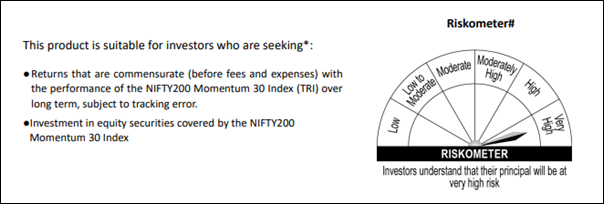
image003

*Investors should consult their financial advisers, if in doubt about whether the product is suitable for them.

# The product labeling assigned during the NFO is based on internal assessment of the scheme characteristics or model portfolio and the same may vary post NFO when the actual investments are made.

SBIFM Pvt. Ltd publishes Integrated Annual Report for FY 2019 – 20

SBI Funds Management Pvt. Ltd. (SBIFM), the leader in the Mutual Fund Industry with assets of Rs 4.21 lakh crores (as on Sept 2020) announced the publication of its Integrated Annual Report for the financial year 2020. The report offers its stakeholders a concise view of how the company’s business, strategy, governance, performance and prospects enabled it to create value for its stakeholders in 2019-20.

SBI Funds Management Pvt Ltd is the first AMC in India to have launched its Integrated Annual Report for the 2nd year in succession. The report has been developed in accordance with the principles of the International Framework of the International Integrated Reporting Council (IIRC) and remains true to its principles of Integrated Thinking.

The report themed on “Building a progressive and sustainable world” explores SBIFM’s continued commitment towards UN’s Sustainable Development Goals, progress across eight capitals and demonstrates its responsibility towards its investors. The report also includes SBIFM’s financial and non-financial performances across a range of areas and provides key insights into its corporate governance, material topics, the principle of responsible investing and value creation process among other sections.

Releasing the report, Mr. Vinay Tonse – MD & CEO of SBIFM said “The 2020 edition while keeping the basic tenets of last year’s report, includes newer elements which highlight our Company’s deep resolve to adhere by the UN’s Sustainable Development Goals (SDGs) – which hold more significance today than ever before – while creating value for our customers and investors”

Mr. Navneet Munot – Chief Investment Officer of SBIFM said “This year through our Integrated Report we are commemorating the 75th anniversary of the United Nations and the 5th anniversary of the adoption of Sustainable Development Goals (SDGs). This year’s report also includes aspects on how we as a company adopted Responsible Investing and how our value creation process highlights the impact of our business on SDGs”

The detailed Statutory Statements and Financial Reports are also part of this document and are in line with the requirements of the Companies Act, 2013 and the rules made thereunder, Indian Accounting Standards and applicable Secretarial Standards.

The complete Integrated Report for FY 2019 – 20 is available at https://www.sbimf.com/en-us/integratedreport/fy20.pdf

Views on RBI monetary policy – Mr Navneet Munot, CIO, SBI Mutual Fund

’The RBI left the rates unchanged and yet delivered an extremely dovish monetary policy by taking measures to keep the risk free rate low and providing on-tap liquidity. Looking through the transient inflationary hump and supporting growth was a clear message sent out in today’s policy. Overall, the forward guidance was extremely favourable as there was an explicit message to keep policy accommodative at least until FY 2022.

The new external MPC members appear to be more dovish in their policy views. In past, they have been quite vocal on liquidity, credit market dynamics, and have advocated for the RBI to look at unconventional or untested measures. The minutes of the meeting, which will be released a fortnight later, will be an important document to watch to gauge their views now (within the mandate of inflation targeting framework).

The RBI finally came out with its expectations on growth for FY21, which is only a tad short of double-digit contraction (-9.5% for FY21).

Ever since the pandemic, RBI had been advocating to do whatever it takes to support the economy and financial sector. Various regulatory relaxations announced since COVID onset had been novel, not tested through time and yet very appropriate and timely. On-tap TLTRO, the introduction of round-the-clock RTGS facility, co-origination of priority sector loans between banks and NBFC/HFCs, and measures to boost export and housing loans announced today are very encouraging.

The RBI has expressed its discomfort on any up-move in yields. Devolvement of primary auctions to PDs on select occasions and cancellation of an OMO is a testament to that. Today, the RBI raised the quantum of OMO purchase, gave explicit guidance for OMO and for the first time, stated plans to conduct OMOs for SDL as well, thereby nudging market from all sides to invest in bonds. We commend RBI’s ‘Open Mouth Operations’ matched with ‘Open Market Operations’. Given the constrained fiscal situation, the government had mostly focused on reforms, while RBI has done the heavy lifting to lend liquidity in the economy.

Over the last few months, the central bank had been juggling through multiple objectives- of keeping the inflation low, managing rupee and bond yields – all of which almost impossible to achieve simultaneously. With inflation shooting past RBI’s comfort zone, it was understandably reluctant to inject more liquidity. On top of that, high Balance of Payments (BoP) situation has already lent considerable rupee liquidity in the system. So the central bank has shied away from an explicit purchase of government papers, which raised the market’s concern amidst increased fiscal deficit. The lack of RBI buying in Q2 led to the 10 years G-sec remaining sticky around 6% since June.

Something eventually had to give- either rupee appreciates or bond yield sell-off or liquidity injected to prevent these outcomes despite high inflation. Eventually, it appears that the central bank had sided with easing the liquidity and nudge yields down.

With India experiencing a large demand shock, and fiscal space not unconstrained, it will be important to ensure the monetary easing achieved thus far is not reversed. To that extent, the explicit OMO guidance is a welcome move. Our view has been that despite the higher G-sec supply this year, a little extra push from the RBI amidst low bank credit and higher private savings will enable the increased government borrowing to go through non-disruptively in this exceptional year. RBI’s buying will catalyze market appetite as well. In particular, banks are flushed with deposits While incremental bank credit FYTD has been a negative of Rs.1.5 trillion. Further, to the extent that the rise in inflation is supply-side driven while demand and employment stay weak and till the extent it does not become more generalised, it should not pose many challenges for RBI. In the long run, supply-side reforms should help lower inflation trajectory.

As such, we continue to remain constructive on duration. On equities, our approach continues to be bottom-up’’.

SBI Mutual Fund to launch SBI Magnum Children’s Benefit Fund – Investment Plan

Mumbai, September 7, 2020: SBI Mutual Fund announces the launch of SBI Magnum Children’s Benefit Fund – Investment Plan, an open-ended fund to enable parents to invest for their child’s dreams. The Investment Plan is a new offering as part of SBI Magnum Children’s Benefit Fund which currently has Savings Plan, a predominantly debt-oriented offering.

SBI Magnum Children’s Benefit Fund – Investment Plan will predominantly invest in Equity & Equity related instruments including Equity ETFs with a minimum of 65% going up to 100%, Debt including Debt ETFs and money market instruments up to a maximum of 35% in REITS & InvITs up to 10% and up to 20 % in Gold ETFs.

The new plan would be ideal for a child aged 1 year ideally going up to when he/she is 14 years old, thereby allowing long-term capital appreciation over the long-term. There would be a lock-in period for at least 5 years or till the child attains the age of majority, whichever is earlier. 

Mr. Vinay Tonse, MD & CEO, SBI Mutual Fund said: “Funding education of their children is the top priority for any parent. Given the dual challenges of rising cost of education and interest rates coming down significantly, there is a need to look beyond traditional investment options. SBI Magnum Children’s Benefit Fund – Investment Plan is an ideal fit given its construct of being well-diversified across asset-classes, be it equity, debt or gold.”

“Equity asset class as a long-term wealth-creator will help parents in having the right financial support to take care of their child’s future and the sooner they start the better it is,” Mr Tonse added.

Mr. Navneet Munot, Chief Investment Officer, SBI Mutual Fund said, “Our strategy would be to create a fund portfolio with a combination of high conviction ideas with a long-term orientation within a robust risk management framework. Equity portion would be market capitalisation agnostic, while Debt portion would be invested in high credit quality portfolio with a short-to-medium duration profile.”

Mr. D P Singh, Chief Business Officer, SBI Mutual Fund said: “The aspirations of children today are very different and have been shaped by the strong influence of the evolving media & technology around us. Parents must have a strong financial plan to be prepared for these aspirations. I believe, children-oriented mutual funds are a compelling solution for parents to save for their children’s future as it helps create a separate ‘bucket’ in which they invest only for their child. Such a segregation in their investment can alert them to not dip into and withdraw from this corpus for an impulsive or short-term need. The fund is an ideal fit given its construct of being well-diversified across asset-classes, be it equity, debt or gold.”

‘’The SIP route works well for all long-term goals and in this fund particularly for young parents who can start planning early for their child’s dreams. Starting a SIP and regularly doing a top-up of their SIP amount every year can make funding for their children’s education easier.” Mr. Singh added. 

The NFO period of SBI Magnum Children’s Benefit Fund – Investment Plan opens on Tuesday, 8th September 2020 and will close on Tuesday, 22nd September 2020. The fund managers of the Investment Plan will be Mr. R. Srinivasan for Equity Portion and Mr. Dinesh Ahuja for Debt Portion.