Tag: Global biopharmaceutical company

AbbVie Bengaluru Staff Volunteer to Empower Young Students in Annual Event

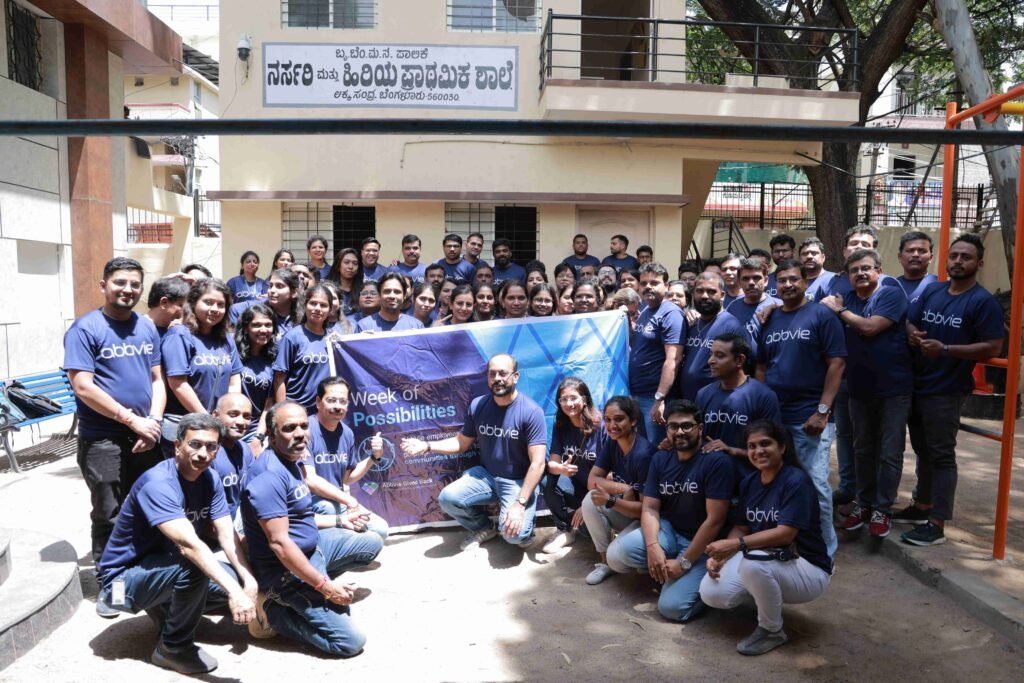
Bengaluru, July 1st, 2024 – AbbVie, a global biopharmaceutical company focused on creating medicines and solutions announced the ninth annual ‘Week of Possibilities.’ It is a global volunteering program that unites employees with a shared mission: to give back to local communities. From 10th June 2024, thousands of AbbVie employees across 50 countries and territories collaborated with trusted nonprofit and community partners to complete hands-on projects that benefit local communities and impact tens of thousands of people worldwide. This year, the highly anticipated ‘Week of Possibilities’ event will unfold across the vibrant cities of Mumbai, Chennai, New Delhi, and Bengaluru.
1719575738241

“We at AbbVie are committed to supporting our local community in Bengaluru through volunteering. We are excited to collaborate with iVolunteer that helped us reach Maulana Abul Kalam Azad Urdu School in Bengaluru,” said Suresh Pattathil, Managing Director & General Manager AbbVie India. “During our ‘Week of Possibilities,’ one of our most anticipated annual volunteer initiatives, thousands of AbbVie employees globally come together to serve their local communities.”

In Bengaluru, volunteers experienced the joy of spending time and making a day of a group of government school students’ fun-filled and fruitful. The activity was divided into two sessions. In the first half, a session on ‘problems due to fast fashion and textile waste’ was by an iVolunteer representative for the volunteers. Then a training on how to upcycle a T-shirt into a simple cloth tote bag. In the second half, the Volunteers were paired with 1 or 2 students and conducted a session to train them on upcycling a T-shirt into a simple cloth bag. The bags were then donated to students at the school.

Speaking at the event, Natasha Tiwary, Director, Human Resources, AbbVie India said, “The AbbVie Foundation believes that the initiative unites employees globally to make a tangible difference in local communities through various volunteer activities. This annual event aligns with AbbVie’s commitment to philanthropy, focusing on strengthening educational programs and creating a positive environmental impact. By listening and learning from our partners, we empower them to develop innovative solutions that address critical inequities and advance health equity in their communities.”

Each ‘Week of Possibilities’ location selects service projects that align with the greatest needs of the local community.

Since its inception in 2014, AbbVie’s Week of Possibilities has become a cherished global tradition. Funded in part by the AbbVie Foundation, the initiative focuses on service projects in the local communities where AbbVie employees live and work.

China CDE Approves Global Phase III Study of Olverembatinib for SDH-Deficient GIST

SUZHOU, China, and ROCKVILLE, Md., June 11, 2024 — Ascentage Pharma (6855.HK), a global biopharmaceutical company engaged in developing novel therapies for cancer, chronic hepatitis B (CHB), and age-related diseases, announced today that the Center for Drug Evaluation (CDE) of China’s National Medical Product Administration (NMPA) has approved a global registrational Phase III study of the company’s novel drug candidate olverembatinib (HQP1351), in patients with succinate dehydrogenase (SDH)-deficient gastrointestinal stromal tumor (GIST) who had failed prior systemic treatment. This approval marks a major milestone in Ascentage Pharma’s clinical development in solid tumors.

Ascentage Pharma Logo

This global, multicenter, single-arm, open-label, pivotal registrational Phase III study is designed to evaluate the efficacy and safety of olverembatinib in patients with SDH-deficient GIST. The CDE has agreed that results from the study can be used to support a future New Drug Application (NDA) for olverembatinib in SDH-GIST.

GIST is the most common type of soft tissue sarcoma that arises in the gastrointestinal track, with a global incidence of 1-1.5/100,000 per year.1 KIT and PDGFRA are key genetic drivers of GIST, and 85% – 90% of all patients with GIST harbor KIT or PDGFRA mutations. The introduction of tyrosine kinase inhibitors (TKIs) has improved the prognosis of patients with this subset of GIST. However, 85% of pediatric patients and 10%-15% of adult patients with GIST do not harbor KIT or PDGFRA mutations, thus belong to a subtype dubbed wild-type GIST. Depending on whether the SDH expression is lost in the patient, wide-type GIST can be further categorized into SDH-deficient and non-SDH-deficient GISTs.2-3 .

SDH-deficient GIST has unique clinical and pathological characteristics. According to existing literatures, SDH-deficient GIST has a median age of diagnosis of 21 years and is more common in women. SDH-deficient GIST, primarily arises in the gastric area with a high propensity to metastasize, is characterized in immunohistochemistry essays by the loss of SDHB protein expression. Patients with early-stage localized SDH-deficient GIST can be treated with surgeries, although most patients eventually relapse. At present, there is no standard treatment option for relapsed and advanced SDH-deficient GISTs. Imatinib is generally considered ineffective for the condition and other TKIs have also failed to demonstrate satisfactory efficacy2-5, offering a five-year event-free survival (EFS) rate of just 24%.4 Being commonly diagnosed at young ages, patients with SDH-deficient GIST endure significant impact on their quality of life and survival, therefore have urgent unmet medical needs for new treatment options.

Olverembatinib is an orally-available novel third-generation TKI developed by Ascentage Pharma. The drug has been granted a Breakthrough Therapy Designation by the China CDE for the treatment of patients with SDH-deficient GIST who had received first-line treatment. As a multi-targeted TKI, olverembatinib has shown excellent efficacy and manageable safety in patients with SDH-deficient GIST. Since 2022, the clinical study evaluating olverembatinib in SDH-deficient GIST has been selected for presentations at the American Society of Clinical Oncology (ASCO) Annual Meeting for three consecutive years, including an oral report at the 60th ASCO Annual Meeting just took place this month. According to the latest results, olverembatinib has achieved a clinical benefit rate (CBR) of 92.3% in patients with SDH-deficient GIST.

Olverembatinib is the first China-approved third-generation BCR-ABL inhibitor. To date, the drug has been approved for two indications in China, including adult patients with TKI-resistant chronic-phase chronic myeloid leukemia (CML-CP) or accelerated-phase CML (CML-AP) harboring the T315I mutation; and adult patients with CML-CP resistant to and/or intolerant of first-and second-generation TKIs. Olverembatinib is jointly commercialized in China by Ascentage Pharma and Innovent Biologics.

“In earlier studies, olverembatinib has already shown encouraging efficacy and favorable safety in patients with SDH-deficient GIST,” said Dr. Yifan Zhai, Chief Medical Officer of Ascentage Pharma. “We are excited by the approval for this global registrational Phase III study because it could potentially lead to a clinical breakthrough for another indication that currently lacks approved treatment options while marking a major milestone for Ascentage Pharma’s clinical development in solid tumors. Remaining steadfastly committed to the mission of addressing unmet clinical needs in China and around the world, we will expeditiously advance this clinical development program for the benefit of more patients.”