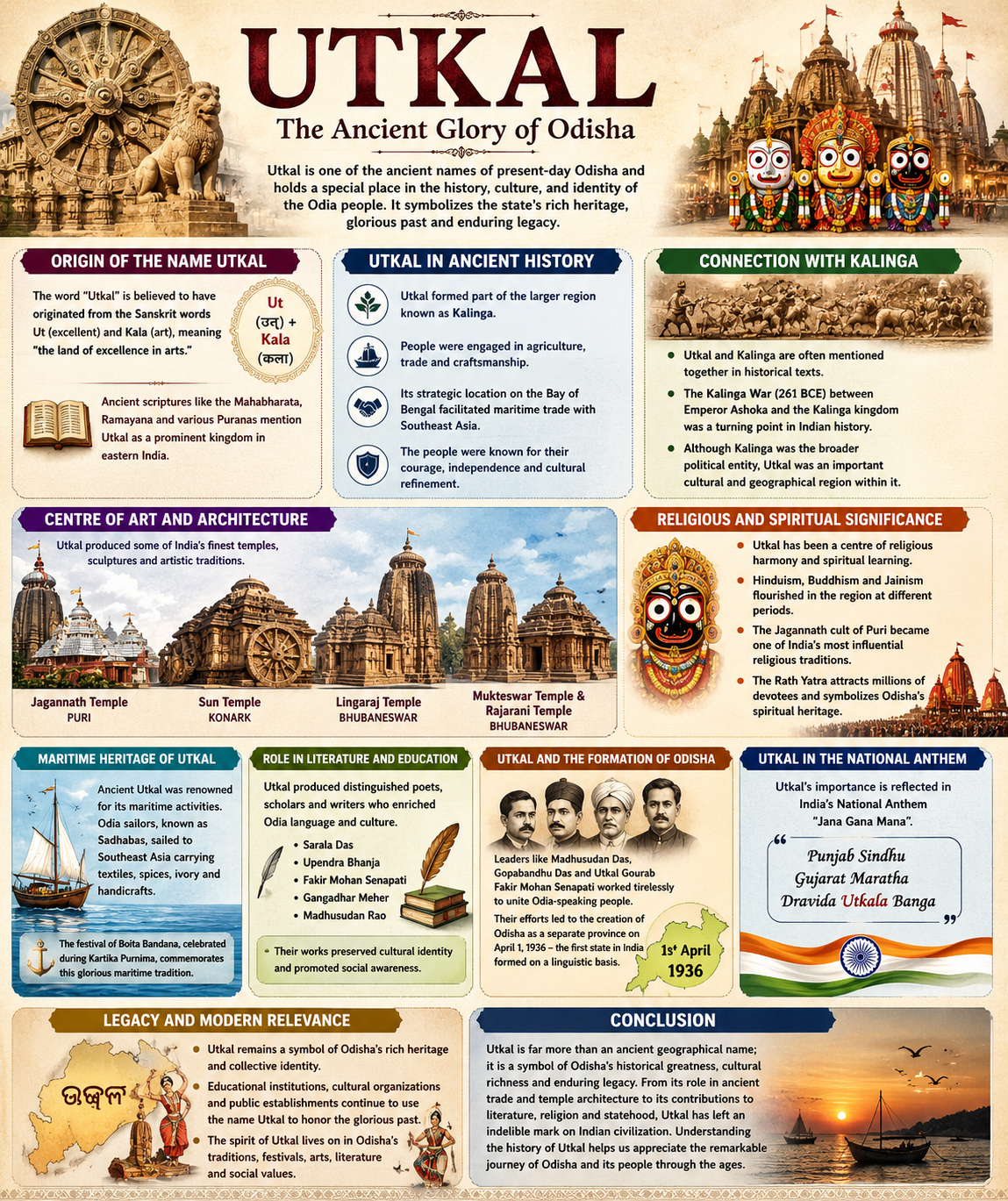
Utkal is one of the ancient names of present-day Odisha and holds a special place in the history, culture, and identity of the Odia people. The name “Utkal” appears in several ancient texts, inscriptions, and literary works, reflecting the region’s rich heritage and glorious past. For centuries, Utkal was known as a land of art, architecture, learning, spirituality, and maritime trade. Even today, the term evokes pride among Odias and symbolizes the state’s cultural and historical legacy.
Origin of the Name Utkal
The word “Utkal” is believed to have originated from the Sanskrit words Ut (excellent) and Kala (art), meaning “the land of excellence in arts.” This interpretation highlights the region’s long-standing tradition of artistic and cultural achievements. Ancient scriptures such as the Mahabharata, Ramayana, and various Puranas mention Utkal as a prominent kingdom in eastern India.
Utkal in Ancient History
Historically, Utkal formed part of the larger region known as Kalinga. The area was inhabited by prosperous communities engaged in agriculture, trade, and craftsmanship. Utkal gained prominence due to its strategic location along the Bay of Bengal, which facilitated maritime trade with Southeast Asian countries such as Java, Sumatra, Bali, and Sri Lanka.
The people of Utkal were known for their courage, independence, and cultural refinement. Ancient records indicate that the kingdom maintained political and economic relations with several neighboring regions and kingdoms.
Connection with Kalinga
Utkal and Kalinga are often mentioned together in historical texts. The Kalinga War fought in 261 BCE between Emperor Ashoka and the Kalinga kingdom remains one of the most significant events in Indian history. The immense destruction caused by the war led Ashoka to embrace Buddhism and adopt a policy of non-violence.
Although Kalinga was the broader political entity, Utkal represented an important cultural and geographical region within it. The legacy of Kalinga and Utkal continues to shape Odisha’s historical identity.
Centre of Art and Architecture
One of the greatest contributions of Utkal to Indian civilization is its remarkable art and architecture. The region produced some of India’s finest temples, sculptures, and artistic traditions.
Notable monuments include:
-
The Jagannath Temple at Puri
-
The Sun Temple at Konark
-
The Lingaraj Temple at Bhubaneswar
-
Mukteswar Temple and Rajarani Temple
These architectural masterpieces demonstrate the advanced engineering skills and artistic excellence of the people of Utkal.
Religious and Spiritual Significance
Utkal has long been a center of religious harmony and spiritual learning. Hinduism, Buddhism, and Jainism flourished in the region at different periods of history. The Jagannath cult, centered in Puri, became one of India’s most influential religious traditions.
The annual Rath Yatra of Lord Jagannath attracts millions of devotees from across the world and serves as a symbol of Odisha’s spiritual heritage.
Maritime Heritage of Utkal
Ancient Utkal was renowned for its maritime activities. Odia sailors, known as Sadhabas, undertook voyages across the seas for trade and cultural exchange. They sailed to Southeast Asian countries carrying textiles, spices, ivory, and handicrafts.
The famous festival of Boita Bandana, celebrated during Kartika Purnima, commemorates this glorious maritime tradition. It reminds people of Utkal’s historical role as a major center of international trade.
Role in Literature and Education
Utkal has made immense contributions to literature and learning. The region produced distinguished poets, scholars, and writers who enriched Odia language and culture.
Prominent literary figures include:
-
Sarala Das
-
Upendra Bhanja
-
Fakir Mohan Senapati
-
Gangadhar Meher
-
Madhusudan Rao
Their works helped preserve the cultural identity of Odisha and promoted social awareness among the people.
Utkal and the Formation of Odisha
The name Utkal played a significant role during the movement for the unification of Odia-speaking regions. During British rule, Odia-speaking areas were divided among different provinces, leading to administrative and cultural challenges.
Visionary leaders such as Madhusudan Das, Gopabandhu Das, and Utkal Gourab Fakir Mohan Senapati worked tirelessly to unite Odia-speaking people. Their efforts culminated in the creation of Odisha as a separate province on April 1, 1936, making it the first state in India formed on a linguistic basis.
Utkal in the National Anthem
The importance of Utkal is reflected in India’s National Anthem, “Jana Gana Mana,” written by Rabindranath Tagore. The anthem includes the phrase:
“Punjab Sindhu Gujarat Maratha, Dravida Utkala Banga”
This mention highlights Utkal’s historical significance and its contribution to India’s cultural diversity.
Legacy and Modern Relevance
Today, Utkal remains a symbol of Odisha’s rich heritage and collective identity. Educational institutions, cultural organizations, and public establishments continue to use the name Utkal to honor the state’s glorious past.
The spirit of Utkal is reflected in Odisha’s traditions, festivals, arts, literature, and social values. Preserving this heritage is essential for future generations to understand and appreciate their roots.
Conclusion
Utkal is far more than an ancient geographical name; it is a symbol of Odisha’s historical greatness, cultural richness, and enduring legacy. From its role in ancient trade and temple architecture to its contributions to literature, religion, and statehood, Utkal has left an indelible mark on Indian civilization. Understanding the history of Utkal helps us appreciate the remarkable journey of Odisha and its people through the ages.