The Future of Low Back Pain Management: Beyond Surgery
A Shift towards Active Recovery
Treating More Than Just the Spine
Technology Driving Better Care


Bhubaneswar, Nov 21 (UDN): In an era dominated by Instagram reels, YouTube videos and on-demand streaming, television may appear to be losing its place in the daily lives of younger audiences. Yet, even among Generation Z and children who have grown up with smartphones, the traditional television screen continues to retain its appeal.

Representational Image
From cartoons and films to live sports, news and cultural programmes, television offers an experience that short-form digital content cannot entirely replicate. Its ability to bring families together, deliver detailed information and create shared viewing moments continues to give the medium a distinct place in the digital age.
As the world observes World Television Day on November 21, the occasion offers an opportunity to reflect on how television has evolved and why it remains relevant despite the rapid growth of digital platforms.
Television has undergone a remarkable transformation since its early days of black-and-white broadcasts. High-definition screens, smart TVs, digital channels and internet-based services have changed both the way programmes are delivered and how audiences consume them.
The United Nations General Assembly proclaimed November 21 as World Television Day in 1996, marking the significance of the first World Television Forum held on November 21 and 22 that year.
The observance recognises television’s influence on public opinion, communication and awareness of important social, political and global issues.
Over the decades, television has moved beyond entertainment to become an important source of information, education and public engagement.
Younger audiences increasingly turn to smartphones and social media for quick updates, entertainment and information. Short videos and streaming platforms offer convenience and personalised content, making them an integral part of modern media consumption.
However, television provides a different kind of viewing experience. News bulletins, documentaries, debates and special reports can offer greater context and sustained coverage of events, while live broadcasts allow viewers to follow major developments as they unfold.
Television also continues to connect generations. Families often share the experience of watching films, sporting events, serials and special programmes, creating moments that go beyond individual screen time.
For many children, cartoons and movies on television remain a familiar source of entertainment even as mobile devices become increasingly accessible.
Akshita, a Class IV student from Bhubaneswar, said she enjoys watching cartoons and films on television during her leisure time despite being familiar with smartphones and social media.
Her preference reflects how traditional television can continue to appeal to young viewers alongside newer digital platforms.
The growing popularity of social media has made information more accessible, but it has also increased concerns about misinformation, misleading clips and unverified viral claims.
In this environment, responsible television journalism and credible broadcasting continue to have an important role. Professional news coverage, fact-based reporting and in-depth discussions can help audiences understand developments beyond the headlines and short clips circulating online.
Television also remains a platform for public awareness campaigns, educational programming and stories that bring social issues into the public conversation.
The rise of OTT platforms and mobile-first entertainment has changed television’s traditional dominance, but it has also pushed broadcasters to adapt. Many television networks now offer digital streaming, mobile applications and online content, allowing audiences to access programmes across multiple screens.
Rather than disappearing, television is becoming part of a wider media ecosystem in which traditional broadcasting and digital platforms increasingly coexist.
On World Television Day, the message is not simply about preserving an old medium. It is about recognising television’s continuing ability to inform, educate, entertain and connect people across generations.
The screen may have changed, and the way audiences watch may be different, but television’s place in the media landscape is far from over.
New Delhi, Nov 21: Concerns over alleged high-tech gold adulteration have triggered alarm among jewellery traders ahead of the peak wedding season, with the Chamber of Trade and Industry (CTI) calling for stricter testing standards, tougher penalties and greater transparency in the gold supply chain.

Representational Image
The traders’ body has warned that sophisticated methods of mixing other metals with gold could undermine consumer confidence, damage the reputation of genuine jewellers and disrupt a crucial period for the jewellery business.
The concern comes as the wedding season gets underway with Tulsi Vivah. Around 5.2 million weddings are expected across India, generating an estimated business of ₹6 lakh crore, according to figures cited by the CTI. Delhi-NCR alone is projected to account for nearly five lakh weddings and business worth around ₹1 lakh crore.
CTI Chairman Brijesh Goyal said reports of suspected adulteration had caused anxiety across the jewellery trade, with hundreds of traders approaching the organisation over the issue.
According to Goyal, reports suggest that metals such as ruthenium, iridium and osmium are allegedly being mixed with gold to increase the weight of jewellery while making conventional testing more difficult.
These metals have densities comparable to or higher than gold, potentially allowing adulterated pieces to evade detection by certain testing methods, he said.
Goyal cited reported experiments in which jewellery sold as 22-carat gold was found to contain only 81.73 per cent pure gold, equivalent to approximately 20 carats. Genuine 22-carat gold is expected to contain at least 91.6 per cent gold.
The possibility that such jewellery could pass hallmarking-related checks has raised questions about the effectiveness of existing testing arrangements, the CTI said.
The allegations have not been independently established in the information provided by the organisation. However, the traders’ body wants authorities to investigate the suspected practices and strengthen safeguards for buyers.
The organisation has placed four key demands before the government and regulators.
It has called for restrictions on imports of suspicious metal powders from China, including rhenium powder, and sought public disclosure of the importers involved.
The CTI has also demanded cancellation of the licences of jewellers found guilty of adulteration, along with publication of their names on the Bureau of Indian Standards (BIS) website.
Another proposal involves upgrading the BIS Care App to give buyers more detailed information about jewellery composition. The organisation wants consumers to be able to access the actual gold content and details of other metals present, rather than relying only on the stated carat category.
The fourth demand is for the government to issue a white paper within seven days, detailing the volume of rhenium imported, the number of centres where adulteration has been detected and the number of jewellers prosecuted in connection with such cases.
Alongside its demands for regulatory intervention, the CTI has issued an advisory asking jewellery businesses to strengthen their own quality checks.
Traders have been urged to get their gold stock retested at authorised laboratories and display the resulting reports prominently. The organisation has also recommended issuing a purity card with every jewellery purchase, specifying the gold content and the presence of other metals.
It has called on jewellers to upgrade older X-ray fluorescence (XRF) testing equipment and adopt more advanced technology capable of identifying suspected adulterants, including rhenium.
The CTI has further encouraged traders to share information about suppliers allegedly involved in selling adulterated gold, promising to protect the identities of those who provide such information.
“One dishonest jeweller defames 100 honest jewellers,” Goyal said, stressing the potential damage to the industry’s reputation.
For consumers, the CTI has advised greater caution while purchasing gold, particularly during the wedding rush.
Buyers have been asked to verify the Hallmark Unique Identification (HUID) number through the BIS Care App and insist on a valid GST invoice for every purchase. The organisation has also cautioned against relying exclusively on a hallmark without taking other precautions.
It has urged consumers to be wary of offers priced ₹3,000–₹5,000 below the prevailing market rate, saying unusually steep discounts could warrant closer scrutiny.
The CTI has also recommended that consumers get the purity of old jewellery checked before selling or exchanging it. Those who suspect adulteration can approach the CTI or BIS with complaints, the organisation said, assuring that complainants’ identities would be kept confidential.
With wedding-related spending expected to generate substantial business, the issue has put the spotlight on the need for reliable testing, transparent disclosure and effective enforcement to protect both consumers and legitimate jewellery businesses.
Mumbai, Nov 21: Indian equity markets continued their upward march for the fourth straight week, with strong foreign institutional buying and a sharp rally in banking shares helping benchmark indices withstand heavy selling pressure in global technology stocks.

Representational Image
The Nifty 50 rose 2.61 per cent over the week, closing at 25,800 after gaining 1.12 per cent in the final trading session. The BSE Sensex advanced 897 points, or 1.08 per cent, on the day to settle at 81,592, taking its weekly gain to 2.85 per cent.
Banking stocks emerged as the biggest contributors to the market rally. The Bank Nifty climbed 5.6 per cent during the week to touch fresh record highs, supported by gains in both public sector banks and private lenders.
Auto, consumer durables, financial services and realty stocks also attracted buying interest. Information technology shares, however, remained volatile amid concerns over elevated valuations of artificial intelligence-linked companies and a broader sell-off in global technology stocks.
Foreign institutional investors (FIIs) provided a significant boost to Indian equities, recording cumulative net inflows of nearly ₹1,11,950 crore so far in November. Domestic institutional investors (DIIs), meanwhile, registered net outflows of around ₹61,787 crore over the same period.
Market participants attributed the domestic market’s resilience to sustained overseas investment, softer crude oil prices and improving currency conditions, even as Wall Street and Asian markets faced selling pressure.
Investors also appeared to shift funds away from crowded global AI-related trades towards Indian equities, although the broader market rally remained uneven.
The Nifty Midcap 100 edged up just 0.23 per cent during the week, while the Nifty Smallcap 100 declined 1.09 per cent. The divergence suggests that buying interest remained concentrated in frontline stocks rather than spreading uniformly across the market.
The moderation in crude oil prices to around $81–84 a barrel provided some relief to India, which relies heavily on imported energy. Lower oil prices can help ease the country’s import bill and reduce pressure on domestic inflation.
However, the latest inflation figures have emerged as a concern for investors and policymakers. India’s consumer price index (CPI) inflation rose to 6.09 per cent in October, moving above the Reserve Bank of India’s upper tolerance threshold. Food inflation climbed to 8.94 per cent.
The combination of easing oil prices and elevated retail inflation leaves markets weighing the benefits of lower external cost pressures against the possibility of tighter monetary conditions.
For the Nifty 50, the immediate resistance zone is placed between 25,800 and 26,000, while support is seen in the 25,600–25,700 range.
The Bank Nifty faces near-term resistance around 65,000, with 64,000 emerging as an important support level.
Market analysts expect investors to continue favouring a buy-on-dips approach, with attention focused on companies with strong fundamentals and sectors demonstrating relative strength. They have cautioned against chasing stocks after sharp rallies, particularly as global market volatility and domestic inflation remain important risks.
The fourth consecutive week of gains highlights the relative strength of Indian equities, but the next leg of the rally may depend on whether foreign inflows remain steady and inflationary pressures begin to ease.
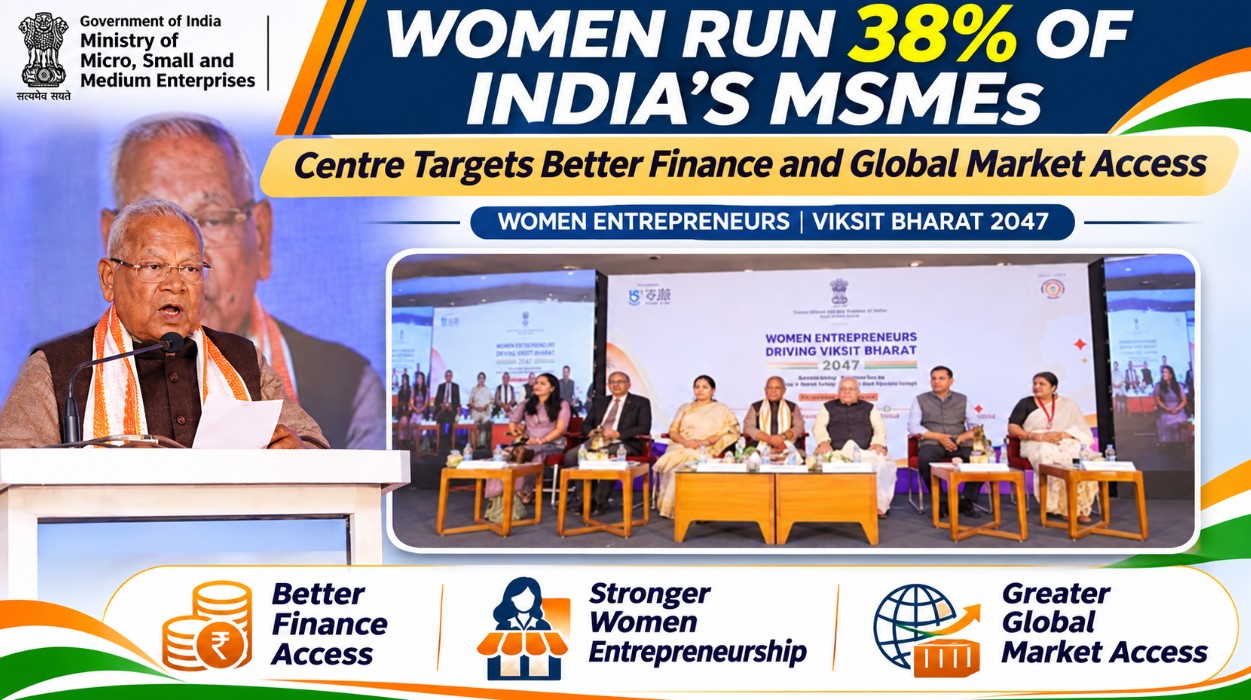
New Delhi, Nov 21: Women entrepreneurs account for nearly 38% of India’s registered MSME ecosystem, highlighting their growing role in the country’s economic development. The government is now looking to build on this momentum by improving access to finance, technology, markets and international business opportunities for women-led enterprises.

The focus was at the centre of the Women Entrepreneurship Day 2026 celebrations organised by the Ministry of Micro, Small and Medium Enterprises in partnership with the India SME Forum in New Delhi on November 19.
The conference brought together policymakers, financial institutions, industry representatives, development organisations and women business owners to discuss ways to help women move from starting small enterprises to building competitive and scalable businesses.
The discussions were structured around four priorities — Enable, Accelerate, Digitise and Globalise — reflecting the need to strengthen support for women at every stage of entrepreneurship.
Union MSME Minister Jitan Ram Manjhi, who attended as the chief guest, highlighted the contribution of women to families, communities and the wider economy.
He said nearly 38% of MSMEs were women-led and emphasised the importance of government schemes, international partnerships and policy reforms in expanding opportunities for women entrepreneurs.
Manjhi also referred to amendments to the MSME Development Act, 2026, and the role of the Trade Receivables Discounting System (TReDS) in improving payment access and addressing delays in payments to small businesses.
Secretary of the MSME Ministry Bharat Khera said women-owned enterprises account for approximately 38% of the more than 10 crore enterprises registered with the Ministry. He stressed that the next stage of development must go beyond formal registration and help women-led businesses become stronger market players.
He called for better access to global markets, equity investment and wider integration into domestic and international value chains.
Minister of State for MSME and Labour and Employment Shobha Karandlaje said financial independence was essential for women to emerge as leaders in business and society.
She pointed to the growing financial credibility of women entrepreneurs and said the Reserve Bank of India’s recognition of women-led self-help groups as reliable borrowers reflected increasing confidence in their financial capabilities.
Karandlaje also highlighted the contribution of government programmes, stating that the Prime Minister’s Employment Generation Programme (PMEGP) had supported the creation of more than 25 lakh jobs for women.
She further noted that public procurement from women-owned micro and small enterprises had crossed the mandatory 3% target, indicating growing participation in government purchasing.
Kalraj Mishra, former Governor of Rajasthan and Himachal Pradesh and Chief Patron of the India SME Forum, called for transforming women from job seekers into job creators.
Referring to initiatives such as Lakhpati Didi, he emphasised the need to connect grassroots skills and local production capabilities with larger markets. Digitalisation, access to growth capital and institutional support, he said, could help women-led businesses become part of global value chains.
Additional Secretary and Development Commissioner of the MSME Ministry, Dr Rajneesh, described women entrepreneurs as an important contributor to India’s economic growth. He said rising female labour force participation, improved access to credit and opportunities emerging from India’s free trade agreements were creating new possibilities for women-led enterprises.
The conference featured four technical sessions designed to address the challenges faced by women entrepreneurs at different stages of business development.
Enable – From Aspiration to Enterprise: Focused on helping aspiring women entrepreneurs establish businesses through better access to support systems and institutional resources.
Accelerate – From Survival to Scale: Examined ways to help existing enterprises expand operations, improve competitiveness and achieve sustainable growth.
Digitise – Empowering Women through Digitalisation: Explored how digital tools and technology can improve business efficiency and widen market access.
Globalise – From Local to Global: Discussed ways to connect women-led enterprises with international trade opportunities and global supply chains.
Representatives from several government departments and institutions, including the Ministries of Rural Development and Electronics and Information Technology, Government e-Marketplace (GeM) and SIDBI, participated in the discussions.
State Rural Livelihood Missions from Andhra Pradesh, Bihar and Jammu and Kashmir were also represented, alongside organisations such as UN Women, the Gates Foundation, Digital Empowerment Foundation and Vedanta’s CSR arm.
The discussions highlighted a broader shift in India’s approach to women’s entrepreneurship. While access to registration, training and initial financial support remains important, the next challenge is to help women-owned businesses expand, compete and secure a stronger position in the marketplace.
The Ministry of MSME said it would continue working to improve women’s access to finance, skills, technology, procurement opportunities and international markets.
With women already accounting for a significant share of registered MSMEs, strengthening their ability to scale up could have wider implications for employment generation, economic participation and India’s ambition of becoming a developed nation by 2047.
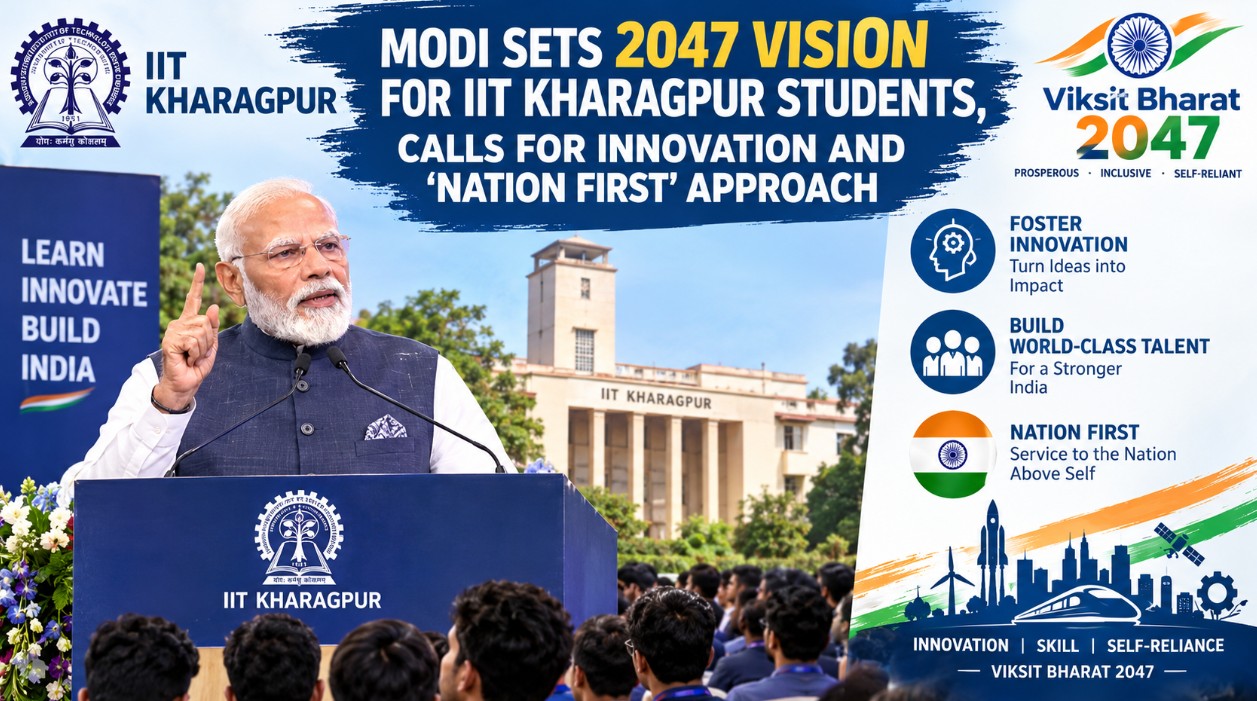
Kharagpur, Nov 21: Prime Minister Narendra Modi on Saturday urged students and alumni of IIT Kharagpur to challenge conventional thinking, pursue ambitious goals and contribute to India’s transformation into a developed nation by 2047.
Representational Image
Addressing the institute’s Platinum Jubilee celebrations, Modi said the country’s progress depended on its ability to overcome self-imposed limitations and turn seemingly impossible goals into achievable realities.
He described IIT Kharagpur’s 75-year journey as closely connected with India’s own development, pointing out that the country’s first Indian Institute of Technology had contributed to nation-building through successive phases of industrialisation, scientific research, space technology and the information technology revolution.
The Prime Minister also called on the institute’s students and alumni to use their knowledge and innovation to address major national challenges, saying their professional achievements should contribute to the larger goal of building a developed India.
Recalling the history of the institution, Modi highlighted the significance of its location, which once housed a detention camp for freedom fighters during the British rule.
He said the same land that had witnessed the struggle for self-rule was now nurturing young minds working towards India’s self-reliance.
“Then, the dream was freedom; today, the opportunity is to build the future,” was the central message of his remarks on the institution’s historical transformation.
The Prime Minister said the aspirations of freedom fighters had helped shape the country’s journey, while the ideas and innovations of present-day students could strengthen India’s ambition of becoming self-reliant.
He also congratulated the faculty, staff, students and alumni for the institute’s contribution over the past 75 years.
Modi recalled that IIT Kharagpur began its journey shortly after Independence, when India urgently needed engineers to build its industries and infrastructure.
As the country expanded its scientific capabilities, graduates from the institution contributed to areas such as space research and atomic energy. Later, during the rise of information technology and the expansion of the global economy, its alumni played an important role in strengthening India’s software industry and taking leadership positions in major global companies.
He said the institution must now prepare to play an equally significant role in the next phase of India’s development, particularly as the country focuses on innovation, advanced manufacturing and emerging technologies.
A major theme of the Prime Minister’s address was the need to overcome what he described as “limiting beliefs” — the tendency to restrict ambitions by assuming that certain goals are beyond reach.
He said individuals and nations often limit their potential by deciding in advance what is possible and what is not.
Citing poverty reduction as an example, Modi said India had moved beyond the belief that poverty was an unavoidable and permanent challenge.
He referred to government initiatives aimed at improving access to sanitation and essential services, saying the focus had shifted towards empowering people and improving their quality of life.
The Prime Minister also cited a recent World Bank report, which he said showed that around 50 crore people in India had moved out of poverty over a period of 12-13 years. The figure was presented as an example of what could be achieved through a change in policy priorities and national ambition.
Modi also highlighted the country’s efforts to build a domestic semiconductor ecosystem, recalling that the decision to launch the semiconductor mission had initially faced questions over India’s ability to compete in an industry dominated by established global players.
He referred to an earlier attempt by a foreign company to set up semiconductor manufacturing operations in India decades ago, which did not materialise.
The Prime Minister said India could not continue to remain on the sidelines simply because other countries had entered the sector earlier.
He pointed to the development of semiconductor facilities in recent years and India’s entry into chip exports as signs of progress.
Encouraging IIT Kharagpur students to take advantage of the emerging opportunities, he said the country’s ambitions extended across the entire manufacturing and technology ecosystem — from chips to ships.
The Prime Minister cited the opening up of India’s space sector to private participation as another example of breaking conventional barriers.
He said young innovators outside the traditional space establishment had earlier faced limited opportunities to participate in the country’s space programme. Policy changes, he added, had created greater scope for private companies and start-ups to contribute to space technology and launch services.
Highlighting the contribution of IIT Kharagpur alumni, Modi referred to Pawan Kumar Chandana, co-founder of Skyroot Aerospace, whose company developed India’s first privately built rocket to reach space.
He said the growing number of space start-ups was giving fresh momentum to India’s space programme and demonstrating how young innovators could turn ambitious ideas into practical achievements.
Looking ahead, Modi said the coming two decades would be among the most productive and decisive years for the current generation of students.
By 2047, many of them would be occupying leadership positions across industries, research institutions and public life, making their contribution important to India’s development journey.
He urged students to identify the challenges facing the country and consider how their skills could help solve them.
“Nation First,” he said, should remain the guiding principle for young professionals and innovators. He added that a commitment to national priorities could also create new opportunities for individual growth.
Concluding his address, the Prime Minister set an ambitious goal for the institute: its centenary celebrations should take place in a developed India.
He recalled that freedom fighters held firm to their resolve to secure Independence while confined at the detention camp that once stood on the campus site. Drawing a parallel, he called on the present generation to commit itself to building a developed India within the next two decades.
Quoting Swami Vivekananda, Modi ended his address with the message: “Arise, awake, and stop not until the goal is reached.”
As IIT Kharagpur marks 75 years of academic and technological contributions, the Prime Minister’s message placed the institution’s next chapter within the larger national ambition of innovation, self-reliance and development by 2047.

New Delhi, Nov 21: India’s push to integrate artificial intelligence into public healthcare is gaining a multilingual dimension, with the government’s BHASHINI platform demonstrating how voice-based AI tools can help doctors document medical records faster and communicate with patients across language barriers.

At the Global Digital Health Summit (GDHS) 2026 in New Delhi, BHASHINI showcased its language technology solutions alongside three major healthcare institutions — the All India Institute of Medical Sciences (AIIMS), Jawaharlal Institute of Postgraduate Medical Education and Research (JIPMER), and the Directorate General of Medical Services (DGMS), Indian Army.
The demonstrations focused on practical applications of speech recognition, text-to-speech and translation technologies in clinical settings, including recording patient histories, preparing prescriptions, documenting hospital rounds and communicating with patients in different languages.
The two-day summit, held at Bharat Mandapam on November 20 and 21, brought together government, healthcare, industry and academic stakeholders under the theme, “Implementing Artificial Intelligence – AI in Action”.
One of the key applications demonstrated at the summit was the integration of BHASHINI’s speech technology into existing hospital information systems.
At AIIMS, New Delhi, the speech-to-text facility has been integrated with the National Informatics Centre’s eHospital prescription module. The system allows doctors to dictate prescriptions instead of entering the information manually.
According to AIIMS, the technology received positive feedback during its pilot in the Neurology and Neurosurgery departments. The institute is now expanding the application across its facilities.
JIPMER has integrated e-BHASHINI with its e-Sushrut Hospital Management Information System. The system enables doctors to use voice inputs in English and supported Indian languages to document outpatient case histories, inpatient clinical notes and discharge instructions.
The integration is intended to reduce the time healthcare professionals spend on routine documentation, allowing them to focus more on patient care.
The Directorate General of Medical Services (Army) also presented its use of BHASHINI technology through the Dhanwantri platform.
The application converts doctors’ spoken clinical notes into typed text, supporting voice-based medical documentation.
Maj Gen Sandeep Bhalla, ADGMS (IS, H and PS), said multilingual support was important for the Army’s medical system because it serves personnel, retired servicemen and their families from different linguistic and cultural backgrounds.
He said the integration of speech-to-text technology could save doctors’ time and make patients more comfortable by allowing them to communicate in languages they understand.
BHASHINI also demonstrated Shrutlekh, its speech-to-text capability, during the summit sessions. The tool supports multilingual transcription and translation, illustrating how spoken communication can be converted into text across languages.
The exhibition featured the BHASHINI mobile application, which offers translation and voice-based services, along with Data Daan, an initiative encouraging community contributions of language data to strengthen Indian-language AI systems.
Another platform, Granthika, was presented for the guided collection and digitisation of written and oral language resources.
The Digital India BHASHINI Division operates under the Digital India Corporation and the Ministry of Electronics and Information Technology.
The platform supports 36 Indian text languages, 23 Indian voice languages and 35 international languages. Its services include translation, speech recognition, speech synthesis and transliteration.
According to the division, the BHASHINI ecosystem has processed more than 11 billion inferences, with around 24 million inferences being handled daily.
CEO Amitabh Nag said language should not become an obstacle to accessing essential services, particularly healthcare. He said collaborations with AIIMS, JIPMER and the Army’s medical services demonstrate how multilingual AI can be integrated into everyday clinical workflows.
The demonstrations at GDHS 2026 highlighted the potential of indigenous language technologies to make digital healthcare more accessible and efficient. Their wider impact, however, will depend on how reliably these tools perform across languages and medical settings, and how effectively they are adopted by doctors and hospitals.
The broader objective is to ensure that linguistic diversity does not prevent patients from understanding medical advice or healthcare professionals from recording and accessing critical clinical information.
Dubai, UAE, Nov 21: FIA President Mohammed Ben Sulayem said today that a milestone agreement to bring back V8 engines to the FIA Formula One World Championship from 2030 is a major victory for the sport, its fans and the future direction of Grand Prix Racing.
The FIA announced last night that the 2030 Formula 1 Power Unit technical framework has been unanimously agreed between the global governing body for motor sport, Formula One Management (FOM), the teams and Formula 1 Power Unit manufacturers.
“This agreement marks a significant milestone in shaping the future of Formula 1,” said FIA President Ben Sulayem, who has been the driving force behind efforts to secure the return of V8 engines.
“From the outset I have been clear in my ambition to deliver a sport that is more competitive and more exciting for our fans, while remaining at the forefront of innovation and sustainability.
“The return of V8 engines represents an opportunity to reconnect with the DNA of this Championship, bringing back the sound, emotion and pure racing that is loved worldwide. Our vision is clear, lighter, simpler and more affordable cars that put driver skill at the heart of the competition.
“I want to thank all involved for their collaboration. This is an important step forward, and demonstrates what we can achieve when we work together to deliver the best possible future for our sport.”
The FIA presented F1 Power Unit regulations for introduction from 2030 with a 2.1 litre turbocharged V8 as the power unit of choice carrying over some geometrical specifics.

The overriding objective is to deliver a power unit which is a lot less complex, lighter and cheaper than the current power units.
It will feature limited hybridisation, relevant and sustainable technology with the aim of enhancing attack-oriented racing and a sound which resonates with fans.
Additionally, the plan is to marry the V8 power unit to a chassis which will also be lighter, more agile and placing greater emphasis on driver skill and close racing.
The next step is to present a definitive 2030 Regulatory Framework to the FIA World Motor Sport Council (WMSC) meeting in Shanghai next month. All regulatory changes are subject to approval by the WMSC.
FIA President Ben Sulayem, a 14-time FIA Middle East rally champion, has emphasised that his experience as a driver combined with a desire to give passionate race fans around the world what they truly want, lay behind his commitment to bring back V8 engines to the FIA Formula One World Championship.
His rallying career gave him a practical understanding of what drivers, teams and organisers need from the sport, and he says this told him that a lighter F1 car, one a driver can push to the limit, is the foundation of great racing.
The FIA President will be in attendance at the 35th edition of the Abu Dhabi Desert Challenge which brings the 2026 FIA World Rally-Raid Championship to its climax over the next six days. The spectacular event, founded by Ben Sulayem in 1991, has its ceremonial start in Al Ain tomorrow night.
New Delhi, Nov 21: India’s merchandise exports are gaining momentum across major international markets, with Africa emerging as the fastest-growing destination and exports to Asia crossing the $100-billion mark during the first six months of the 2026-27 financial year.

Representational Image
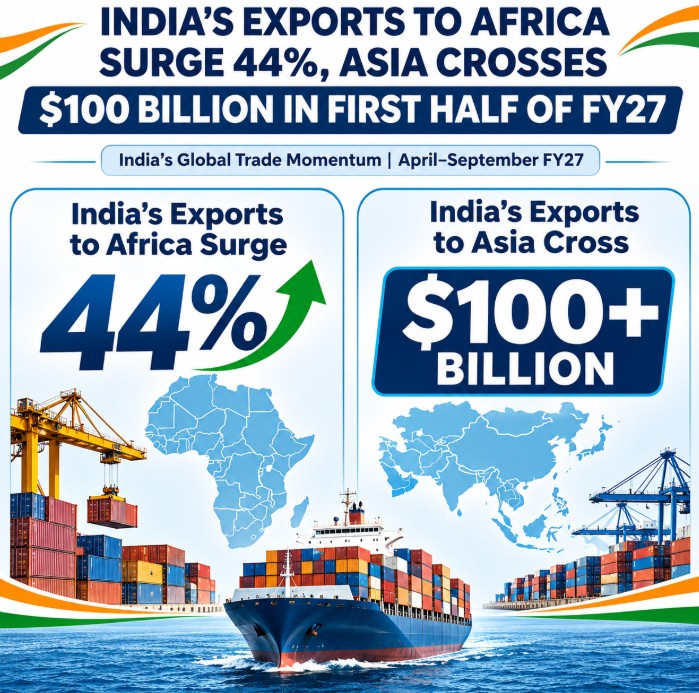
Exports to Africa jumped 44% to $31.42 billion during April-September 2026, while shipments to Asia rose 21% to $103.84 billion, according to a backgrounder released by the Ministry of Commerce and Industry.
The Americas recorded 13% growth, taking exports to $66.82 billion, while Europe registered an 8% increase to $51.04 billion. Exports to the CIS and Baltic countries grew 7% to $3.36 billion.
The figures point to an expanding geographical footprint for Indian goods, supported by demand for engineering products, electronics, petroleum products, pharmaceuticals and chemicals.
Africa recorded the strongest growth among the major regions, with exports rising from $21.87 billion to $31.42 billion.
South Africa remained India’s largest export destination in the region, accounting for $5.69 billion, up 52%. Tanzania emerged as a particularly strong market, with exports jumping 121% to $4.77 billion. Shipments to Kenya more than doubled, increasing 101% to $3.63 billion.
Exports to Egypt rose 73% to $3.25 billion, while Nigeria and Mozambique also registered positive growth.
Petroleum products were the biggest contributor to India’s exports to Africa, reaching $11.85 billion after a 137% surge. Engineering goods rose 29% to $7.48 billion, while drugs and pharmaceuticals accounted for $2.58 billion.
Asia continued to be India’s largest regional export market, with shipments climbing 21% from $85.84 billion to $103.84 billion.
China and Singapore were among the leading destinations, receiving Indian goods worth $11.39 billion and $11.07 billion, respectively. Exports to China increased 36%, while shipments to Singapore more than doubled, recording 103% growth.
Other significant markets included Bangladesh at $5.66 billion, Malaysia at $5.58 billion and Hong Kong at $5.12 billion. Malaysia registered 83% growth, while exports to Hong Kong increased 37%.
Engineering goods remained the largest export category at $27.47 billion, up 22%. Petroleum exports rose 28% to $17.05 billion, while electronic goods nearly doubled to $10.54 billion, registering 91% growth. Gems and jewellery reached $9.59 billion, while organic and inorganic chemicals stood at $6.17 billion.
India’s exports to the Americas increased 13% to $66.82 billion from $59.30 billion in the corresponding period.
The United States continued to dominate the region, accounting for $50.80 billion in Indian exports, an 11% increase. Brazil, Mexico and Canada were other important destinations, with exports reaching $4.33 billion, $3.45 billion and $2.67 billion, respectively.
Mexico recorded 26% growth, followed by Canada at 18% and Brazil at 14%.
Engineering goods and electronics were the principal export drivers. Engineering exports rose 21% to $19.19 billion, while electronic goods increased 23% to $15.35 billion. Drugs and pharmaceuticals accounted for $6.59 billion, followed by organic and inorganic chemicals at $4.17 billion.
Exports to Europe grew 8% to $51.04 billion during April-September 2026, compared with $47.06 billion a year earlier.
The United Kingdom remained India’s largest export destination in the region at $7.32 billion, followed by Germany at $6.34 billion. Exports to Germany increased 12%.
Spain and Italy also emerged as strong markets. Shipments to Spain rose 45% to $4.68 billion, while exports to Italy increased 25% to $4.55 billion. Exports to Turkey recorded an even sharper 72% rise to $3.63 billion, while France accounted for $3.73 billion.
Engineering goods led the major export categories at $15.88 billion, registering 12% growth. Electronic goods recorded a significant 52% increase to $5.44 billion. Organic and inorganic chemicals reached $4.06 billion, while drugs and pharmaceuticals stood at $3.29 billion.
India’s exports to the CIS and Baltic region increased 7% to $3.36 billion from $3.14 billion.
Russia remained the largest destination, with exports rising 7% to $2.39 billion. Georgia accounted for $250 million, while Armenia and Kazakhstan also recorded positive growth.
Among the key product categories, organic and inorganic chemicals increased 33% to $370 million. Meat, dairy and poultry products rose 36% to $360 million, while electronic goods reached $240 million.
The regional figures highlight the growing spread of Indian merchandise exports across established and emerging markets. While Asia remained the largest destination, the sharp expansion in Africa and continued growth in the Americas and Europe indicate that Indian exporters are reaching a wider range of international buyers.
The performance of markets such as Tanzania, Kenya, Singapore, Malaysia, Spain and Turkey also points to new opportunities beyond India’s traditional export destinations.
Engineering goods, electronics and petroleum products remained important contributors across several regions, while pharmaceuticals, chemicals, gems and jewellery and agricultural-linked products added to the diversity of India’s export basket.
The broad-based growth during the first half of FY27 signals a strengthening international presence for Indian goods, with market diversification and demand across multiple product categories playing an important role in the export expansion.
New Delhi, Nov 21: In a move aimed at making government procurement more inclusive, the Government e-Marketplace (GeM) has partnered with the Tribal Indian Chamber of Commerce and Industry (TICCI) to help tribal entrepreneurs access business opportunities through the government’s online procurement platform.
The two organisations signed a Memorandum of Understanding (MoU) on November 20, 2026, with a focus on bringing more tribal-owned businesses into the public procurement ecosystem through targeted outreach, training, onboarding assistance and continued support.
The partnership seeks to address some of the challenges that often prevent small and emerging tribal enterprises from accessing government markets, including limited awareness of procurement procedures and difficulties in navigating digital platforms.
Under the agreement, TICCI will identify and mobilise tribal entrepreneurs across regions and facilitate outreach programmes at both regional and national levels. It will also provide field-level assistance and build a network of trainers and mentors to guide businesses through the procurement process.
GeM, in turn, will provide training materials, facilitate registration and onboarding, organise capacity-building initiatives and support mechanisms to address issues faced by participating entrepreneurs.
Both organisations will jointly prepare action plans, track progress and collect feedback from entrepreneurs to identify gaps and improve participation.
The MoU was signed by GeM Additional CEO Ajit B. Chavan and TICCI Founder and Chairman Sudhakar Dharavath.
GeM CEO Mihir Kumar said the partnership would help tribal entrepreneurs become more aware of procurement opportunities, strengthen their business capabilities and participate more actively in the platform’s procurement network.
Chavan said the collaboration would take GeM closer to tribal business communities through focused outreach, training and handholding support.
GeM serves as the government’s digital platform for procurement of goods and services. By working with TICCI, the portal aims to expand the participation of enterprises from tribal communities and help them connect with government buyers.
The initiative is expected to provide tribal businesses with greater visibility and access to a wider market, while supporting their ability to compete for public-sector orders.
The success of the partnership will depend on how effectively outreach and training translate into actual onboarding and procurement opportunities for tribal entrepreneurs.