India’s payment habits have changed dramatically in just a few years. A small QR code at a neighbourhood shop can now connect a customer directly to a bank account in seconds. For millions of Indians, paying digitally has become as ordinary as carrying a wallet.
At the heart of this transformation is the Unified Payments Interface (UPI), which has made instant bank-to-bank payments simple, fast and accessible. Keeping everyday UPI payments free and affordable is helping make this digital shift easier for consumers, merchants and small businesses.
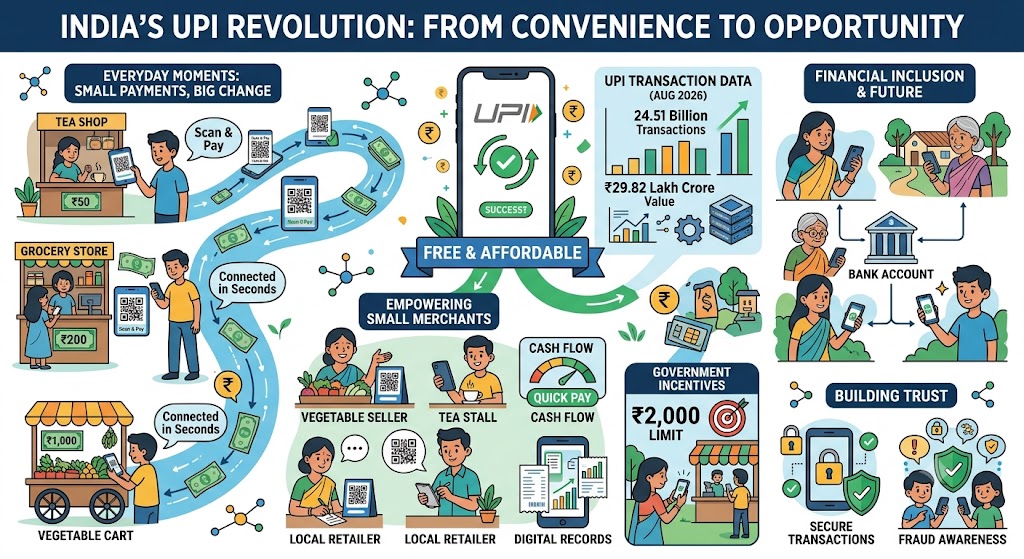
The scale of this transformation is significant. UPI processed 24.51 billion transactions worth nearly ₹29.82 lakh crore in August 2026, according to National Payments Corporation of India data. The numbers show how deeply digital payments have become embedded in everyday economic activity.
When Small Payments Become a Big Change
A ₹50 tea bill, a ₹200 grocery purchase or a ₹1,000 payment to a local service provider may seem like small transactions. But multiplied across millions of people every day, these payments form a major part of India’s digital economy.
The Department of Financial Services has stated that UPI remains free for peer-to-peer transactions and 96 per cent of merchant transactions.
For consumers, this means greater convenience when making routine payments. For small merchants, it means they can accept digital payments without making the customer think twice about the cost of a small transaction.
That simplicity has helped UPI move beyond cities and large businesses into neighbourhood stores, street markets, small enterprises and everyday household transactions.
A Digital Boost for Small Merchants
For a small business owner, receiving money quickly can make a difference to daily cash flow.
A QR code allows a vegetable seller, tea shop, home-based entrepreneur or local retailer to accept payments without requiring a traditional card machine. Digital transaction records can also help businesses maintain clearer accounts and better understand their daily cash flow.
Over time, such digital footprints can support greater participation in the formal financial system.
This is particularly relevant for India’s vast micro, small and informal business community, where even small improvements in payment convenience can make routine business operations easier.
₹2,000 and the Push for Low-Value Digital Payments
Low-value transactions are an important part of India’s digital-payment story. The government’s incentive framework for BHIM-UPI merchant transactions has specifically focused on encouraging small-value digital payments, including transactions up to ₹2,000.
The idea is simple: when small payments are easy to accept and do not impose an additional burden on customers or merchants, digital payment adoption can spread deeper into everyday commerce.
This creates a cycle in which more merchants accept digital payments, more consumers use them and the overall digital ecosystem becomes stronger.
Making Financial Inclusion More Practical
Digital financial inclusion is not only about opening a bank account. People also need convenient ways to use that account.
UPI helps bridge this gap by allowing people to transfer money and make purchases directly from their bank accounts using mobile phones. For people in smaller towns and villages, this can reduce dependence on cash and make everyday financial transactions more convenient.
For women, students, workers, senior citizens and small entrepreneurs, simple digital payments can provide greater flexibility in managing routine transactions.
Building Trust Around Digital Payments
As digital payments become more common, affordability needs to go hand in hand with security.
A larger digital economy requires reliable payment infrastructure, strong cybersecurity, effective fraud prevention and greater awareness among users. Consumers need to understand safe payment practices, while businesses need systems that can protect transactions and customer information.
The success of UPI has therefore created not just a payment revolution but also a larger responsibility to keep India’s digital financial infrastructure secure and dependable.
From Convenience Today to Opportunity Tomorrow
The importance of free and accessible UPI payments goes beyond avoiding transaction charges.
It is about reducing friction in everyday commerce.
When a customer can pay instantly, a merchant can receive money immediately and a small business can maintain a digital record of its transactions, the entire payment cycle becomes more efficient.
At a larger level, millions of such interactions can support the growth of a more connected digital economy.
India’s digital-payment journey is ultimately being built through ordinary moments—a customer scanning a QR code, a small shop receiving its first digital payment of the day or a family member transferring money home within seconds.
