Inventory planning has always been one of the most important aspects of running a successful retail business. Retailers need to maintain the right balance between product availability and inventory costs. Keeping too much stock can increase storage expenses and lead to unsold products, while insufficient inventory can result in missed sales opportunities and dissatisfied customers.
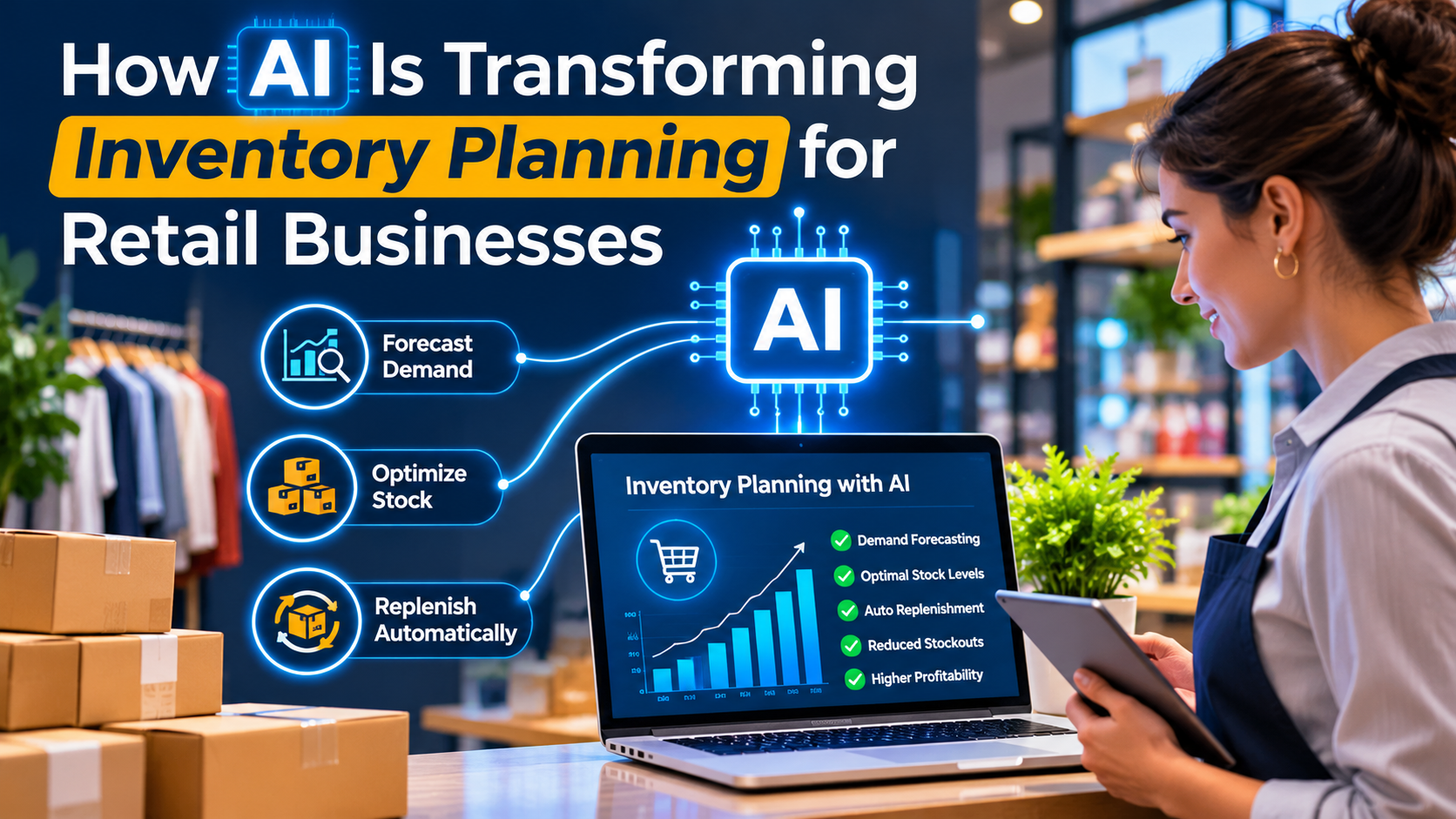
Traditional inventory planning methods often rely on historical sales reports, manual calculations, and spreadsheets. However, changing customer preferences, seasonal demand, market trends, and unpredictable supply chain disruptions have made inventory management more challenging than ever.
This is where Artificial Intelligence (AI) is transforming the retail industry. By using advanced algorithms, machine learning, and predictive analytics, AI helps retailers make smarter inventory decisions, forecast demand more accurately, and improve overall business efficiency.
Let’s explore how AI is changing inventory planning for retail businesses and why it is becoming an essential part of modern retail operations.
1. Accurate Demand Forecasting with AI
One of the biggest challenges for retailers is predicting how much stock they will need in the future. Traditional forecasting methods may not always account for sudden changes in customer demand, market conditions, or seasonal trends.
AI-powered demand forecasting analyzes large volumes of data, including:
-
Historical sales performance.
-
Customer purchasing behavior.
-
Seasonal buying patterns.
-
Market trends and promotions.
-
Weather conditions and regional demand.
-
Product performance across different locations.
Using this information, AI systems can identify patterns and predict future demand more accurately.
For example, a clothing retailer can use AI to predict increased demand for winter jackets based on previous sales, weather forecasts, and current shopping trends. This allows the business to stock the right products before demand increases.
The result: Better forecasting, fewer stock shortages, and reduced excess inventory.
2. Real-Time Inventory Tracking and Visibility
Retail businesses often manage thousands of products across multiple stores, warehouses, and online platforms. Keeping track of inventory across all these channels can be complicated.
AI-powered inventory management systems provide real-time visibility into stock levels. When integrated with technologies such as barcode scanners, RFID, IoT devices, and point-of-sale systems, AI can help retailers monitor inventory movement more efficiently.
These systems can:
-
Track stock levels across multiple locations.
-
Identify fast-moving and slow-moving products.
-
Detect unusual inventory movements.
-
Notify managers when stock reaches predefined levels.
-
Improve inventory accuracy across sales channels.
For instance, if a particular product starts selling faster in one store, the system can identify the change and help managers transfer additional stock from another location.
This improves inventory visibility and enables retailers to respond quickly to changing business requirements.
3. Automated Replenishment and Smarter Stock Management
Maintaining the right stock levels is essential for avoiding both overstocking and stockouts. Manual replenishment processes can be time-consuming and may result in delayed purchasing decisions.
AI simplifies this process through automated inventory replenishment.
By analyzing sales trends, current stock levels, supplier lead times, and demand forecasts, AI systems can recommend when and how much inventory should be reordered.
Some advanced systems can also automate purchase order creation and replenishment workflows based on predefined business rules and approval requirements.
For example, a grocery retailer can use AI to monitor the sales of essential products such as milk, bread, and packaged food. When inventory levels are expected to fall below the required threshold, the system can recommend or initiate replenishment.
This helps retailers maintain product availability while reducing unnecessary inventory purchases.
4. Reducing Overstocking and Stockouts
Overstocking and stockouts are two major problems that directly affect retail profitability.
Overstocking ties up working capital, increases warehouse expenses, and creates the risk of product damage or obsolescence. On the other hand, stockouts can lead to lost sales and customers switching to competitors.
AI helps retailers minimize these challenges by continuously analyzing inventory levels and predicting future demand.
For example:
-
If a product is selling slower than expected, AI can alert managers to reduce future orders.
-
If demand for a product is increasing, AI can recommend additional stock.
-
If certain products are approaching their expiration dates, AI can help prioritize their sale or redistribution.
-
If inventory is accumulating at one location, AI can recommend transferring it to a store with higher demand.
By identifying potential inventory problems early, retailers can take preventive action instead of reacting after losses occur.
5. Personalized Inventory Planning Based on Customer Behavior
Modern customers expect retailers to offer products that match their preferences and shopping habits. However, customer demand can vary significantly across regions, age groups, and shopping channels.
AI analyzes customer purchase histories, browsing patterns, product preferences, and buying frequency to understand what customers are likely to purchase.
This information helps retailers make more targeted inventory decisions.
For example, a fashion retailer operating stores in different cities may discover that customers in one location prefer casual clothing, while another location has higher demand for formal wear.
Instead of maintaining identical inventory across all stores, the retailer can use AI-driven insights to customize stock according to local customer preferences.
This approach improves product availability, reduces unnecessary inventory, and creates a better shopping experience.
6. Improving Supply Chain and Supplier Management
Inventory planning is closely connected to supply chain performance. Even with accurate demand forecasts, delayed supplier deliveries can create inventory shortages.
AI helps retailers improve supply chain planning by analyzing supplier performance, delivery schedules, transportation data, and potential disruptions.
AI-powered systems can help businesses:
-
Predict possible delivery delays.
-
Evaluate supplier reliability.
-
Optimize purchase order schedules.
-
Identify alternative sourcing opportunities.
-
Improve warehouse and distribution planning.
-
Estimate the impact of supply chain disruptions.
For example, if an AI system identifies a potential delay in the delivery of a high-demand product, it can alert inventory managers and recommend ordering from an alternative supplier or redistributing available stock.
This allows retailers to respond proactively and maintain smoother business operations.
7. Dynamic Pricing and Inventory Optimization
AI is also changing how retailers manage product pricing based on inventory levels and market demand.
Dynamic pricing systems analyze factors such as product demand, competitor pricing, remaining stock, seasonal trends, and product shelf life to recommend suitable price adjustments.
For example, a retailer may use AI to identify products that are approaching the end of their seasonal selling period. The system can recommend promotional pricing to clear excess inventory before the season ends.
Similarly, products experiencing strong demand may require different pricing and replenishment strategies.
When implemented carefully, AI-driven pricing helps retailers improve inventory turnover, reduce markdown losses, and protect profit margins.
8. Better Decision-Making Through Predictive Analytics
Retail inventory planning involves numerous decisions, including how much to purchase, when to reorder, which products to promote, and where to distribute available stock.
AI-powered predictive analytics provides retailers with actionable insights to support these decisions.
Instead of relying only on historical reports, managers can use predictive models to understand possible future scenarios.
For example, retailers can analyze:
-
Expected sales for the upcoming month.
-
Products likely to experience demand fluctuations.
-
Potential inventory shortages.
-
Slow-moving and excess stock.
-
Expected inventory carrying costs.
-
Product performance across different stores.
These insights help management make faster, more informed, and data-driven decisions.
9. Challenges of Implementing AI in Retail Inventory Planning
Although AI offers significant benefits, implementing it successfully requires proper planning and investment.
Some common challenges include:
Data quality and integration: AI systems require accurate and consistent data. Incomplete sales records or disconnected inventory systems can affect forecasting results.
Implementation costs: Advanced AI solutions may require investment in software, infrastructure, employee training, and system integration.
Employee training: Inventory managers and retail teams need to understand how to use AI-generated recommendations effectively.
Data security: Retailers must protect sensitive customer, supplier, and business information when using AI-powered platforms.
Human oversight: AI predictions are not always perfect. Unexpected events and unusual market conditions can affect accuracy, so human supervision remains important.
Retailers should begin with clearly defined business objectives, reliable data, and manageable implementation projects before expanding AI across their operations.
10. The Future of AI in Retail Inventory Planning
The future of inventory planning will become increasingly automated, predictive, and intelligent.
Emerging AI technologies are expected to make retail inventory management more efficient through:
-
Generative AI: Helping managers analyze inventory reports, understand trends, and receive recommendations through natural-language conversations.
-
Autonomous inventory systems: Supporting automated replenishment and inventory decisions with appropriate business controls.
-
Digital twins: Creating virtual representations of supply chains to simulate inventory scenarios and evaluate potential disruptions.
-
Advanced predictive analytics: Improving demand forecasts by combining more data sources and identifying complex patterns.
-
AI-powered robotics: Supporting warehouse operations, stock counting, sorting, and order fulfillment.
As these technologies continue to develop, retailers will be able to move from reactive inventory management toward proactive and intelligent planning.
Conclusion
Artificial Intelligence is transforming inventory planning by helping retail businesses forecast demand, monitor stock levels, automate replenishment, reduce excess inventory, and improve supply chain efficiency.
Instead of depending entirely on manual processes and historical sales reports, retailers can now use AI-driven insights to make smarter and faster inventory decisions.
However, successful AI adoption requires accurate data, suitable technology, employee training, and continuous monitoring.
Retail businesses that embrace AI as part of their inventory planning strategy can improve operational efficiency, reduce costs, increase product availability, and deliver better customer experiences.
Ultimately, AI is not just changing how retailers manage inventory; it is helping them build smarter, more responsive, and more profitable retail operations.
