Category: Technology

Provenir Named a Major Player in the IDC MarketScape: Worldwide Decision Intelligence Platforms 2026 Vendor Assessment

PARSIPPANY, N.J., – October 14, 2026 – Provenir, the Decision Intelligence Platform for financial services providers, on Oct 12 announced it has been positioned in the Major Players Category in the IDC MarketScape: Worldwide Decision Intelligence Platforms 2026 Vendor Assessment (Doc #US54118426, September 2026). Provenir was also named a Major Player in the 2024 edition of this IDC MarketScape.

The recognition follows two years of continued investment in Provenir’s Decision Intelligence Platform, including production-accurate simulation, advances in AI models and assistants, and expanded capabilities designed to help customers design, test and deploy decision strategies faster.

The IDC MarketScape evaluated vendors supporting decision design, decision engineering and decision orchestration. The assessment covered vendors serving industries from financial services and insurance to government, manufacturing, and retail; we believe Provenir earned its position while maintaining a deliberate focus on financial services and adjacent sectors. The 2026 assessment also reflects the growing role of generative and agentic AI in how decision logic is authored, tested and explained, alongside continued human oversight. 

The IDC MarketScape highlights Provenir’s unified low-code platform, stating “Provenir brings together decisioning, data orchestration, model orchestration, simulation, and case management in a single cloud-native environment, reducing reliance on separate point solutions for related decisioning functions.” 

IDC highlights three areas of strength: 

  • Unified low-code platform: Provenir brings together decisioning, data orchestration, model orchestration, simulation, and case management in a single cloud-native environment, reducing reliance on separate point solutions for related decisioning functions.
  • Breadth of the data marketplace: The vendor’s marketplace includes more than 150 prebuilt integrations with third-party data and analytics providers, and new integrations are typically turned around in about two weeks, shortening timelines that can otherwise stretch to several months.
  • Platformwide AI assistant: A generative AI assistant operates across dashboards, model building, and documentation functions platformwide, providing conversational access to insights, recommendations, and translated documentation regardless of which page a user is working from. 

The IDC MarketScape also notes Provenir’s “same engine” simulation approach: “where changes are tested using the identical processing rails and up to 12 months of live production data that power the operational platform, which may appeal to organizations that want confidence in projected outcomes before rules or scorecards go live.” This gives organizations greater confidence in projected outcomes before changes go live. 

“I believe being named a Major Player for the second assessment in this market reflects the progress we’ve made in building a true decision intelligence platform,” said Lawrence Smith, CEO of Provenir. “Financial services providers need to change strategy quickly without losing control of how decisions are made. By bringing data, AI, simulation and governance together, we help customers test, understand and improve decisions before changes go live.” 

Provenir’s generative AI assistant and MCP connectivity are in production today, supporting documentation retrieval, insight generation and guided model building. The IDC MarketScape also notes that Provenir’s near-term road map priorities include “natural language–driven flow generation, expanded automated recommendations, and human-in-the-loop monitoring for agents, reflecting a broader shift from assisted decision design toward continuous, machine learning–informed strategy optimization across the decisioning life cycle.” 

To read the IDC MarketScape excerpt featuring Provenir, visit: https://www.provenir.com/idc-report-2026/

Moldova’s Tech Ecosystem Reaches New Milestone as MITP Surpasses 3,000 Active Resident Companies


CHIȘINĂU, Moldova,  Oct 14: Moldova Innovation Technology Park (MITP), Europe’s first nationwide e-Park, has surpassed 3,000 active resident companies, marking a new milestone in the rapid expansion of the Republic of Moldova’s technology sector. The milestone comes as MITP companies continue to record double-digit growth, expand internationally and increase their role in the country’s economy.

MITP started operations in 2018 with 338 resident companies. Eight years later, it brings together more than 3,000 active businesses and over 27,000 employees, while company founders and investors represented in the ecosystem come from more than 50 countries. Approximately 90% of the products and services developed by MITP residents are intended for export, connecting Moldova-based technology companies with customers and markets around the world.

“Reaching 3,000 active residents is much more than a numerical milestone. It reflects a structural change in Moldova’s economy and the role technology now plays in its development. MITP has become one of the country’s main drivers of economic development, combining local entrepreneurship, exports, foreign investment and highly skilled jobs. At the same time, we are increasingly seeing Moldovan companies evolve from outsourcing-led business models towards developing their own products, intellectual property and scalable solutions for international markets,” said Marina Bzovîi, Administrator of Moldova Innovation Technology Park.

“Our role is to make this transition easier. MITP provides a predictable framework in which startups can launch, test and grow their businesses, while an expanding ecosystem of instruments helps companies attract investment, access international markets and bring global talent to Moldova. From the IT Visa and simplified business environment to startup financing and innovation support, we want Moldova to be a place where technology companies can build global businesses and global teams.”

MITP’s latest figures show that this growth is spread across a broad and increasingly diversified business base. In the first half of 2026, residents generated MDL 10.7 billion (Eur 0.5B) in combined sales, 19.1% more than during the same period of 2025. At the end of June, companies with active resident status employed more than 27,150 people (3.3% of country’s workforce).

Local entrepreneurship is at the core of the ecosystem. Eighty-six percent of MITP residents are locally owned companies, while foreign-owned businesses account for 14% of residents and approximately 26% of total sales. The figures illustrate a model in which Moldovan-founded companies provide the scale of the ecosystem while international investors contribute capital, expertise and connections to global technology markets.

The data also challenge the perception that technology-sector growth is concentrated among a handful of large employers. Companies with fewer than 50 employees generated 55% of all MITP resident sales in the first half of 2026, while companies with fewer than 250 employees generated approximately 82%. Around two-thirds of MITP sales were generated outside the Park’s 35 largest companies.

This structure reflects an economy increasingly driven by knowledge, intellectual property and the ability of relatively small teams to serve international markets. It also creates conditions for Moldovan technology companies to progress beyond service-based models and build products with the potential to scale internationally. The growing economic weight of the ecosystem is already visible at national level: MITP residents’ activity accounted for 5.3% of Moldova’s GDP in 2025.

MITP is simultaneously expanding the infrastructure around these companies. Its IT Visa programme provides resident businesses with a simplified framework for bringing foreign executives, investors and highly qualified technology specialists to Moldova, reducing immigration and hiring barriers for companies building international teams.

For early-stage innovation, the newly launched Moldova Innovation Fund, operated by MITP, adds a financing mechanism for technology projects moving from ideas through validation and prototyping towards market-ready products. The Fund has an initial budget of more than EUR 1 million, with four funding rounds planned over 24 months for pre-seed and early-stage projects.

The Park’s core operating model remains a simplified 7% single tax on sales revenue, together with digital-first administration and virtual residency. The stability of the tax regime is guaranteed by the state until the end of 2035, providing technology businesses with a long-term and predictable framework for investment and growth.

MITP resident companies are projected to generate approximately MDL 20 billion (Eur 1B) in combined revenue in 2026, further strengthening the technology sector’s contribution to Moldova’s exports, employment, investment attraction and transition towards a higher-value, knowledge-based economy.

56 percent of Multilingual Consumers Have Walked Away From a Purchase Over Poor Website Localization, Liferay Survey Finds

New report finds consumers are confident they can spot machine-translated content, while better localized digital experiences can influence trust, loyalty and which brands they choose

LOS ANGELES – AI and automated translation have made it easier than ever for brands to deliver websites, product information and digital experiences in multiple languages. But as translation becomes easier to scale, brands face more pressure to maintain quality and local relevance across every market. Liferay, a leading provider of Digital Experience Platforms (DXPs), released new research examining where multilingual digital experiences are falling short and what consumers notice when localization misses the mark.

The Liferay 2026 Website Localization Report, conducted in September 2026 via the third-party platform Pollfish, surveyed 800 U.S. adults who had used a website, app or digital service in a language other than English in the past 12 months. The report examines how multilingual consumers experience translated and localized digital content, which mistakes they notice and how those mistakes affect trust, purchase decisions and brand loyalty.

Key findings include:

  • Poor localization is costing sales. 56% of multilingual consumers have decided not to buy from a company because its website or app felt poorly adapted to their language.
  • Good translations can still hide a bad experience. 54% of consumers who rate brands’ non-English translations as good or excellent have still walked away from a purchase over poor localization.
  • Most translated websites still don’t feel truly local. Only 23% say non-English websites usually feel like they were written for them.
  • Consumers think they can spot machine translation. 82% are confident they can tell when content was machine-translated rather than written or reviewed by a fluent speaker.
  • Localization problems are nearly universal. 90% have noticed at least one localization problem on a website or app.
  • Better localization can win business. 48% have chosen one company over a competitor because its website or app felt better adapted to their language and culture.
  • Consumers associate better localization with human review. Only 20% credit AI alone for strong localization, while 43% credit human involvement.

“You can translate every page and technically have everything working, but that doesn’t mean the experience feels natural to the person using it,” said Bryan Cheung, co-founder and CMO at Liferay. “That’s where a lot of companies can underestimate the difference between translation and localization. Translation gets the content into another language. Localization is what makes it feel natural to the people using it.”

The findings show that consumers notice when a translated experience doesn’t feel natural. As brands expand multilingual content, getting the wording, tone and cultural context right can make the difference between a site that simply does the job and one that feels made for the people using it.

Visit the Liferay 2026 Website Localization Report on Liferay’s website for the complete survey results and additional insights.

Kira AI Launches AI Workspace that Thinks and Acts Across Everything Users Do, Say, and Decide

“Life Operating Software” acts like a capable chief of staff for every person and team, handling the email, scheduling, calls, and follow-ups that stand between the users and the work only they can do

DOVER, Del.—October 14, 2026—Kira on Oct 13 announced the launch of a multi-part AI workspace that functions as an “operating intelligence” of the user’s life. Kira does more than just answer questions. Built to think, remember, and act, Kira learns about the user and his or her business, recalls every detail, and takes action across calls, emails, content, and workflows.

“Kira came to life based on an insight that most of the workday doesn’t involve actual work,” explained a spokesperson for Kira. “Instead, we spend huge amounts of time coordinating the work, chasing replies, moving meetings, writing the same email in five different ways, and so forth. This is the problem we are solving with Kira. Kira exists to close that gap. Kira acts as a capable chief of staff for every person and team. It handles the email, scheduling, calls, and follow-ups that stand between you and the work only you can do.”

Kira brings the user’s tools into one place and gives AI agents the ability to act on his or her behalf, but always with the user in control.

Key features include:

  • Email Agent, which drafts, triages, and sends, with the user’s sign-off on anything that matters.
  • AI Call Agents, which place and take calls, then hand the user the summary, not the transcript.
  • Smart Calendar, which schedules, reschedules, and preps the user’s life before the day begins.
  • Voice Command, which runs the dashboard hands-free.
  • Connected integrations, which link the tools the user already works in.

Kira is a connected workspace that includes My Brain, My Files, and My Workspace. These are where the user’s notes, tasks, and documents live together.

Kira runs on a loop built to keep the user in charge while cutting out manual steps in various work tasks. “We connect the tools you already use, from email to calendar, and beyond,” the spokesperson added. “You delegate a goal, in plain language or by voice, but you get to review what Kira proposes before anything goes out.” As Kira executes, it learns the user’s preferences so the next round takes less time.

Brompton LED processing brings Hollywood-grade virtual production to VG Media Studio in Germany

Brompton LED processing brings Hollywood-grade virtual production to VG Media Studio in Germany


Oct 13: VG Media Studio, a full-service marketing and production agency based in Laichingen near Stuttgart, Germany, has installed Brompton Technology LED processing as part of a new virtual production facility designed to support everything from advertising and automotive work to short films and feature-length productions.

Virtual production was not originally part of the studio’s plans. During the development of the wider complex, however, the team began discussions with LG around its LED technology and its ambitions for an official reference studio in Europe. This led VG Media Studio to consider how LED, processing and tracking could work together to create a high-performance virtual production environment.

The decision was ultimately driven by a desire to give productions more options while maintaining the reliability and efficiency needed to keep projects moving. As a full-service marketing agency, VG Media Studio regularly looks for alternative approaches to production, whether that means a different camera angle, a social-first concept or a particular visual treatment.

That same approach informed the design of the LED studio, with technical performance and ease of operation key considerations. Brompton processing provides the superior colour precision, camera flexibility, and operational reliability required across the studio’s varied workload.

The studio is built around an LG LED volume, Mo-Sys tracking and Brompton Tessera processing, and is already being used for a diverse range of productions for external companies looking to harness virtual production facilities, equipment, and expertise.

The LED setup comprises more than 100 square metres of LG LED, with two 4K Tessera SX40 processors driving the wall and a Tessera S8 powering the ceiling. Each SX40 is paired with two Tessera XD 10G data distribution boxes. The system can operate at up to 60fps, with the potential to reach 120fps through further configuration.

VG Media Studio operates two spaces within the facility: the main LED studio offering approximately 250 square metres of space in front of the wall, alongside a 70-square-metre studio that can be used as a conventional film or photography space. Together, they allow the team to accommodate different production requirements under one roof.

“I really like the Brompton system we have here because it’s super fast and reliable,” says Simon Brüstl, Virtual Production Engineer at VG Media Studio. “The UI is really clean and has all the functions you need during operation. It just does the job that it has to do.”

The system is designed to make day-to-day operation straightforward. Brompton’s integration with Stream Deck allows the team to control the LED stage from a familiar interface, while its colour pipeline provides a precise and consistent result across different cameras. 

Integration with Mo-Sys adds another layer of flexibility. VG Media Studio can use Mo-Sys markers that are visible to the tracking system but hidden from the production camera, allowing tracking information to be displayed without compromising the camera image. Frame Remapping can provide different LED feeds for individual cameras in multi-camera productions, while Custom Markers can display text, cues, or other instructions for the crew without appearing in the final shot.

“Brompton processing supports any production that needs the best camera performance, best visual colour performance, and of course, accuracy and reliability,” says Oliver Dier, Technical Solutions Manager (EMEA) at Brompton Technology. “VG asked us to deliver exactly that.” 

“We try to individually explore the option of filming in front of the wall with each of our customers, and already have done that in some parts,” adds Philipp Offermann, Head of Management and Booking at VG Media Studio. “But the overall goal is mainly to rent our facilities, equipment and know-how to external production companies. We are really happy with the results, our partners, and the support we’re getting, and we are proud to be able to offer the best Hollywood-grade products on the market to our customers.”

The studio has already hosted a wide range of work, including external commercial productions, a short film with multiple settings, car commercials and a full movie production in July 2026. VG Media Studio’s wider client base includes Adobe, Alb Gold, Bosch eBike Systems, Porsche AG, SONY, Swarovski, Tamron and Wieland-Werke, among others.

With a growing range of productions already taking place in the space, VG Media Studio sees the new facility as an extension of its wider production offering, combining its existing creative and marketing expertise with a virtual production environment capable of serving both its own clients and external production teams.

“It has been fantastic to see this installation come together and to watch VG Media Studio put it straight to work on such a varied slate of productions,” concludes Dier. “The team knew exactly what they wanted from day one, and that clarity made for a smooth collaboration from planning through to delivery. Seeing the studio already booked up with external productions just months after going live shows what’s possible when the right technology is paired with the right team.”

MDI Gurgaon Strengthens Executive Learning with Programmes Focused on AI, Leadership and Business Transformation

Gurugram, India, October 13, 2026: As organisations navigate rapid technological change, evolving customer expectations, shifting market dynamics and growing sustainability imperatives, professionals are increasingly required to strengthen their capabilities and adapt to emerging business priorities. Addressing these evolving needs, Management Development Institute (MDI) Gurgaon has announced its November 2026 portfolio of Executive Development Programmes (EDPs), covering artificial intelligence, leadership, marketing, sustainability, communication, analytics, operations and project management. The programmes are designed to combine contemporary management perspectives with practical learning, enabling professionals to apply relevant frameworks and approaches to real-world business challenges.

Commenting on the portfolio, Prof. Sumita Rai, Dean IC, MDI Gurgaon, said,“The pace of technological and business change is making continuous learning increasingly important for professionals across industries. At MDI Gurgaon, our Executive Development Programmes are designed to bring together contemporary business perspectives, academic expertise and practical application. The November portfolio reflects this approach by addressing areas such as artificial intelligence, leadership, marketing, sustainability, analytics and project management. Through these programmes, we aim to enable professionals to strengthen their capabilities, make more informed decisions and navigate emerging business challenges with greater confidence and effectiveness. ”

Strengthening Leadership and Managerial Capabilities

Leadership and people management remain central to organisational performance. Leadership for Impact will focus on leadership competencies, values and ethical approaches that enable professionals to create greater organisational impact. Coaching and Mentoring for Building Effective Managers & Leaders will further explore coaching, mentoring, communication and interpersonal approaches that can help managers develop individuals, build effective teams and strengthen leadership capabilities.

The portfolio also includes Negotiation Strategies: A Win-Win Approach, which will focus on negotiation processes, conflict resolution, communication and collaborative outcomes. Problem Solving and Decision Making will address the processes and techniques required to evaluate alternatives, develop effective solutions and improve the quality of managerial decision-making.

Building Capabilities for an AI-Driven Business Environment

As artificial intelligence continues to influence business models, processes and decision-making, AI-driven Business Transformation will examine AI-led digital strategies, business applications of machine learning and emerging AI technologies, alongside considerations around AI strategy, leadership and risk.

Complementing this, Generative AI and Business Transformation: From Models to Markets will explore practical applications of generative AI across business processes, customer experience, innovation and decision-making, while also addressing considerations around responsible adoption.

Enabling Data-Driven Marketing and Customer Engagement

The marketing portfolio brings together programmes focused on growth, customer engagement and sector-specific marketing. Growth Marketing will explore full-funnel growth, experimentation and data-driven decision-making, while Marketing of Financial Services will examine customer-centric and digital approaches relevant to the evolving financial services landscape.

Customer Engagement and Digital Marketing Communication will focus on digital marketing, social media, communication strategies and customer engagement, helping professionals navigate an increasingly connected and digitally driven marketplace.

Advancing Sustainability and Responsible Business Practices

Sustainability continues to be an important consideration for organisations and business leaders. Sustainable Business Strategies and Analytics for UN SDGs and Climate Change Transition will examine sustainability strategies, ESG considerations, analytics and climate transition, while ESG Investing Practices will focus on the evolving ESG landscape and its relevance to investment and business decision-making.

Strengthening Communication, Operations and Project Capabilities

The portfolio also addresses critical capabilities across customer experience, supply chain, communication and project management. Customer Experience and Professional Communication for Managers will focus on customer engagement and effective managerial communication, while From Forecast to Fulfilment: Demand Planning, S&OP and Supply Chain Decision-Making will examine how organisations can translate forecasts into effective supply-chain decisions.

For professionals looking to communicate insights more effectively, Business Storytelling Using Data will explore approaches to presenting and communicating data-driven insights for greater business impact. The portfolio also includes Project Management, addressing the growing importance of structured project management capabilities as organisations increasingly rely on projects to respond to technological and business change.

The November portfolio reflects MDI Gurgaon’s broader focus on equipping professionals with capabilities relevant to an increasingly dynamic business environment. By bringing together AI, leadership, marketing, sustainability, communication, analytics, operations and project management, the programmes offer professionals opportunities to deepen their expertise while addressing contemporary organisational challenges.

Through its Executive Development Programmes, MDI Gurgaon continues to combine academic knowledge with practical business perspectives, enabling professionals across functions and industries to strengthen their capabilities, make informed decisions and contribute more effectively to organisational growth and transformation.

BHASHINI Enables Real-Time English-Spanish Translation at International Governance Programme in Mussoorie

Mussoorie, October 13, 2026: The Digital India BHASHINI Division (DIBD), under Digital India Corporation (DIC), Ministry of Electronics and Information Technology (MeitY), has facilitated real-time multilingual communication at an international capacity-building programme for civil servants at the National Centre for Good Governance (NCGG) in Mussoorie.

The Capacity Building Programme on Urban Service Delivery for Civil Servants of Multiple Countries is being conducted from October 12 to 23, 2026. Sponsored by the Ministry of External Affairs (MEA), the programme is organised by NCGG under the Department of Administrative Reforms and Public Grievances (DARPG) as part of India’s international cooperation and capacity-building initiatives through the Indian Technical and Economic Cooperation (ITEC) Programme.

BHASHINI Enables Real-Time English-Spanish Translation at International Governance Programme in Mussoorie


The programme brings together civil servants and public-sector representatives from Peru, Cambodia, Nigeria, Kenya, Palestine, Lebanon, The Gambia, Ecuador and Spain. It provides a platform for participants to exchange experiences, share governance practices and explore approaches to improving urban service delivery.

As part of the initiative, BHASHINI deployed its Shrutlekh platform during the programme’s ice-breaking session to enable real-time translation between English and Spanish. The two-way translation facility allowed participants speaking either language to communicate more effectively, reducing language barriers and encouraging greater interaction among international delegates.

The deployment highlights BHASHINI’s Voice-First Multilingual AI approach, which aims to make digital communication and public services more accessible through speech-based language technologies. The initiative demonstrates how artificial intelligence can facilitate cross-cultural engagement and support inclusive participation in international governance and administrative training programmes.

The BHASHINI team also assisted participants in using Shrutlekh and introduced them to the broader BHASHINI ecosystem, including its multilingual AI capabilities and potential applications in healthcare, finance, agriculture and public service delivery. Delegates were encouraged to explore the BHASHINI mobile application and its features for overcoming language barriers in everyday communication and digital interactions.

Shrutlekh is expected to remain available throughout the programme until October 23, subject to operational requirements, enabling participants to continue using the translation facility during the training sessions.

The initiative underscores the growing role of AI-powered language technologies in international cooperation, knowledge-sharing and public-sector capacity building. By enabling communication across languages, BHASHINI is showcasing India’s capabilities in developing multilingual digital solutions that can make technology more accessible to diverse communities.

The engagement also reflects the potential of voice-first AI tools to support more inclusive governance, strengthen international partnerships and facilitate the exchange of administrative expertise across linguistic and cultural boundaries.

Hexnode XDR Adds Threat Intelligence, Alert Prioritization and Automated Remediation

Hexnode, the enterprise software division of Mitsogo, has expanded Hexnode XDR with new capabilities for threat detection, alert prioritization and remediation, alongside support for macOS. The enhancements address a persistent challenge for security teams: detecting a threat does not necessarily make it easier to resolve.

“We built Hexnode XDR around one complaint we heard constantly: security tools are good at telling you something is wrong, and bad at helping you do anything about it. More alerts was never the request. Fewer steps between the alert and the fix — that was the request,” said Apu Pavithran, CEO and Founder of Hexnode, during the HexCon26 opening keynote.

Delivering on that requires connecting security investigations to action on affected devices. Hexnode XDR’s native integration with Hexnode UEM brings threat detection, device intelligence and endpoint management together, helping teams contain threats and address the underlying exposure with fewer manual steps.


Hexnode XDR Adds Threat Intelligence, Alert Prioritization and Automated Remediation


What’s new in Hexnode XDR’s detection and triage?

Hexnode XDR brings threat signals and supporting context into a centralized incident view, helping teams determine what happened and where attention is needed first.

The latest capabilities include:

·  Integrated threat intelligence: Integrations with Mandiant (Google Threat Intelligence) and Recorded Future cross-reference endpoint activity against external threat intelligence, helping identify known threats and indicators faster.

·     Sandbox analysis: Suspicious files can be examined in an isolated environment, with the results fed back into detection to provide additional context before teams take action.

·         Anomaly detection: Identifies unusual activity that may not match known threat signatures, helping surface new or previously unknown attack behavior.

·         Alert prioritization: Ranks alerts based on severity and urgency so analysts can focus on higher-priority activity rather than reviewing alerts in the order they arrive.

·         Asset scoring: Assigns endpoints a dynamic risk score based on defined risk parameters, helping teams identify which devices require closer attention.

·         AI-assisted investigation:Hexnode Genie AI provides plain-language alert summaries to support triage. Analyse with Genie uses live incident data to explain what happened, identify what is affected and recommend a fix.

To further reduce false positives, administrators can configure exclusion policies for trusted files, applications and processes, keeping investigations focused on activity that requires review.


How does Hexnode XDR streamline threat response?

Once a threat has been identified and prioritized, Hexnode XDR provides response capabilities designed to contain the incident and address the underlying endpoint risk.

·         Endpoint isolation: Enables one-click isolation of affected devices from the network while maintaining management access through Hexnode, helping contain potential threat spread while investigation and remediation continue.

·         Vulnerability management: Identifies vulnerabilities and missing patches, with remediation carried out through Hexnode UEM. This connects XDR threat investigation with endpoint patching, helping teams address the security gaps uncovered during an incident.

·         Automated remediation: Triggers predefined fixes based on configured rules and policies, reducing repetitive manual corrective actions.

Together, these capabilities connect detection with containment and follow-up remediation rather than leaving teams to coordinate each stage through separate workflows.

To keep key security information visible, custom dashboards allow teams to tailor their view to their role and monitoring priorities. Integrations with Splunk and QRadar also connect Hexnode XDR with existing security information and event management (SIEM) systems for broader investigation and reporting.

 How is Hexnode XDR building toward AI-assisted SOC operations?

Together, alert prioritization, asset scoring and automated remediation provide the context and response framework needed to support more AI-assisted SOC workflows, helping move security operations from identifying what matters to determining where action should be taken. Hexnode Genie AI complements this by drawing on live incident data to support investigation and response decisions.

Hexnode plans to build on this foundation with deeper AI-assisted investigation and orchestration across XDR and the wider Hexnode platform.

Integrated Power Services (IPS) Acquires Bold Renewables 

Adds Exclusive OEM Solar Inverter Parts and Field Service Capabilities to IPS’ Renewable Energy Platform  

Greenville, SC, October 13, 2026 – Integrated Power Services (IPS), North America’s largest provider of aftermarket power management lifecycle service solutions, has acquired Bold Renewables, effective October 9th. Headquartered in Windsor, Colorado, Bold is the exclusive OEM source of field service, spare parts, and preventive maintenance for Advanced Energy central solar inverters branded Solaron, NX, TX, and PV Powered. 

“The acquisition of Bold Renewables brings new and exciting inverter capabilities that strengthen IPS’s service offering for the lifecycle of solar and wind assets,” said John Zuleger, President and CEO of IPS. “Bold’s exclusive OEM parts position, experienced field service team, and installed-base reach complement IPS’ engineering, component repair, and renewable energy service capabilities. The addition of Bold, combined with our previous acquisition of ENA Electronics, positions IPS as the go-to provider for aftermarket lifecycle inverter solutions across wind, solar, mining, and industrial markets.  Our enhanced inverter offerings are built to address the service shortfalls of OEMs and provide a solution to poorly served customers seeking inverter lifecycle performance.” 

Bold supports an installed base of approximately 14,000 legacy solar inverters, representing more than 4 GW of capacity across more than 3,000 solar sites in the United States and Canada. The company holds the original OEM design drawings, blueprints, and firmware for these inverter platforms and provides proprietary spare parts, technical service, preventive maintenance, and field service through technicians located across North America. 

As the installed base ages, Bold’s stocked replacement parts and specialized service model provide customers with an alternative to costly inverter replacement and the associated rewiring and repowering of solar fields. Bold reports 99% average inverter uptime and combines deep platform knowledge with responsive service for independent power producers, utilities, solar asset managers, site owners, and operations and maintenance providers. 

“Joining IPS is an exciting next step for Bold Renewables,” said Brenda Clarke, President of Bold Renewables. “IPS brings additional engineering, repair, sales, and service resources that can help us support our customers more broadly while preserving the OEM knowledge, parts access, and responsiveness they rely on. Together, we can expand the lifecycle solutions available to solar asset owners and operators across North America.”  

Bold will join the IPS Motion division as part of its renewable energy services group and operate alongside ENA Electronics and IPS Folcroft. The combined platform will align solar and wind power electronics expertise, field service, engineering, component repair, logistics, and inventory resources to provide more complete support for renewable energy customers. 

The addition of Bold is another step in IPS’s solution expansion into full lifecycle services, now including whole-inverter repair and cross-trained field technicians across solar and wind equipment for co-located operator owners.   Together, IPS’s Motion and Electrification services provide a one-stop shop for our customers’ Power Management Ecosystem spanning battery energy storage systems (BESS), as well as transformers and switchgear across multi-branded asset fleets. IPS continues its commitment to revolutionizing reliability for customers by delivering responsive, lifecycle-based solutions for mission-critical power assets.

Blink-powered glasses could keep an eye on health

October 12, 2026

New smart glasses harvest mechanical energy from facial movements to power sensors

EVANSTON, Ill. — From blinking and smiling to jaw clenching and eyebrow raising, faces are constantly in motion — and generating tiny amounts of energy along the way.

Blink-powered glasses could keep an eye on health


Now, Northwestern University engineers are putting that energy to work.

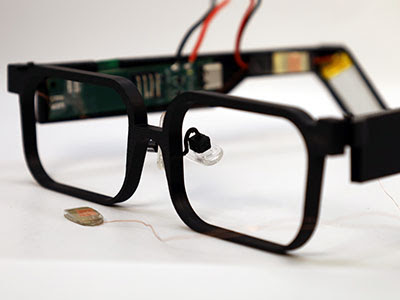
In a new study, the team developed a wholly new type of smart glasses equipped with tiny sensors that harvest mechanical energy from facial movements and convert it into electrical power. Even a quick blink or an artery’s faint pulsing provides enough mechanical energy to activate the highly sensitive sensors.

To put their battery-free device to the test, researchers used the glasses to detect jaw clenching, teeth tapping, blinking and eyebrow raising. Not only did the glasses distinguish these movements from everyday activities like talking and eating, but it also recognized teeth tapping with 99% accuracy and jaw clenching with 96% accuracy. 

The advance could pave the way for common glasses to seamlessly monitor cardiovascular health, bruxism (inadvertent jaw clenching and teeth grinding), fatigue, eating behaviors and other activities throughout the day — without bulky batteries or regular charging.

The researchers will present this work, called GlassTENG, at 4 p.m. China Standard Time (4 a.m. EDT) on Thursday, Oct. 15 at UbiComp/ISWC 2026, a premier conference for ubiquitous, pervasive and wearable computing. “GlassTENG: Self-powered triboelectric nanogenerator based sensing of pulse, jaw and upper facial activity from everyday glasses,” is a part of the session “Eyewear Computing.” The paper is available in the Proceedings of the 2026 ACM International Symposium on Wearable Computers.

“The human face is a goldmine for health data, making everyday glasses the perfect wearable,” said Northwestern’s Nivedita Arora, who led the work. “Generally, wearables track health data, like heart rate, through the wrist. But people have to remember to wear those trackers and take them off to recharge. Our idea is based on the fact that half the population already wears glasses. We can turn those glasses into wearables without asking people to change their habits and behaviors.”

An expert in self-powered electronics, Arora is the Breed Chair Assistant Professor of Electrical and Computer Engineering and Computer Science at Northwestern’s McCormick School of Engineering, where she leads the Vasudhaiva Kutumbakam (VAK) Embodied Systems Lab. Raj Dave, Jovanis Prodanich and Yung-ching Lai — all master’s students in the VAK Embodied Systems Lab — are the study’s co-first authors.

A little static goes a long way

At the heart of the new glasses are three paper-thin devices called triboelectric nanogenerators (TENGs). Although the name sounds complicated, the phenomenon behind them is familiar: static electricity.

Anyone who has rubbed a balloon against their hair or pet a cat’s fur on a dry winter day has experienced the triboelectric effect. When two different materials come into contact and then separate, electrons can transfer from one material to the other, generating a brief electrical charge.

GlassTENG takes advantage of that same basic phenomenon. Each flexible sensor contains layers of materials that repeatedly press together and separate in response to facial movements. A blink, for example, pushes against one sensor. A clenched jaw activates another. Even the subtle pressure produced by blood pumping through an artery can push the sensors. 

“As the layers touch and separate, they generate a tiny voltage,” Arora said. “That means the very movement being measured supplies the mechanical energy needed to power its detection. In other words, a blink helps power the sensor that detects the blink.”

Three sensors, many signals

To capture as much information as possible, Arora and her team positioned three sensors at strategic locations around the glasses frame. One sits at the bridge of the nose, near the angular artery and muscles surrounding the eyes. There, it can pick up the pulse as well as blinking and eyebrow movements. Another sensor sits near the temple, where it detects the superficial temporal artery along with jaw movements. A third sensor sits closer to the ear, where it detects movements from chewing and clenching.

Together, the three sensors give the glasses different vantage points from which to “feel” the face’s movements. And the sensors are sensitive to a range of forces. An arterial pulse — the lightest force the researchers tested — generated electrical signals of about 50 to 100 millivolts. Blinks and eyebrow raises produced roughly 200 to 500 millivolts. Stronger jaw movements, including chewing and clenching, generated signals as high as 1.5 volts.

“These differences give various facial activities their own recognizable electrical signatures,” Arora said.

While wearing GlassTENG, 20 participants performed six activities: blinking, raising their eyebrows, clenching their teeth, tapping their teeth, eating and talking. The research team then used machine-learning algorithms to analyze patterns in the electrical signals and determine which activity each participant performed. Across the six activities, the system achieved 93.8% accuracy.

“One of the most exciting possibilities is using this technology to turn unconscious behaviors into opportunities for meaningful behavior,” said study coauthor Nabil Alshurafa, an associate professor of preventive medicine, computer science and electrical and computer engineering at Northwestern, where he has appointments at Northwestern University Feinberg School of Medicine and McCormick. “Imagine glasses that recognize when someone is clenching their jaw and gently prompt them to relax or detect eating and encourage mindful awareness of their habits. By combining cardiovascular and behavioral sensing within the same ultra-low-power platform, GlassTENG opens the door to studying how physiological states and everyday behaviors interact and to delivering personalized interventions at the moments they may be most helpful.”

Ultra-low power, big benefits

Beyond what GlassTENG can do, another big advantage is what it doesn’t need: electricity. Many existing wearables continuously draw power. Constant power consumption leads to bigger energy demands that require bigger batteries, which add weight and bulk. Batteries also need regular recharging, which presents another barrier to truly continuous health monitoring.

GlassTENG’s three sensors consume just 4.1 microwatts of power combined — orders of magnitude less power than many conventional sensing technologies. From there, it uses Bluetooth to stream data straight to a smartphone or tablet.

“In the long-term, we want to do on-device computation,” Arora said. “If it detected a physiological event, it could have on-device intelligence in a battery-free way that could give immediate feedback. For example, if it detected jaw clenching, it could immediately alert the user to relax their jaw. I think it’s only a matter of time until the glasses we wear everyday can monitor our health.”

“The future isn’t just wearables that tell us what we did,” Alshurafa said, “but wearables that help us recognize and change what we’re doing in the moment.”

The study, “GlassTENG: Self-powered triboelectric nanogenerator based sensing of pulse, jaw and upper facial activity from everyday glasses,” was partially supported by the Ansys, Inc.