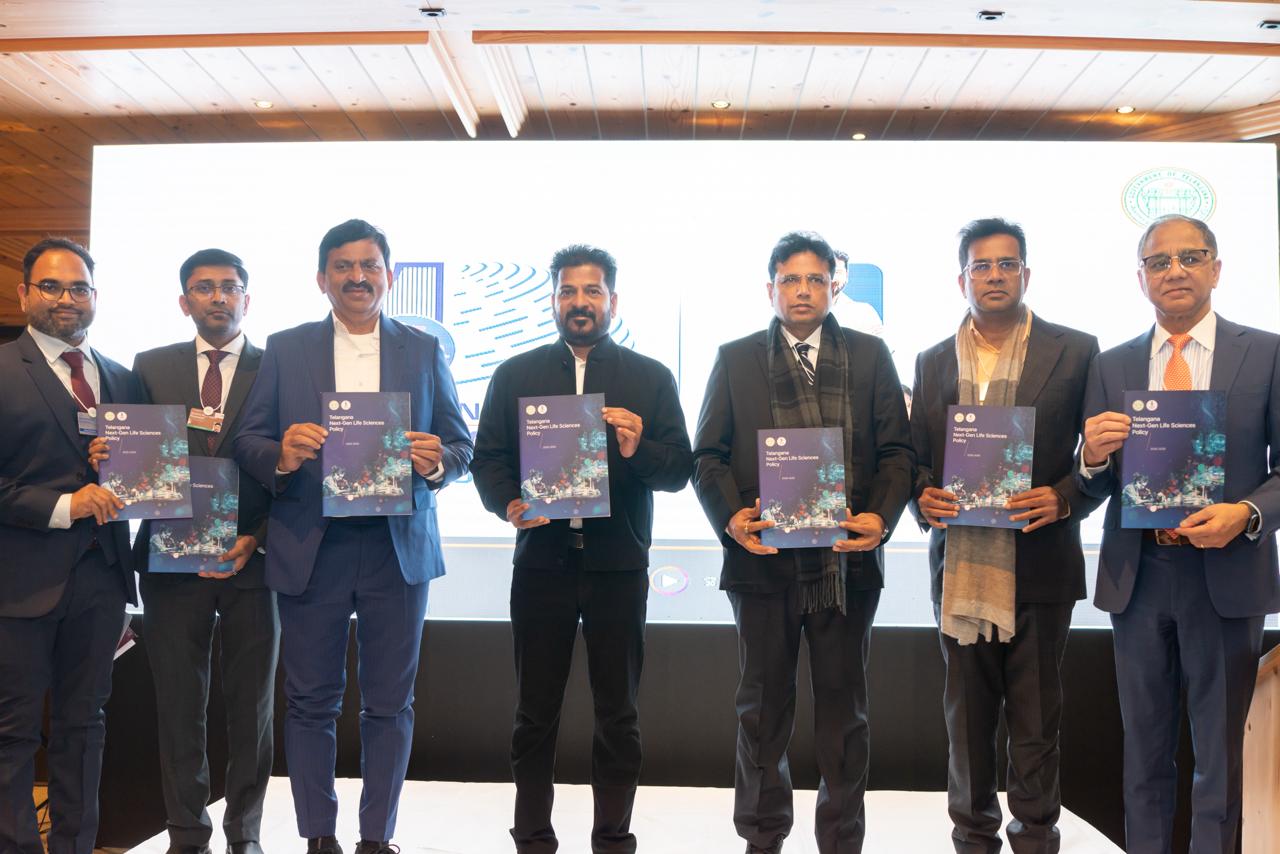
Jan 21: The Government of Telangana, India unveiled its Next-Gen Life Sciences Policy 2026–30 at the World Economic Forum Annual Meeting in Davos, signalling the State’s intent to play a far more consequential role in shaping the future of global healthcare, advanced therapeutics, and sustainable bio-manufacturing.
The policy articulates a decisive shift from scale-driven manufacturing to value-led, innovation-powered growth and positions Telangana as a globally integrated life sciences hub across discovery, development, and deployment. With a clear ambition to rank among the top five life sciences clusters worldwide by 2030, the policy targets USD 25 billion in investments, creation of 500,000 high-quality jobs, and deeper integration into global life sciences value chains.
The manufacturing depth is increasingly complemented by high-value R&D and innovation activity. Several global sciences organizations —including Amgen, Sanofi, Bristol Myers Squibb, Lilly, among several others have established or expanded R&D, digital, and global capability centres in Hyderabad, reflecting confidence in the Telangana’s scientific talent and innovation-ready infrastructure.
The Next-Gen Life Sciences Policy 2026–30 represents a deliberate scale-up, designed to accelerate Telangana’s transition from being indispensable to global supply chains to becoming a global originator of advanced therapies and platforms. The policy was unveiled by the Hon’ble Chief Minister Mr. A. Revanth Reddy in the presence of the Hon’ble Minister for IT & Industries, Mr. D. Sridhar Babu, Special Chief Secretary Mr. Sanjay Kumar IAS, and the CEO, Telangana Lifesciences, Mr. Shakthi M. Nagappan.
Unveiling the policy, Mr. A Revanth Reddy, Chief Minister of Telangana, India said “We are building one of the world’s most trusted and transformational biosciences ecosystems—driving global health impact from Telangana. The policy’s global unveiling at Davos reflects Telangana’s conviction that the next phase of growth in life sciences will be driven by cross-border collaboration, global capital, and shared innovation agendas.”
“In the last two years alone, we have been able to attract investment to the tune of Rs. 73,000 Crores. With the launch of new policy, we are now aiming higher to attract Rs. 2 Lakh crore over the next 5 years. The policy prioritizes frontier science and advanced manufacturing platforms, including cell and gene therapies, peptides, precision fermentation, and other next-generation modalities. It strengthens the broader ecosystem across clinical research, pharma services, diagnostics, medical electronics and digital health—positioning Telangana as a preferred destination for global life sciences hubs” Mr. D. Sridhar Babu Minister for IT, Electronics & Communications, and Industries & Commerce, Government of Telangana.
Adding to this Mr. Sanjay Kumar (IAS), Special Chief Secretary, Industries & Commerce and ITE & C Departments, Government of Telangana, “The Policy builds on the strong foundation and spirit of innovation. The policy is not merely a framework; it is designed to accelerate the adoption of breakthrough technologies such as AI, digital health, and next generation therapeutics, while nurturing skilled talent. A defining reform is the recognition of R&D units as full-fledged industrial enterprises, allowing them equal access to incentives and reinforcing the State’s commitment to innovation and high-value scientific activity”
“Focused on frontier R&D, sustainable manufacturing, talent development, and a robust startup-to-scale-up pipeline, the policy strengthens Telangana’s integration into the global life sciences value chain. A dedicated Life Sciences Innovation Fund, scalable up to INR 1,000 crore (USD 100 million), will catalyze early- and growth-stage innovation, support deep-tech ventures – particularly biotherapeutics. Another key initiative proposed is the establishment of the Telangana School of Life Sciences, a university of global excellence focused on research, education, and future-ready talent development” added Mr. Shakthi M. Nagappan, CEO, Telangana Life Sciences.
The policy implementation will be anchored by globally benchmarked infrastructure, including the Green Pharma City, ten Pharma Villages, expansion of Genome Valley, and further strengthening of the Medical Devices Park.
Key Focus Areas of the Policy
- Frontier R&D and Advanced Manufacturing: Promotion of next-generation technologies and platforms, including biologics and biosimilars, cell and gene therapy, mRNA platforms, CRISPR technologies, antibody-drug conjugates (ADCs), oligonucleotides, peptides, and precision fermentation, with a focus on value-added and technology-intensive manufacturing.
- Clinical Research: Strengthening the clinical trial ecosystem by enabling faster approvals, creation of disease-specific clinical registries, and operationalization of initiatives such as the Clinical Innovation Sandbox
- Pharma Services: Expansion of the pharma services ecosystem, including Contract Research Organizations (CROs) and Contract Development and Manufacturing Organizations (CDMOs), to scale the sector from the current estimated size of USD 2 billion to approximately USD 10 billion.
- Diagnostics and Medical Electronics: Development of a robust hub for research, development, and manufacturing of diagnostics and medical electronics.
- Global Value Centres and Global Innovation Centres: Attracting Global Capability Centres (GCCs) and Global Innovation Centres focused on advanced analytics, artificial intelligence, engineering, digital health, and high-end R&D functions in the life sciences and healthcare domains.
- Precision Medicine and Personalized Therapies: Advancing precision medicine through the development of clinical registries and privacy-compliant digital health records to enable personalized therapies, data-driven healthcare interventions, and improved clinical outcomes.
Strategic Levers for Implementation:
Infrastructure Development: The policy proposes the creation of world-class infrastructure to support the full life sciences value chain, including:
· Establishment of the Green Pharma City, a sustainable and integrated industrial cluster incorporating zero liquid discharge (ZLD), centralized waste management, energy-efficient systems, and net-zero practices.
· Development of ten (10) Pharma Villages, each spanning approximately 1,000 to 3,000 acres along the Outer Ring Road (ORR), to promote decentralized, balanced, and inclusive industrial growth across the State.
· Expansion of Genome Valley and establishment of a Bio-Innovation and Bio-Manufacturing Cluster in collaboration with Government of India, featuring multi-tenant laboratories and flatted factories to promote collaboration, innovation, and ease of entry for startups and MSMEs.
· The Policy also envisages the expansion of the Medical Devices Park, with enhanced common infrastructure and plug-and-play facilities to support R&D and manufacturing in medical devices and diagnostics.
Talent Ecosystem: The policy emphasizes the cultivation of a dynamic and future-ready workforce through initiatives such as the flagship Telangana School of Life Sciences and other skilling and capacity-building platforms. Key measures include industry-aligned curricula, structured internships, lifelong learning pathways, and certification programs across critical domains such as biologics, advanced analytics, artificial intelligence and bioinformatics, and Health Outcomes and Economic Research (HOER).
Regulatory Streamlining and Ease of Doing Business: Implementation of TG-iPASS as a single-window system with time-bound approvals and deemed approvals in case of delays. The policy permits 24×7 operations in designated life sciences parks, subject to prescribed safety norms. A dedicated consultation committee (CDSCO, Telangana DCA, and TGPCB) to simplify state-level clearances and active advocacy with central regulators.
Funding Ecosystem: Establishment of a dedicated Life Sciences Innovation Fund with an initial corpus of INR 100 crore (USD 12 million), scalable to INR 1,000 crore (USD 111 million), structured through a public-private partnership model with co-investment alongside venture capital and private equity funds to support startups, scale-ups, and translational research initiatives.
Ancillary Ecosystem Development: Promotion of a strong and integrated ancillary ecosystem comprising suppliers, service providers, logistics partners, testing facilities, and specialized vendors to support the core life sciences industry and enhance overall sector competitiveness.