Bengaluru, Jan 21: Sambhav Foundation, a non-profit organisation working at the intersection of education and creating livelihoods through community-owned initiatives, today celebrated the beginning of its 20th year with Built Up, a milestone event held at the Institute for Social and Economic Change (ISEC), Bengaluru. The occasion marked two decades of the Foundation’s work in enabling communities, empowering individuals, and fostering long-term systems change.
Over the last 20 years, Sambhav Foundation has worked across education, livelihoods, and disability inclusion, impacting 3.5 million lives across more than 20 states, through partnerships with governments, corporates, and communities. The Foundation has collaborated with global and national brands to co-create initiatives that promote education-to-employment pathways, disability inclusion, and community-led skilling models, ensuring interventions are locally owned, scalable, and sustainable.
Built Up served as both a moment of reflection and a forward-looking dialogue on how social and economic change is designed, owned, and sustained, particularly across education, livelihoods, disability, and agency. Leaders from philanthropy, academia, industry, grassroots organisations, and public systems, including Prateek Madhav – ATF Labs, Meera Shenoy – Youth4Jobs, Alina Alam – MITTI Cafe, Paras Sharma – Alternative Story, Rohini Kaul – GivFunds & Kantar India Foundation, Anita Gurumurthy – IT for Change, Tej Prakash Yadav – BBC Media Action and Sonal Madhushankar, Actress, were present at the event, reflecting on their journey with the foundation. These conversations come at a time when India is re-examining the effectiveness of skilling, education, and employment models amid rising automation, demographic pressure, and persistent exclusion of women, persons with disabilities, and first-generation learners from formal economic systems
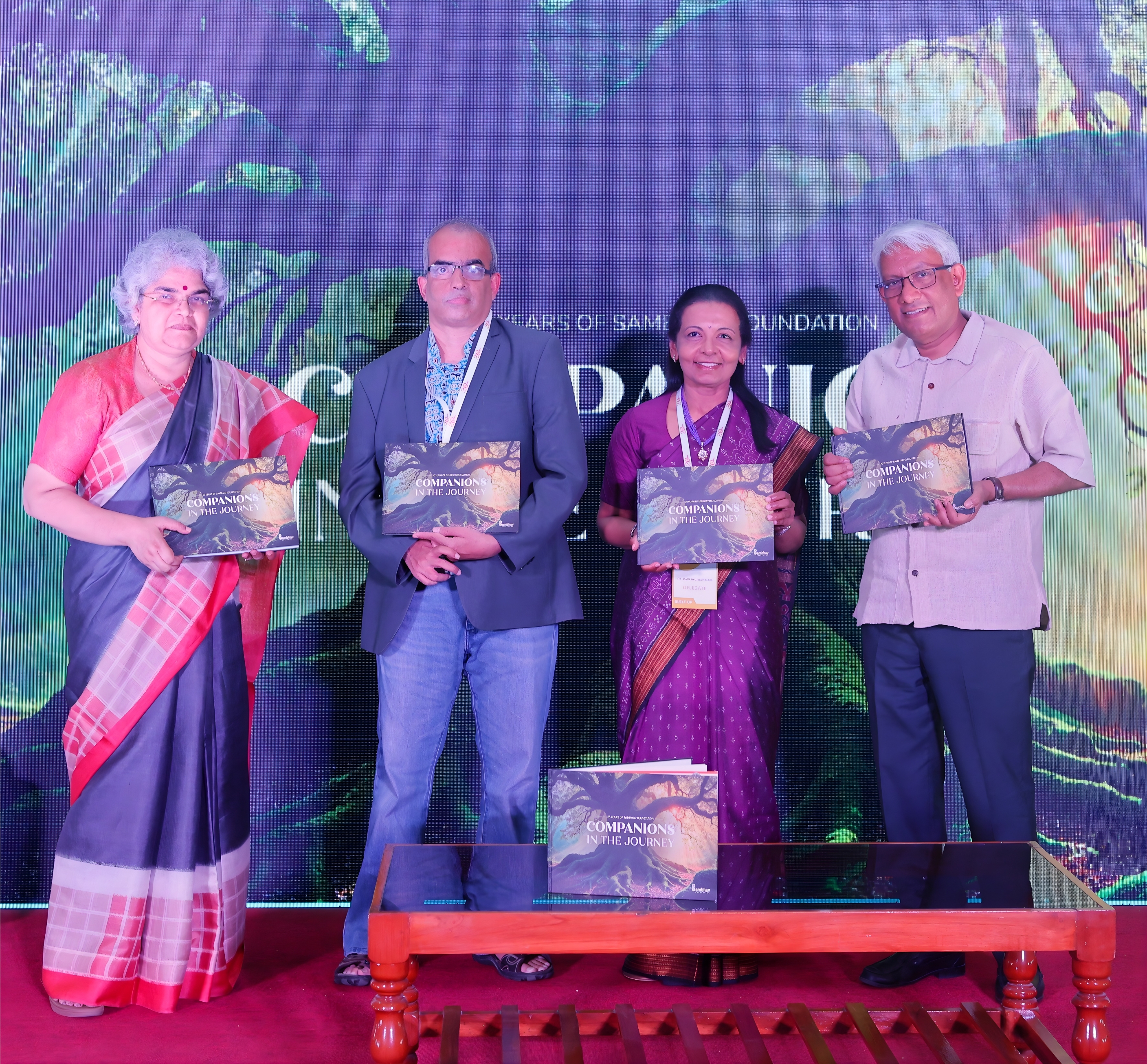
Sambhav Foundation also launched its compendium, “Companions in the Journey: Sambhav at 20”, documenting reflections, learnings, and experiences from partners, practitioners, and communities over the past two decades. Launching the digest, Dr. Gayathri Vasudevan, Chief Impact Officer – Sambhav Foundation, reflected on the organisation’s philosophy of shared ownership and learning and said, “Our work has never been about scaling for the sake of numbers, or about education or livelihoods in isolation. It is about nurturing small sub-clusters of change and then giving up ownership so that communities can carry the work forward. Uncertainty and failures are a constant in long-term social change, but they offer a chance to learn. We may not always know what will work on the first attempt. What matters is staying with the work, learning honestly from failure, and continuing the journey without walking away midway.”
Dr. Ashwin Mahesh, Founder and CEO – LVBL, reflected on the deeper responsibility of systems working on skilling and livelihoods. He said, “Too often, skilling is treated as a corrective measure for those who are seen to have failed within the education system. That framing is flawed. Children do not fail systems; systems fail children. If we are serious about impact, skilling must be treated as work, not remedial education. Young people have a right not only to education, but to their first job. Education is complete only when it leads to meaningful work.”
Dr. Valli Arunachalam, nuclear scientist, semiconductor technologist, and philanthropist, added, “Change is inevitable, but adaptation is what determines survival. Whether in nature, technology, or communities, systems must be designed to evolve with their environments. Every individual has a unique role to play. When systems recognise and bring together these strengths, the whole becomes far greater than the sum of its parts.”
Delivering the keynote address, Ravi Venkatesan, Founding Trustee – Global Alliance for Mass Entrepreneurship (GAME), and former Chairman of Microsoft India and Cummins India, spoke candidly about the realities of systems change. “Every system is perfectly designed to deliver the outcomes it produces. When outcomes are poor, the problem lies not with individuals but with the system. While programmatic interventions are easier to execute, lasting impact requires patient, locally owned systems change. Most systems change efforts take at least 15 years to show results. This work demands patience, humility, and the ability to learn from what does not work. Sambhav’s refusal to give up over two decades is precisely what makes this work matter.”
Over the course of this year, as part of its 20-year journey, Sambhav Foundation will release a series of practice-led publications, host field immersions for partners and policymakers, and deepen collaborations focused on education-to-employment pathways, disability inclusion, and community-owned skilling models.