
Farmers Ready to Transition – National Conference Calls for Markets, Finance and Policy to Share the Risk
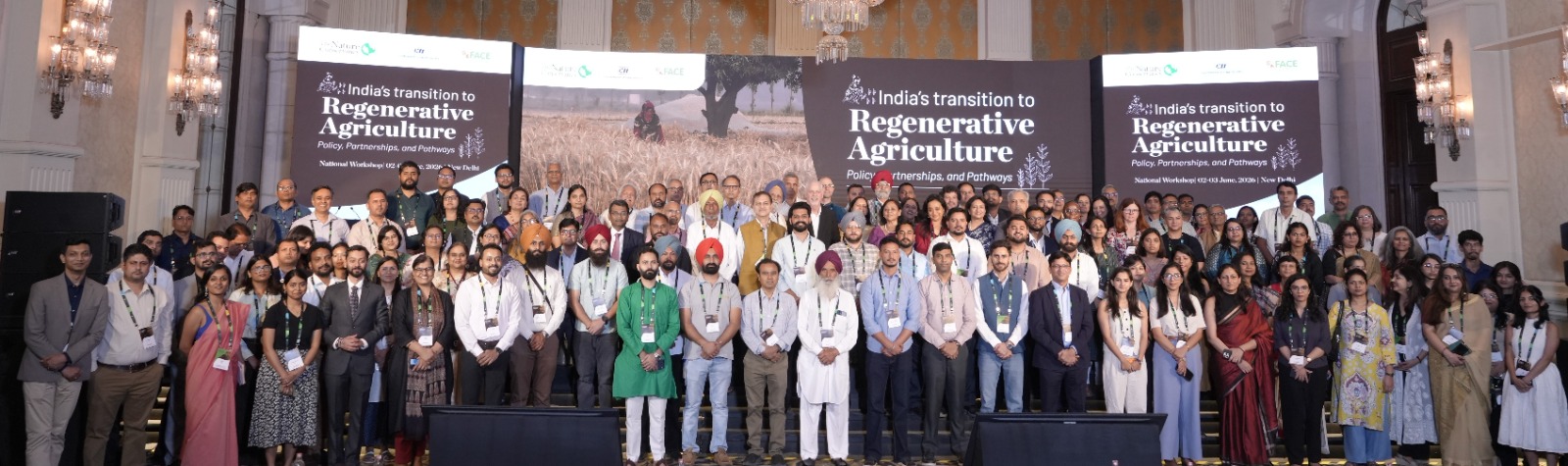
New Delhi, June 05: India’s agricultural transformation is no longer a distant aspiration – it is already underway. Over two days of deliberations at national conference on India’s Transition to Regenerative Agriculture: Policy, Partnerships, and Pathways – policymakers, farmers, agribusiness leaders, financial institutions, researchers, and civil society organizations came together with a shared recognition: while farmers are increasingly willing to adopt regenerative and climate-resilient practices, they cannot be expected to bear the risks and costs of transition alone.
A clear consensus emerged from the discussions that the next phase of India’s agricultural journey will require far more than isolated pilots and fragmented interventions. Participants emphasized the need for integrated, systems-level solutions that align policy frameworks, market incentives, financing mechanisms, technological innovation, and last-mile delivery systems.
The Nature Conservancy (TNC), in collaboration with the Confederation of Indian Industry’s Food and Agriculture Centre of Excellence (CII FACE), convened a two-day conference on 2-3 June in Delhi bringing together diverse stakeholders to deliberate on pathways for transforming India’s food and agricultural systems. It drew on findings from four years of PRANA’s (Promoting Regenerative and No-burn Agriculture) on-ground impact, TNC’s flagship programme, operating in 18 districts and 6,826 villages of Punjab to move farmers towards adopting regenerative agricultural practices.
Saswati Bora, Global Director, Regenerative Food Systems, The Nature Conservancy, said, “Transforming food systems demands the integration of science and knowledge, market incentives, and sustained financing working in concert. TNC’s foodscapes strategy brings these elements together to scale regenerative models that restore nature while strengthening livelihoods, and PRANA stands as its most advanced proof point. PRANA’s outcomes make a compelling case for placing food production at the centre of climate and biodiversity outcomes.”
Over the past four years – since its launch in 2021, PRANA has worked with farmers to reduce crop residue burning in Punjab. The programme has also promoted water-efficient rice cultivation techniques like Alternate Wetting and Drying (AWD) and Direct Seeding of Rice (DSR) to conserve groundwater and reduce methane emissions. Alongside, it has focused on crop diversification and piloted innovative solutions like Pay-for-Results, which incentivized machinery service providers to extend services for crop residue management and DSR to farmers who didn’t own specialized machinery.
So far, PRANA has supported 370,000 farmers in adopting no-burn practices across 850,000 hectares. Its interventions have conserved around 400 billion litres of water and led to over 3.8 million tonnes of CO₂ equivalent emissions avoided. A key component of PRANA’s work has been how behaviour change methods, including using women’s agency in influencing decision-making within a patriarchal society, even though they own only 2% of the land holding, have been critical to moving the needle. PRANA built the capacity of and worked through a wide network of on-ground agents of change, including Gurudwara preachers, local sarpanches, women, street theatre groups and rural youth as last mile extension workers – with the vision that sustained behaviour change rooted in community trust can lead to lasting impact.
Marc De Sousa Shields, Country Director, International Fund for Agricultural Development said: “At scale, regenerative agriculture depends on three pillars of trust that farmers need. They need to trust markets to reward change. They need to trust that institutions will support them. They need to trust that supporting infrastructure and technology will evolve and be affordable and accessible. When all this comes together, transition becomes possible. And India, with its scale, its systems, and experience, has the opportunity to show how it’s done. It’s not just agriculture being transformed. We’re building resilience, building sustainable stability. And importantly, we’re empowering farmers to be part of the change, not subject to change.”
The first day of the conference focused on sustainable agricultural practices, with sessions on sustainable rice management, crop diversification, market integration, and regenerative agriculture. Discussions highlighted water-saving technologies, greenhouse gas mitigation, and the transitions to diversified, cropping systems such as agroforestry, horticulture, and climate-smart crops.
During the conference, farmers also shared their lived perspectives. For instance, Parminder Singh, a crop residue management machinery service provider from Fatehgarh Sahib said “PRANA’s Pay-For-Results Model has helped me in increasing my income through service provision. Earlier, I used to provide in-situ crop residue management services over merely 50 acres. Now, I provide such services over 250 acres, and every year, more farmers are requesting in-situ crop residue management services on their fields. The Pay-For-Results pilot has enabled me to build a viable business model through my Super Seeder, which also helps me work with fellow farmers to protect the environment by eliminating residue burning.”
Another farmer, Harbans Singh from Khurshedpur, who has been farming for 45 years now, spoke about the importance of diversifying to poplar with PRANA’s guidance, He said, “poplar plantations have provided me much greater economic value, and the trees also clean the air, oxygenating it. I can also grow wheat alongside (through intercropping) and plan to plant at least a 1000 poplar trees every year. In fact, I will also plant for those farmers who can’t do it themselves.’
Manoj Dabas, Country Director, CIFOR-ICRAF, stated “India made history as the first country in the world to adopt a national agroforestry policy and yet, the integration of trees into farming systems remains an unrealised opportunity at scale. Agroforestry is the key to restoring circularity to our food systems. But knowledge alone will not move farmers, we must create tangible economic value for them to make this transition. The problems our agricultural landscapes face today are fundamentally different from those of a generation ago. Our solutions must evolve accordingly. That is precisely what initiatives like ITRI (Indian Treescapes Resurgence Initiative) are designed to do.”
Day two explored innovations in agri-food systems resilience and the mobilisation of finance for regenerative agriculture. One of the sessions examined how partnership-led approach to solarising agricultural pumps with smart-grid technology and allowing farmers to sell excessive energy back to the grid incentivised efficient water use. Discussions on climate-resilient innovations highlighted the potential of digital tools, agri-meteorological advisories, and improved crop varieties to reduce smallholder risk. A dedicated session on catalysing public-private partnership investments examined blended finance frameworks and the role of development finance institutions in unlocking capital for agricultural transition. The conference closed with a landscape-led session exploring how coordinated, systems-level approaches can scale regenerative agriculture across diverse agro-ecological contexts.
Sushil Saigal, Interim Managing Director, Nature Conservancy India Solutions (NCIS), said: “What gives us the greatest confidence is not just the numbers, it is the partnerships this conference has helped forge. We leave these two days with stronger alignment across government, industry, science, and finance. The task now is to translate that alignment into action – expanding PRANA’s reach, integrating its learnings into national policy frameworks, and ensuring that the farmers of Punjab and beyond have the support they need to lead India’s agricultural transition.”