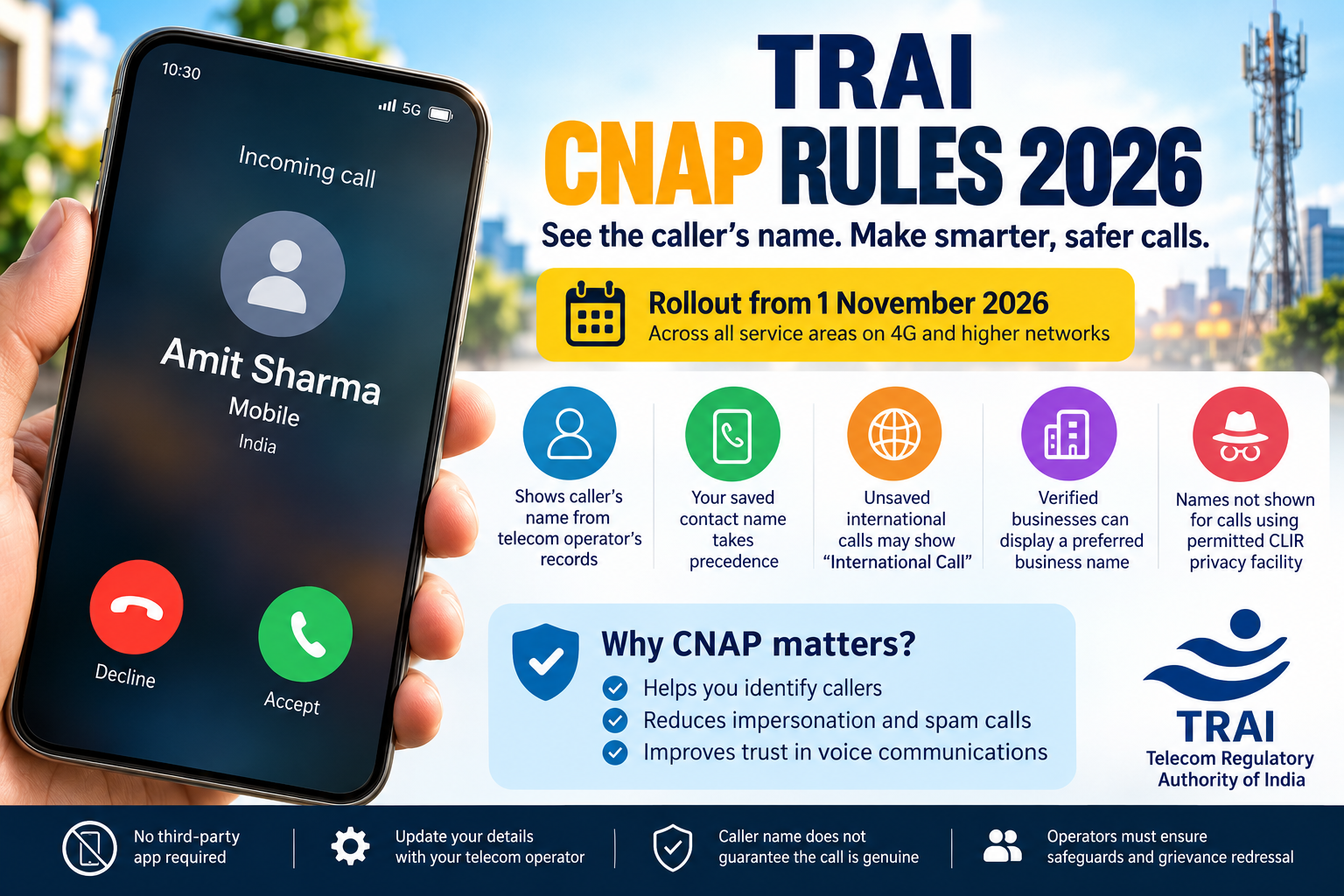
Oct 22: Have you ever ignored a phone call simply because you did not recognise the number? From November 1, 2026, identifying unknown callers in India could become easier as telecom operators begin rolling out Calling Name Presentation (CNAP), a system designed to display a caller’s registered name alongside their phone number.
The Department of Telecommunications (DoT), under the Ministry of Communications, has directed telecom service providers to introduce CNAP across their service areas on 4G and newer-generation wireless networks. The service is intended to help people make more informed decisions about answering incoming calls, while also creating new opportunities for businesses to establish recognition when contacting customers.
How Will India’s New Caller ID System Work?
CNAP will display the caller’s name using subscriber information maintained by the originating telecom operator. Unlike third-party caller identification applications, the system relies on telecom operators’ subscriber records.
The service will be introduced by default, without requiring users to submit a separate request. When a call arrives, the recipient’s phone will display the number and a name field.
If the caller’s number is already saved in the recipient’s contact list, the locally stored contact name will take priority. For an unsaved domestic number, the name recorded in the caller’s telecom subscriber records is expected to appear. Calls originating from another country and terminating in India will display the words “International Call” when the number is not saved.
The initial rollout covers 4G and newer-generation wireless networks, including 5G. The introduction of CNAP on 2G, 3G and landline networks will be considered separately.
How Could Customers Benefit?
For everyday users, CNAP could make it easier to distinguish between familiar contacts, legitimate business calls and unknown numbers. People who regularly receive calls from delivery services, banks, healthcare providers, educational institutions or customer support teams may find it easier to identify the registered caller before answering.
The feature could also help users make more informed decisions about calls they are unsure about. However, displaying a name does not automatically establish that a call is safe. Users should continue to exercise caution when asked to share passwords, one-time passwords, banking details or other sensitive information.
The potential benefit is greater caller visibility, rather than a guarantee that unwanted or fraudulent calls will disappear.
What Happens When a Number Is Not Saved?
The system is particularly relevant when a number is missing from a user’s contact list.
For domestic calls, CNAP is designed to display the caller’s name as recorded in the originating operator’s subscriber database. This could help users recognise calls they might otherwise overlook, including calls from service providers, professional contacts or businesses.
International calls from unsaved numbers will display a general “International Call” label instead of an individual caller name under the prescribed framework. In addition, subscribers who have activated Calling Line Identification Restriction (CLIR), in accordance with applicable guidelines, will not have their names displayed.
These provisions aim to balance caller identification with existing privacy arrangements.
How Could Businesses Benefit From CNAP?
For businesses, customer communication often begins with a phone call. Yet customers may hesitate to answer an unfamiliar number, even when the call concerns a genuine enquiry, service request, delivery or appointment.
CNAP could help reduce some of that uncertainty by making registered caller information visible. Small businesses, service providers, healthcare organisations, educational institutions and customer support teams may benefit when customers can more easily recognise their calls.
The framework also provides for eligible business and bulk connections to use a verified preferred name instead of the name recorded in the subscriber database. This is subject to the telecom operator offering the facility and verifying the supporting documents. Under the October 2026 instructions, the preferred name must correspond to a registered trademark or a trade name registered on the GST portal.
This option could be useful for businesses whose recognised trading identity differs from the name associated with their telecom account. It is not an automatic entitlement to display any chosen brand name.
What Should Businesses Do Before the Rollout?
Businesses that depend on phone-based customer communication can take a few practical steps ahead of implementation.
First, they should review the names and subscriber details associated with their business connections and check whether the information is accurate. Incorrect or outdated records could create confusion when customers see the displayed caller name.
Second, eligible businesses interested in using a preferred name should contact their telecom operator to understand the application process and documentation requirements. Trademark registration or GST records may be relevant, depending on the name they intend to display and the applicable conditions.
Businesses should also continue building trust through consistent communication, clear identification and responsible customer service. A recognised caller name may help a customer decide whether to answer, but the quality and credibility of the interaction remain equally important.
Privacy and Security: What Users Should Know
Caller identification can improve convenience, but the handling of subscriber information remains important.
The DoT’s instructions require telecom operators to adopt a security-by-design approach. The system must be designed so that the retrieved calling name identity is not retained after the incoming call ends. Operators must also establish mechanisms to receive and resolve CNAP-related grievances within a defined timeframe.
Users should understand that CNAP is a caller identification feature, not a complete caller authentication system. A displayed name does not prove that the person speaking is genuinely representing a bank, government department or company. Sensitive requests should always be verified through official channels.
If a displayed name appears incorrect, users should contact their telecom operator through its customer support or grievance redressal process.
What Lies Ahead for India’s Telecom Industry?
TRAI’s recommendations on introducing CNAP were issued in February 2024, followed by further consideration of the framework by the government and telecom authorities. The October 2026 directive establishes November 1 as the implementation date for 4G and newer-generation wireless networks.
The effectiveness of the service will depend on accurate subscriber records, reliable network performance, appropriate privacy safeguards and how easily users can identify legitimate callers. Its actual impact on spam and fraud will need to be assessed over time rather than assumed in advance.
For customers, CNAP could make unfamiliar calls easier to assess. For businesses, it offers a potential way to improve recognition during customer outreach. Ultimately, the system’s value will depend on how reliably caller information is presented and how responsibly people use it.
As India’s telecom ecosystem evolves, CNAP represents a practical step towards greater transparency in everyday phone communication—while reminding users that recognising a caller is only the first step towards deciding whether to trust the call.
