Why Is Odisha Facing Repeated Cyclones and Unseasonal Rain? Climate Change and Bay of Bengal Explained
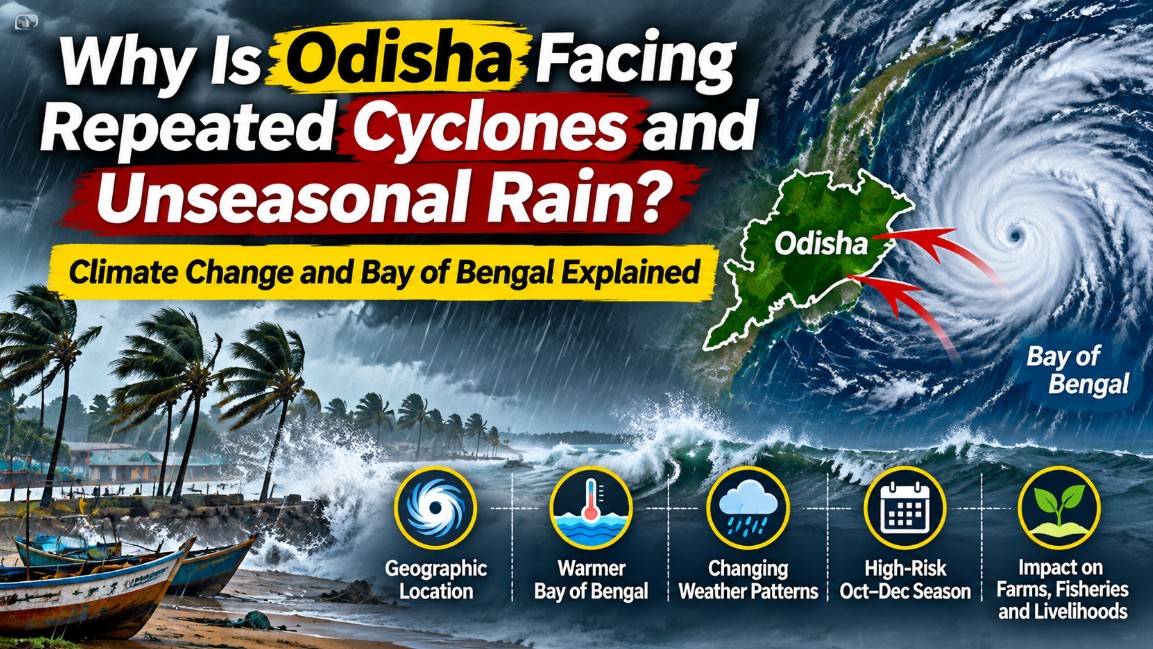
Three Severe Cyclonic Storms in Less Than a Month Raise Alarms: Is Odisha’s Weather Becoming More Unpredictable?
Nov 19: Odisha is once again keeping its eyes on the Bay of Bengal. After facing repeated episodes of extreme weather, the state is preparing for the impact of Severe Cyclonic Storm Akvan. What makes the present situation particularly concerning is the rapid succession of cyclonic systems over the Bay of Bengal during October and November.
From Cyclone Arnab in October to Murasu and now Akvan, the eastern coast has witnessed an unusual sequence of powerful weather systems within a relatively short period. According to a Reuters report published on November 19, Odisha had evacuated more than 47,000 people ahead of Akvan, marking the third severe cyclonic storm in the region in less than a month.
This raises an important question: Why does Odisha repeatedly find itself in the path of cyclones, heavy rainfall and unseasonal weather? Is this simply a geographical reality, or is the changing climate making the situation more complicated?
The answer lies in a combination of geography, ocean temperatures, atmospheric circulation and changing weather patterns.
1. Odisha’s geographical location: A natural cyclone corridor
One of the biggest reasons behind Odisha’s cyclone vulnerability is its geographical position.
The state has approximately 480 kilometres of coastline along the Bay of Bengal. This places it directly in the path of tropical weather systems developing over the north and central Bay.
The Bay of Bengal is historically one of the world’s most cyclone-prone ocean basins. Warm ocean waters, high atmospheric moisture and favourable wind conditions can create an environment in which tropical depressions intensify into cyclonic storms.
Unlike many other coastal regions, Odisha faces additional geographical vulnerabilities because several coastal districts have low-lying terrain, river deltas, estuaries and densely populated settlements.
Districts such as Balasore, Bhadrak, Kendrapara, Jagatsinghpur, Puri and Ganjam remain particularly exposed to different combinations of storm surge, coastal flooding, heavy rainfall and strong winds.
According to the India Meteorological Department’s historical cyclone climatology, the Bay of Bengal’s cyclone tracks frequently affect the eastern Indian coastline. Odisha is therefore not facing an entirely new geographical threat; rather, it is a state that has historically lived with substantial cyclone exposure.
2. Why October and November are particularly dangerous
The cyclone season over the Bay of Bengal has two major periods: pre-monsoon (April–May) and post-monsoon (October–December).
October and November are particularly important because the southwest monsoon begins withdrawing from the Indian subcontinent, changing the atmospheric circulation over the region.
During this transition:
The Bay of Bengal continues to retain considerable heat.
Atmospheric moisture remains available.
Wind patterns change as the monsoon retreats.
Low-pressure systems can develop and intensify.
Certain atmospheric conditions become favourable for tropical cyclone formation.
This explains why Odisha and neighbouring coastal states frequently experience cyclone threats during the post-monsoon season.
The occurrence of multiple storms during this period does not automatically mean that every year will become more cyclone-prone. However, the 2026 sequence highlights how quickly the region can face repeated emergencies.
3. Is the warming Bay of Bengal contributing to stronger cyclones?
Ocean temperature is one of the most important ingredients in tropical cyclone development.
Warm sea surfaces provide energy and moisture to developing weather systems. When ocean conditions are favourable and atmospheric wind shear is sufficiently low, a depression can intensify into a severe cyclone.
Climate change is adding another layer of concern.
Global warming is increasing ocean heat content, while a warmer atmosphere can hold more water vapour. These changes can increase the potential for intense rainfall and contribute to the intensification of certain tropical cyclones.
However, scientists caution against attributing every individual cyclone or every unusual rainfall event directly to climate change.
A more accurate assessment is that climate change is influencing the background conditions in which cyclones develop, while natural climate variability, atmospheric circulation and regional ocean conditions continue to determine individual storm formation and movement.
For Odisha, this means that disaster preparedness must account not only for wind speed but also for extreme rainfall, flooding and coastal inundation.
4. Why is Odisha experiencing unseasonal rainfall?
Cyclones are not the only explanation for Odisha’s changing rainfall patterns.
The state can receive rainfall outside the traditional monsoon season because of several atmospheric systems.
Low-pressure areas and depressions: Weather systems developing over the Bay of Bengal can travel towards Odisha, bringing widespread rainfall even after the southwest monsoon has withdrawn.
Cyclonic circulations: Even when a system does not become a named cyclone, an atmospheric circulation can produce significant moisture convergence and rainfall.
Post-monsoon easterly winds: Moisture-laden easterly winds from the Bay of Bengal can produce rainfall across coastal and interior Odisha.
Cyclone remnants: A weakening cyclone can continue producing heavy rainfall after moving inland or losing its cyclonic intensity.
Consequently, rainfall in November or December is not necessarily evidence of an entirely new weather phenomenon. It may be associated with known seasonal atmospheric processes, although its timing, intensity and distribution can create serious challenges.
5. Three cyclones in a short period: Is 2026 becoming an exceptional year?
The sequence of Arnab, Murasu and Akvan has brought the eastern coastline into a period of heightened weather uncertainty.
Reuters reported on November 19 that India’s top weather expert, IMD Director General Mrutyunjay Mohapatra, compared the rapid succession of three cyclonic storms in 2026 with a similar pattern observed in 1987.
This comparison is significant because it reminds us that multiple cyclones within a short period are not unprecedented.
However, the frequency of systems, their intensity, their movement and the areas affected are different scientific measurements. Three storms developing in the Bay of Bengal do not necessarily mean three direct landfalls in Odisha.
In the case of Akvan, the IMD issued cyclone warnings for the North Andhra Pradesh and South Odisha coasts. The actual impact on individual districts depends on the storm’s track, intensity, rainfall distribution and local conditions.
6. The biggest concern: Agriculture, fisheries and the rural economy
For Odisha, repeated cyclonic disturbances are not merely meteorological events. They are economic and social emergencies.
Agriculture is among the sectors most vulnerable to untimely rainfall.
November is an important period for paddy cultivation, harvesting and post-harvest activities in several parts of the state. Unexpected rain, waterlogging and strong winds can damage standing crops, delay harvesting and affect the quality of harvested paddy.
Fishermen face another serious challenge. Rough seas and repeated restrictions on fishing activities can affect their daily income and livelihoods.
The rural economy also suffers when roads, electricity networks, irrigation infrastructure and local markets are disrupted.
Repeated weather emergencies can therefore create a cycle of financial insecurity for farmers, fishermen, small traders and coastal communities.
7. Is Odisha prepared for a future of repeated extreme weather?
Odisha has developed considerable experience in cyclone management, particularly after the devastating 1999 Super Cyclone.
Its disaster-management system, early-warning mechanisms, cyclone shelters, evacuation planning and coordination among government agencies have improved significantly over the years.
The large-scale evacuation ahead of Akvan demonstrates the importance of preparedness and timely warnings.
But the changing nature of weather risks demands further improvements.
Odisha needs to strengthen:
District-level weather forecasting and last-mile warning communication.
Flood-resilient drainage systems in coastal towns and urban areas.
Protection and restoration of mangroves and coastal ecosystems.
Climate-resilient agricultural practices and crop insurance.
Cyclone-resistant housing and public infrastructure.
Emergency support and alternative livelihood arrangements for fishing communities.
Scientific monitoring of coastal erosion, sea-level rise and changing rainfall patterns.
Preparedness must go beyond evacuating people before a cyclone. It must also focus on reducing the long-term economic and environmental vulnerability of coastal communities.
8. The larger question: Is the Bay of Bengal changing, or are we becoming more exposed?
Perhaps the most important issue is not simply why cyclones are occurring, but how prepared Odisha is for the consequences of increasingly complex weather risks.
A warming ocean, changing atmospheric circulation, coastal development, ecosystem degradation and population exposure can collectively increase the consequences of extreme weather.
It is also important to recognise that not every unusual rainfall event represents climate change. Long-term meteorological observations and scientific analysis are necessary to identify genuine trends.
Nevertheless, the repeated weather emergencies of 2026 offer a clear warning: Odisha cannot afford to treat every cyclone as an isolated incident.
The state needs a long-term climate adaptation strategy that connects meteorology, agriculture, coastal planning, environmental protection and disaster management.
Conclusion: Odisha needs more than cyclone preparedness; it needs climate resilience
The Bay of Bengal has always been a source of both prosperity and danger for Odisha. It supports fisheries, trade, tourism and coastal livelihoods, but it also exposes the state to some of India’s most destructive weather systems.
The repeated appearance of cyclones and untimely rainfall in 2026 should encourage policymakers, scientists and communities to ask deeper questions about coastal vulnerability and climate resilience.
Cyclones cannot be stopped. Their impacts, however, can be reduced through scientific forecasting, stronger infrastructure, ecosystem protection and community preparedness.
The real challenge before Odisha is no longer simply surviving the next cyclone. It is preparing a generation that can live safely with a changing climate.

 View original content to download multimedia:


 View original content to download multimedia:


 View original content to download multimedia:


 View original content to download multimedia:


 View original content to download multimedia:



 View original content to download multimedia:





 View original content to download multimedia:
